
[论文解读] Domain adaptation using optimal transport for invariant learning using histopathology datasets
本文提出了一种基于最优传输(OT)的新型域自适应方法,用于组织病理学图像分析,通过在特征空间中惩罚不同机构数据批次之间的分布差异,提升模型对未见机构的泛化能力。与在单张图像上操作的标准对抗性域自适应不同,该OT损失能够捕捉全局分布偏移,从而在罕见或代表性不足的表型上实现显著更优的性能,尤其在低资源或未见域中表现突出,且无需标签或对新数据进行微调。
Histopathology is critical for the diagnosis of many diseases, including cancer. These protocols typically require pathologists to manually evaluate slides under a microscope, which is time-consuming and subjective, leading to interest in machine learning to automate analysis. However, computational techniques are limited by batch effects, where technical factors like differences in preparation protocol or scanners can alter the appearance of slides, causing models trained on one institution to fail when generalizing to others. Here, we propose a domain adaptation method that improves the generalization of histopathological models to data from unseen institutions, without the need for labels or retraining in these new settings. Our approach introduces an optimal transport (OT) loss, that extends adversarial methods that penalize models if images from different institutions can be distinguished in their representation space. Unlike previous methods, which operate on single samples, our loss accounts for distributional differences between batches of images. We show that on the Camelyon17 dataset, while both methods can adapt to global differences in color distribution, only our OT loss can reliably classify a cancer phenotype unseen during training. Together, our results suggest that OT improves generalization on rare but critical phenotypes that may only make up a small fraction of the total tiles and variation in a slide.
研究动机与目标
- 解决由不同扫描仪、染色方案和机构引起的组织病理学图像中的域偏移问题。
- 在无需标签或对新数据进行微调的情况下,提升模型对未见机构的泛化能力。
- 克服标准对抗性域自适应的局限性,后者聚焦于单张图像的差异,在罕见或代表性不足的表型上表现不佳。
- 开发一种方法,捕捉机构间数据批次之间的全局分布偏移,而非局部频繁差异。
- 实现在多样化、真实世界组织病理学数据源中临床环境中深度学习模型的稳健部署。
提出的方法
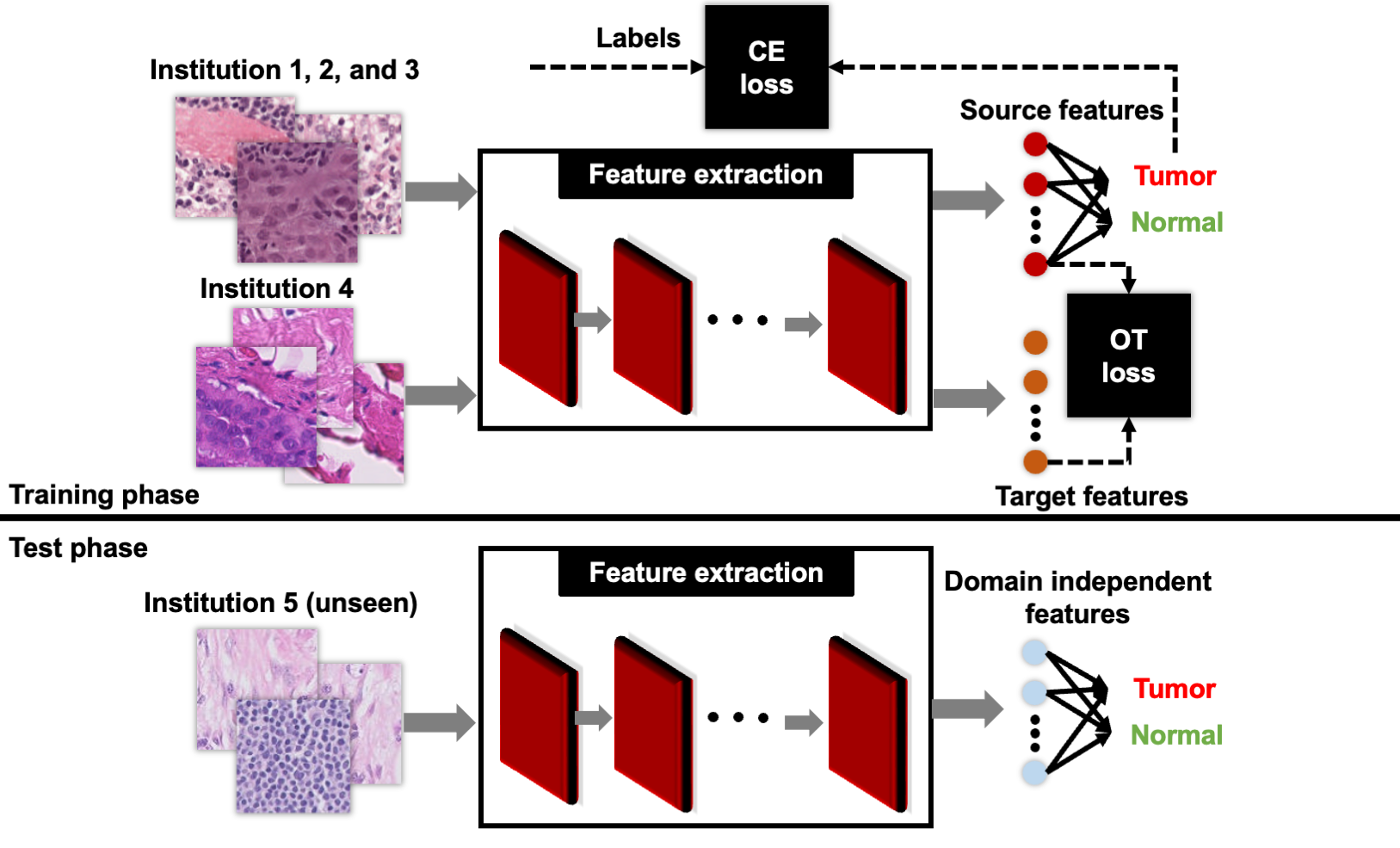
- 提出一种新型最优传输(OT)损失,用于比较来自不同机构图像批次的特征嵌入的完整分布。
- 利用OT量化并惩罚模型训练过程中机构间数据分布的表征差异。
- 通过在OT基础上实现批次级分布对齐,扩展对抗性域自适应,取代基于实例的域分类。
- 将OT损失作为正则化项应用于深度神经网络训练流程,以鼓励学习域不变表示。
- 采用在ImageNet上预训练的ResNet-50主干网络进行特征提取,并使用域判别头实现基于OT的正则化。
- 利用t-SNE可视化和聚类分析验证,基于OT的模型在生物和工艺变异下学习到更鲁棒、更具泛化能力的特征表示。
实验结果
研究问题
- RQ1与标准对抗性域自适应相比,基于最优传输的域自适应是否能提升模型在组织病理学数据集中对未见机构的泛化能力?
- RQ2该OT方法是否能更好地处理组织病理学图像切片中的子群体偏移和代表性不足的表型?
- RQ3在Camelyon17基准上,OT损失相对于其他最先进域自适应方法的表现如何?
- RQ4当未见机构被用作验证集时,OT方法是否能保持性能,表明其对域偏移的鲁棒性?
- RQ5基于OT的正则化对特征空间分布的影响如何,特别是在训练数据覆盖较少的区域?
主要发现
- 基于OT正则化的模型在测试集上达到89.1%的准确率(标准差0.019),显著优于E分模型基线(70.3%)及其他基线方法如CORAL(59.5%)和IRM(68.4%)。
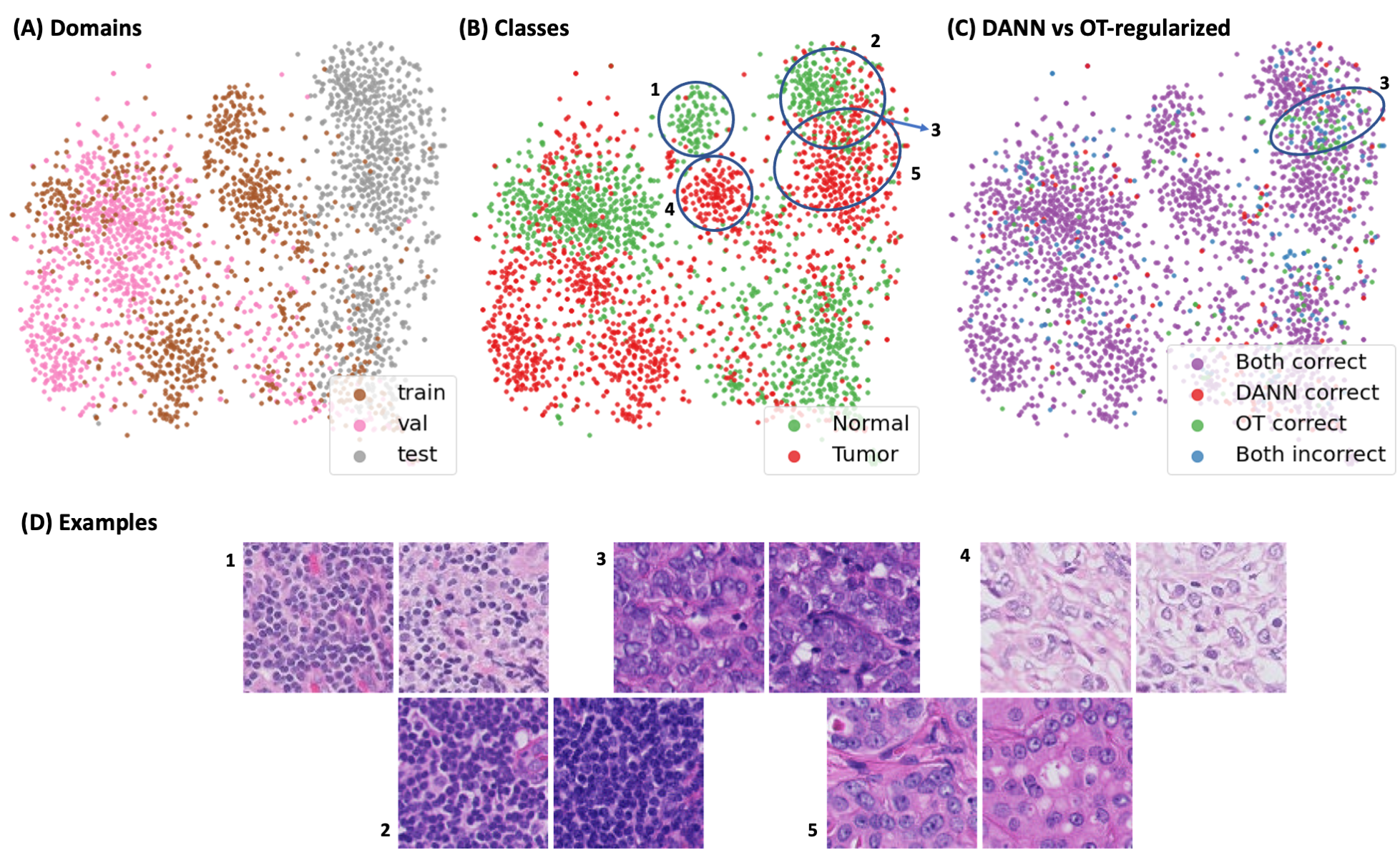
- 在Camelyon17数据集上,OT方法在罕见或代表性不足的表型上表现更优,尤其在聚类3中,DANN失败而OT成功。
- 当验证机构与测试机构角色互换时,基于OT的模型仍能稳健泛化,无论哪一机构为未见机构,均保持强性能。
- t-SNE可视化显示,OT方法更好地保留了特征空间中生物和工艺变异的完整分布,尤其在低覆盖区域。
- 该方法对子群体偏移表现出更强鲁棒性,表明通过OT实现的批次级分布对齐可缓解因训练数据稀疏或不平衡导致的失败。
- 尽管未超越最先进方法(如MBDG、SGD (Freeze-Embed)),但OT方法与现有方法(如染色增强和视觉变换器)具有显著协同潜力。
阅读本论文
在 Nubint 阅读器中打开原文,边读边就任意段落提问。
在 Nubint 中阅读本论文本解读由 AI 根据论文原文生成,引用前请核对原文。