
[论文解读] Domain Specialization as the Key to Make Large Language Models Disruptive: A Comprehensive Survey
本综述对大语言模型(LLMs)的领域专业化技术进行分类与分析,提出基于可访问性(黑盒/灰盒/白盒)的分类法,并概述应用领域、挑战与未来趋势。
Large language models (LLMs) have significantly advanced the field of natural language processing (NLP), providing a highly useful, task-agnostic foundation for a wide range of applications. However, directly applying LLMs to solve sophisticated problems in specific domains meets many hurdles, caused by the heterogeneity of domain data, the sophistication of domain knowledge, the uniqueness of domain objectives, and the diversity of the constraints (e.g., various social norms, cultural conformity, religious beliefs, and ethical standards in the domain applications). Domain specification techniques are key to make large language models disruptive in many applications. Specifically, to solve these hurdles, there has been a notable increase in research and practices conducted in recent years on the domain specialization of LLMs. This emerging field of study, with its substantial potential for impact, necessitates a comprehensive and systematic review to better summarize and guide ongoing work in this area. In this article, we present a comprehensive survey on domain specification techniques for large language models, an emerging direction critical for large language model applications. First, we propose a systematic taxonomy that categorizes the LLM domain-specialization techniques based on the accessibility to LLMs and summarizes the framework for all the subcategories as well as their relations and differences to each other. Second, we present an extensive taxonomy of critical application domains that can benefit dramatically from specialized LLMs, discussing their practical significance and open challenges. Last, we offer our insights into the current research status and future trends in this area.
研究动机与目标
- 由于领域异质性、知识更新变快和伦理约束,推动对 LLMs 的领域特定适应的必要性。
- 基于对 LLMs 的可访问性(黑盒、灰盒、白盒)提供一个系统的领域专业化技术分类。
- 将领域专业化方法映射到大量的应用领域,并讨论其实用意义与尚存的挑战。
- 提供关于领域特定 LLM 应用的当前研究状况与未来趋势的见解。
提出的方法
- 提出一个领域专业化的四阶段通用框架:定义、增强、优化、评估。
- 按可访问性(黑盒/灰盒/白盒)和训练/干预级别(预训练、微调、推理时)对方法进行分类。
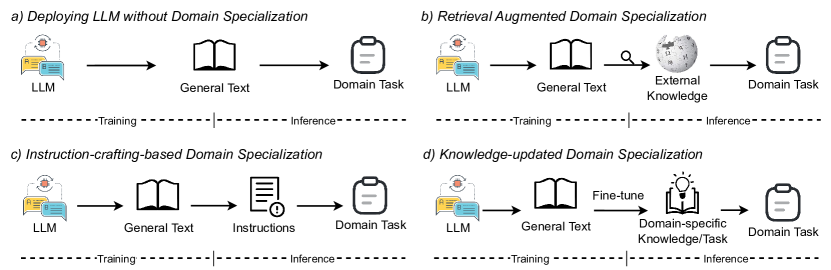
- 描述三类核心方法:外部增强(领域知识和领域工具)、提示设计和模型微调,并给出关系和权衡。
- 说明一个统一的工作流,展示外部知识、提示与参数更新如何结合以实现领域特定任务。
实验结果
研究问题
- RQ1在不同可访问性水平下,哪种分类法最能表征 LLMs 的领域专业化技术?
- RQ2哪些主要的领域应用领域可以从专门化的 LLMs 中受益,它们带来哪些挑战?
- RQ3在成本、性能和泛化方面,外部增强、提示设计和模型微调在领域自适应中的表现如何比较?
- RQ4哪些未来方向和瓶颈影响领域专业化 LLM 的发展?
主要发现
- 一个系统分类法将领域专业化技术分为外部增强、提示设计和模型微调,并与黑盒/灰盒/白盒的可访问性保持一致。
- 提供了应用领域的全面映射,强调领域专业化 LLMs 的实际意义和未解决的挑战。
- 本文讨论了各方法之间的权衡,包括计算成本、实现难易度和泛化能力,并指出它们的互补潜力。
- 所识别的开放挑战包括外部知识的无缝集成、对大型知识库的扩展性,以及保持模型信息的最新性。

阅读本论文
在 Nubint 阅读器中打开原文,边读边就任意段落提问。
在 Nubint 中阅读本论文本解读由 AI 根据论文原文生成,引用前请核对原文。