
[论文解读] Don't Hallucinate, Abstain: Identifying LLM Knowledge Gaps via Multi-LLM Collaboration
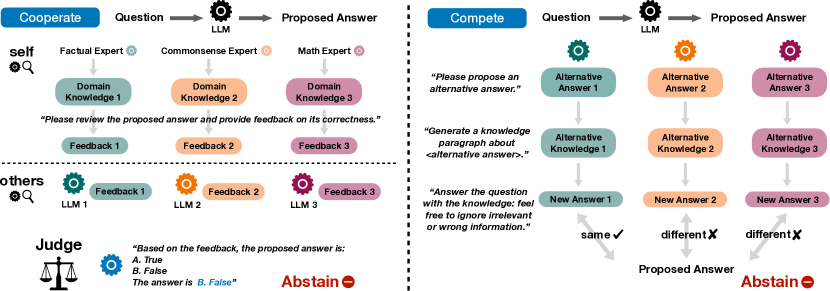
本论文引入合作与竞争的多大语言模型协作(Cooperate and Compete)以识别知识空白并在需要时选择不回答,在四项问答任务上相比强基线,在放弃回答的准确性上实现高达19.3%的提升。
Despite efforts to expand the knowledge of large language models (LLMs), knowledge gaps -- missing or outdated information in LLMs -- might always persist given the evolving nature of knowledge. In this work, we study approaches to identify LLM knowledge gaps and abstain from answering questions when knowledge gaps are present. We first adapt existing approaches to model calibration or adaptation through fine-tuning/prompting and analyze their ability to abstain from generating low-confidence outputs. Motivated by their failures in self-reflection and over-reliance on held-out sets, we propose two novel approaches that are based on model collaboration, i.e., LLMs probing other LLMs for knowledge gaps, either cooperatively or competitively. Extensive experiments with three LLMs on four QA tasks featuring diverse knowledge domains demonstrate that both cooperative and competitive approaches to unveiling LLM knowledge gaps achieve up to 19.3% improvements on abstain accuracy against the strongest baseline. Further analysis reveals that our proposed mechanisms could help identify failure cases in retrieval augmentation and pinpoint knowledge gaps in multi-hop reasoning.
研究动机与目标
- 出于对LLM知识更新与可靠性关注,动机在低置信输出时进行放弃。
- 探索数据、模型或使用因素是否应触发AbstainQA中的放弃。
- 系统性评估11种基线方法(校准、训练、提示、自洽)在放弃方面的表现并识别其局限性。
- 提出并验证两种新颖的多LLM协作方法(Cooperate 与 Compete),以稳健检测知识空白。
提出的方法
- 评审并改编11种现有放弃方法(校准、训练、提示、自洽)以适用于AbstainQA。
- 开发两种多LLM协作策略:Cooperate(专家LLM提供反馈,评审者综合放弃决策)和Compete(外部输入的冲突性测试对参数化知识的依赖性)。
- 在四项知识密集型问答任务中,对三种LLM(Mistral-7B、LLaMA2-70B、ChatGPT)评估方法。
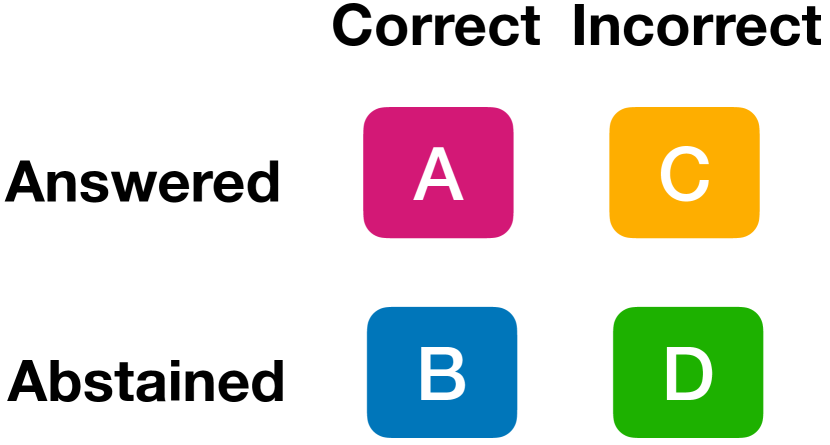
- 通过可靠准确性、有效性可靠性、放弃准确性和放弃F1等指标评估放弃性能。
- 分析检索增强与多跳推理中的失效模式,以定位知识空缺。
实验结果
研究问题
- RQ1放弃机制是否能够在没有保留数据的情况下检测LLM的知识空缺?
- RQ2协作型方法(Cooperate/Compete)是否优于单模型或自我评估基线在放弃方面的表现?
- RQ3不同问答任务和知识领域如何影响跨LLM的放弃有效性?
- RQ4放弃方法是否有助于诊断检索失败和多跳推理的空缺?
- RQ5在模型与任务之间,放弃率与可靠性之间的权衡是什么?
主要发现
- Cooperate 与 Compete 在12种设定中的9种超越所有基线,放弃准确性提升高达19.3%。
- 基于协作的放弃在三种LLM和四项问答任务中表现出色,减少错误回答同时保持覆盖率。
- 基于提示的自我反思和单模型自我评估在没有保留数据时可靠性较低;协作有助于缓解这一问题。
- Cooperate 受益于更强的基础模型(如 ChatGPT),而 Compete 更强调可靠性并在不确定情形下更多放弃。
- 在使用检索增强的问答系统时,放弃机制能够定位多跳推理中的知识缺口并识别检索失败。
阅读本论文
在 Nubint 阅读器中打开原文,边读边就任意段落提问。
在 Nubint 中阅读本论文本解读由 AI 根据论文原文生成,引用前请核对原文。