
[论文解读] Don't Play Favorites: Minority Guidance for Diffusion Models
本文提出少数引导(minority guidance),一种新颖的扩散模型采样技术,通过利用一种名为少数分值(minority score)的新度量,将生成过程引导至低密度、少数类样本。该度量通过感知重建误差量化特征的独特性。实验表明,与标准扩散采样器相比,该方法显著提升了在长尾数据集上对罕见、新颖特征的生成能力,同时通过分类器引导保持了可控性。
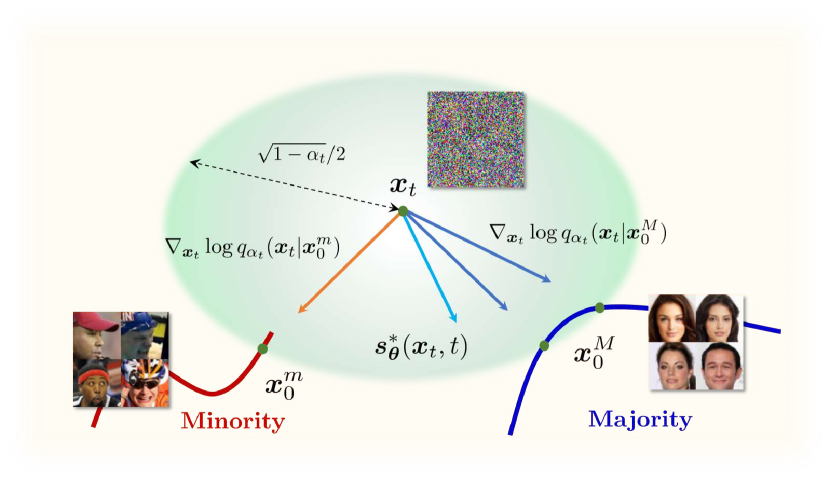
We explore the problem of generating minority samples using diffusion models. The minority samples are instances that lie on low-density regions of a data manifold. Generating a sufficient number of such minority instances is important, since they often contain some unique attributes of the data. However, the conventional generation process of the diffusion models mostly yields majority samples (that lie on high-density regions of the manifold) due to their high likelihoods, making themselves ineffective and time-consuming for the minority generating task. In this work, we present a novel framework that can make the generation process of the diffusion models focus on the minority samples. We first highlight that Tweedie's denoising formula yields favorable results for majority samples. The observation motivates us to introduce a metric that describes the uniqueness of a given sample. To address the inherent preference of the diffusion models w.r.t. the majority samples, we further develop minority guidance, a sampling technique that can guide the generation process toward regions with desired likelihood levels. Experiments on benchmark real datasets demonstrate that our minority guidance can greatly improve the capability of generating high-quality minority samples over existing generative samplers. We showcase that the performance benefit of our framework persists even in demanding real-world scenarios such as medical imaging, further underscoring the practical significance of our work. Code is available at https://github.com/soobin-um/minority-guidance.
研究动机与目标
- 解决扩散模型固有的偏差问题,即倾向于生成高似然性、多数类样本,而非罕见、低密度的少数类样本。
- 开发一种度量方法,用于量化样本中特征的独特性,特别是数据流形低密度区域中的特征。
- 设计一种采样框架,通过控制期望的特征独特性水平,实现对少数类样本的可控生成。
- 通过减少罕见、新颖属性的代表性不足,提升生成模型的公平性与表征多样性。
提出的方法
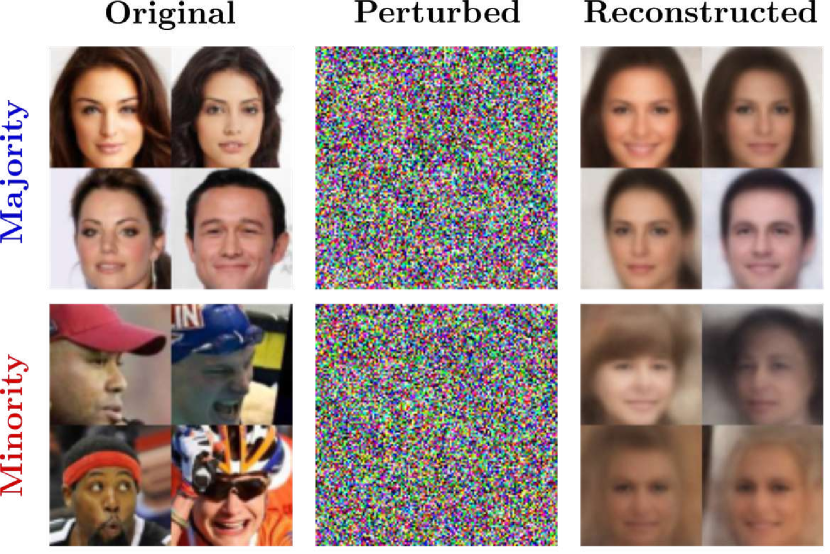
- 提出一种新度量——少数分值,定义为通过Tweedie公式重建的干净样本与其重建结果之间的感知距离(如LPIPS),以量化特征独特性。
- 使用预训练分类器预测噪声输入的离散化少数分值,实现与现有扩散采样器的集成。
- 通过分类器引导将少数分值分类器集成到祖先采样过程中,从而控制生成样本的似然水平。
- 将采样过程条件化于目标少数分值水平(例如,高分值用于罕见特征),实现对独特样本的定向生成。
- 利用Tweedie公式实现高效的单次重建,使少数分值计算具备可扩展性与实用性。
- 将该方法应用于CIFAR-10、CelebA和LSUN-Bedrooms等基准数据集的类别条件与无条件设置。
实验结果
研究问题
- RQ1为何扩散模型尽管具备强大的分布覆盖能力,仍无法生成少数类样本?
- RQ2我们能否使用反映其在数据流形中稀有性的感知度量,来量化样本中特征的独特性?
- RQ3如何修改扩散采样过程,以在不微调模型的前提下,偏好低似然性、高独特性的样本?
- RQ4与标准扩散采样器相比,少数引导在生成罕见、新颖特征方面的提升程度如何?
- RQ5在生成少数类样本时,样本独特性与保真度之间的权衡关系如何?
主要发现
- 少数引导显著提升了对低密度、少数类样本的生成能力,表现为异常检测指标(如局部离群点因子LOF和平均k-近邻密度)值更高。
- 在LSUN-Bedrooms数据集上,针对高少数分值的少数引导方法达到LOF密度得分为0.5935,优于标准DDPM基线的0.7686。
- 在CIFAR-10数据集上,聚焦于罕见特征的少数引导方法获得0.7581的精确率,而标准DDPM为0.8795,表明独特性与保真度之间存在权衡。
- 该方法成功生成了新颖属性(如额外的灯或独特的物体),这些特征常被标准采样器忽略,尤其是在单调或常见场景中。
- 分类器引导尺度$w$与目标少数分值$\tilde{l}$作为有效调节旋钮:提高$\tilde{l}$可使生成结果更偏向低密度区域,而提高$w$则更倾向于高似然性、多数类特征。
- 少数分值与其它异常检测度量高度相关,验证了其作为识别真实数据集中罕见、新颖特征代理的有效性。
阅读本论文
在 Nubint 阅读器中打开原文,边读边就任意段落提问。
在 Nubint 中阅读本论文本解读由 AI 根据论文原文生成,引用前请核对原文。