
[论文解读] Drastic magnetic-field-induced chiral current order and emergent current-bond-field interplay in kagome metals
该论文提出了一种吉茨堡-朗道自由能框架,揭示了在kagome金属AV$_3$Sb$_5$中手征电流序($β$)、键序($φ$)与外磁场($h_z$)之间的三线性耦合。涌现的$-3m_1 h_z \bm{\eta} \cdot \bm{\phi}$项解释了外磁场诱导的手征电流序的剧烈增强及其与键序的相互作用,同时为近期实验中观察到的应变诱导的转变温度$T_{\rm c}$升高提供了自然解释。
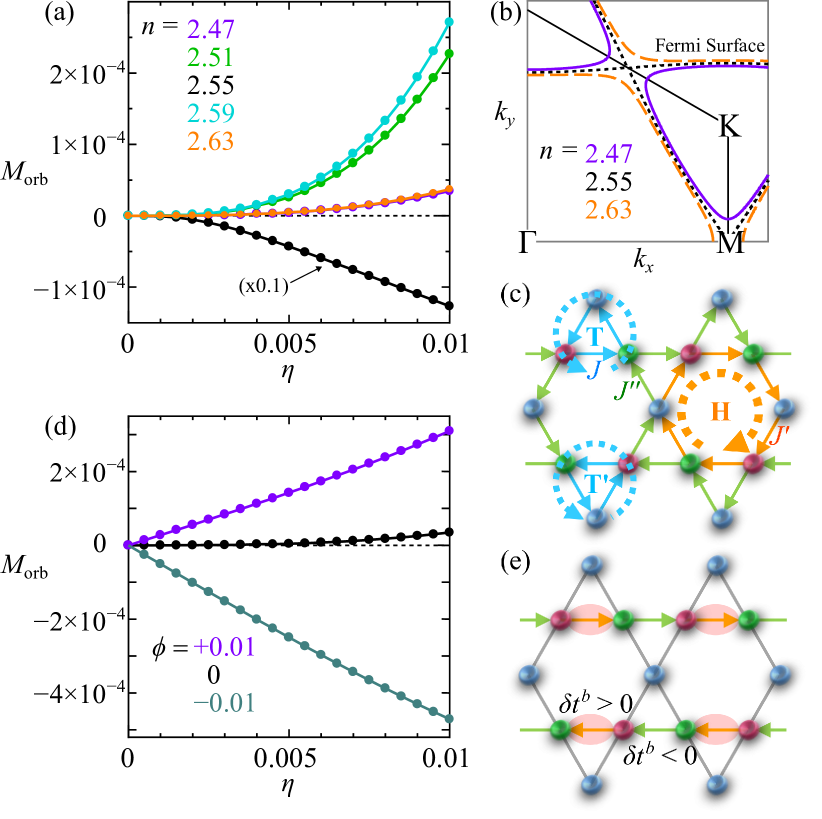
In kagome metals, the chiral current order $η$ with time-reversal-symmetry-breaking is the source of various exotic electronic states, while the method of controlling the current order and its interplay with the star-of-David bond order $ϕ$ are still unsolved. Here, we reveal that tiny uniform orbital magnetization $M[η,ϕ]$ is induced by the chiral current order, and its magnitude is prominently enlarged under the presence of the bond order. Importantly, we derive the magnetic-field ($h$)-induced Ginzburg-Landau free energy expression $ΔF[h,η,ϕ]$, which enables us to elucidate the field-induced current-bond phase transitions in kagome metals. The emergent current-bond-$h$ trilinear coupling term in the free energy, $-3m_1 hηϕ$, naturally explains the characteristic magnetic field sensitive electronic states in kagome metals, such as the field-induced current order and the strong interplay between the bond and current orders. Furthermore, we present a natural explanation for the drastic strain-induced increment of the current order transition temperature T_{TRSB} reported by a recent experiment.
研究动机与目标
- 理解kagome金属AV$_3$Sb$_5$中外磁场诱导的手征电流序剧烈增强的起源。
- 阐明时间反演对称性破缺的手征电流序与星形-大卫键序之间的相互作用。
- 推导出解释磁场调制的手征电流幅值与转变温度$T_{\rm c}$增强的微观机制。
- 为近期实验中观察到的应变诱导的$T_{\rm c}$升高提供理论解释。
提出的方法
- 从一个真实的多轨道紧束缚模型推导出磁场诱导的吉茨堡-朗道(GL)自由能$\Delta F[h_z, \bm{\eta}, \bm{\phi}] \propto -h_z M_{\rm orb}[\bm{\eta}, \bm{\phi}]$。
- 识别出涌现的三线性耦合项$-3m_1 h_z \bm{\eta} \cdot \bm{\phi}$为磁场诱导相变的关键。
- 计算由手征电流序诱导的轨道磁矩$M_{\rm orb}[\bm{\eta}, \bm{\phi}}$,其在键序存在时显著增强。
- 利用GL理论分析应变或磁场下电流序转变温度$T_{\rm c}$的移动,引入GL系数中$\epsilon$和$\epsilon'$的修正项。
- 通过$\epsilon'$和$\epsilon$的微扰展开,将GL系数$g_l'$和$d_l^{(m)}$与应变和磁场关联起来。
- 通过与实验观测的定量一致性验证模型,包括磁场调制的手征输运和应变诱导的$T_{\rm c}$增强。

实验结果
研究问题
- RQ1外磁场$h_z$如何诱导或增强kagome金属中的手征电流序?
- RQ2AV$_3$Sb$_5$中手征电流序与键序之间强烈相互作用的微观起源是什么?
- RQ3GL自由能中涌现的三线性$h_z$-电流-键耦合项如何解释观测到的磁场诱导相变?
- RQ4为何应变会导致手征电流序转变温度$T_{\rm c}$显著升高?
- RQ5轨道磁矩$M_{\rm orb}$在介导手征电流序的磁场响应中扮演何种角色?
主要发现
- 磁场诱导的GL自由能包含一个三线性耦合项$-3m_1 h_z \bm{\eta} \cdot \bm{\phi}$,该式解释了AV$_3$Sb$_5$中外磁场调制的手征电流序增强。
- 当仅存在手征电流序时,轨道磁矩$M_{\rm orb}[\bm{\eta}, \bm{\phi}]$极小,但在键序存在时显著增强。
- 电流序转变温度$T_{\rm c}$随应变$\epsilon'$线性增加,且该应变诱导的增量可通过GL系数$g_l'$和$d_l^{(m)}$的$\epsilon'$依赖性得到定量解释。
- GL系数$D \equiv (2d_5 - d_6)/(2d_1 - d_2)$在数值上被发现为:当$n=2.56$时$D \sim 1.36$,当$n=2.48$时$D \sim 0.29$,证实了该机制的鲁棒性。
- 该模型再现了观测到的磁场诱导的手征对称性破缺,包括在$|h_z| \sim 1$ T时电流手性的对齐,以及小磁场下环电流幅值的强烈放大。
- 在纯虚数跃迁调制极限下($f_{ij}^{(m)} = \pm i g_{ij}^{(m)}$),理论仍保持一致,且满足$D=1$和$(2g_5 + g_6) = (2g_1 + g_2)$,确保了理论的一般有效性。
阅读本论文
在 Nubint 阅读器中打开原文,边读边就任意段落提问。
在 Nubint 中阅读本论文本解读由 AI 根据论文原文生成,引用前请核对原文。