
[论文解读] DreamAvatar: Text-and-Shape Guided 3D Human Avatar Generation via Diffusion Models
DreamAvatar 从文本提示和基于 SMPL 的形状/姿态输入生成高质量的 3D 人体头像,使用双观测空间和基于扩散的自监督来产生符合姿态的几何和纹理。
We present DreamAvatar, a text-and-shape guided framework for generating high-quality 3D human avatars with controllable poses. While encouraging results have been reported by recent methods on text-guided 3D common object generation, generating high-quality human avatars remains an open challenge due to the complexity of the human body's shape, pose, and appearance. We propose DreamAvatar to tackle this challenge, which utilizes a trainable NeRF for predicting density and color for 3D points and pretrained text-to-image diffusion models for providing 2D self-supervision. Specifically, we leverage the SMPL model to provide shape and pose guidance for the generation. We introduce a dual-observation-space design that involves the joint optimization of a canonical space and a posed space that are related by a learnable deformation field. This facilitates the generation of more complete textures and geometry faithful to the target pose. We also jointly optimize the losses computed from the full body and from the zoomed-in 3D head to alleviate the common multi-face ''Janus'' problem and improve facial details in the generated avatars. Extensive evaluations demonstrate that DreamAvatar significantly outperforms existing methods, establishing a new state-of-the-art for text-and-shape guided 3D human avatar generation.
研究动机与目标
- 在文本引导下推动鲁棒的 3D 人物头像生成,同时保持真实的形状和姿态。
- 利用 SMPL 作为形状先验,在扩散式优化中引导几何和姿态。
- 引入一个由可学习形变场连接的双观测空间(规范空间与姿态空间),以实现真实纹理和几何。
- 通过联合全身和缩放头部优化来缓解多面 Janus 问题并增强面部细节。
- 实现文本驱动的编辑和形状变体(通过 SMPL 参数),以生成多样化的头像。
提出的方法
- 使用一个可训练的 NeRF 来表示三维点的密度和颜色。
- 对 2D 自监督应用变分分数蒸馏(VSD)和预训练扩散模型。
- 将基于 SMPL 的密度场用于初始和约束几何(规范空间和姿态空间)。
- 引入一个形变场以在规范空间和姿态空间之间映射,从而实现双观测空间优化。
- 联合优化全身和缩放头部损失,以提升面部细节并减少 Janus 偏差。
- 利用基于 ControlNet 的头部监督并加入背视 token 来稳定头部特征。
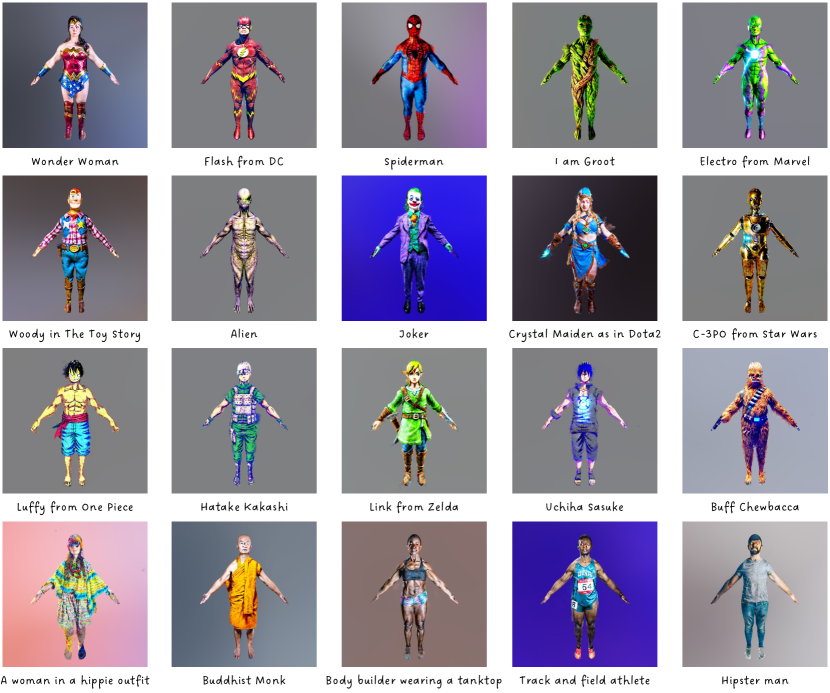
实验结果
研究问题
- RQ1如何利用文本引导扩散来可靠地生成具有现实几何和纹理的一致的 3D 人体头像?
- RQ2将 SMPL 的形状/姿态先验结合是否能改善 3D 头像生成中的姿态一致性和几何保真度?
- RQ3双观测空间设计是否比单一空间方法产生更完整的纹理和对目标姿态更保真的几何?
- RQ4联合优化全身和头部区域是否能缓解面部细节问题和拓扑伪影?
- RQ5文本提示如何编辑以改变头像外观,以及形状参数如何影响生成结果?
主要发现
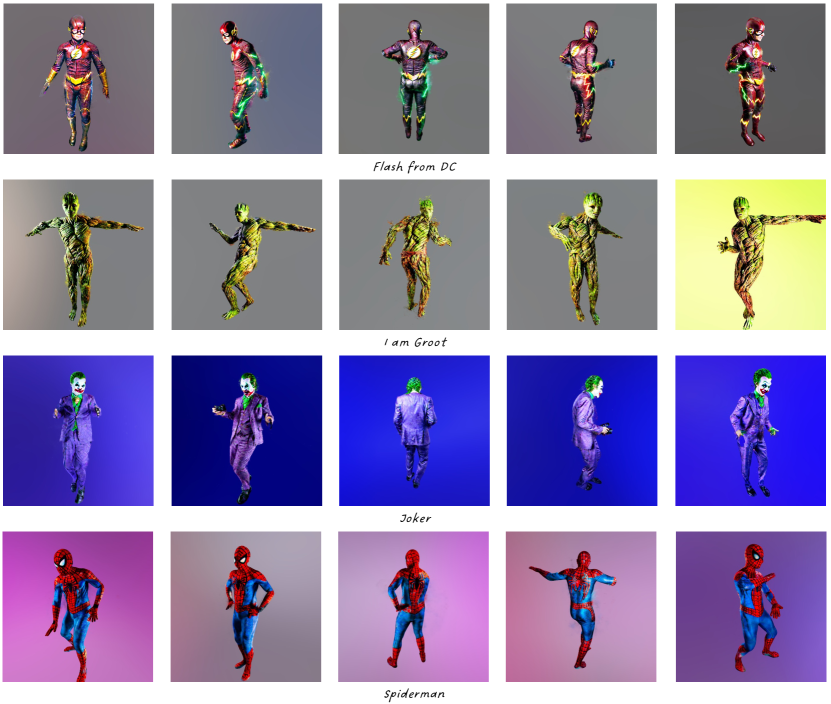
- DreamAvatar 在几何和纹理质量方面在定性评估和用户研究中超越现有的文本+形状引导 3D 头像方法。
- 双观测空间设计使纹理更完整,几何更符合目标姿态。
- 将基于 SMPL 的密度场整合有助于稳定几何并防止不真实的形状。
- 联合头部和全身优化提升面部细节并减少 Janus 问题。
- 文本操作和基于 SMPL 的形状编辑实现跨风格和姿态的可控、多样化头像生成。
阅读本论文
在 Nubint 阅读器中打开原文,边读边就任意段落提问。
在 Nubint 中阅读本论文本解读由 AI 根据论文原文生成,引用前请核对原文。