
[论文解读] DrivAerNet++: A Large-Scale Multimodal Car Dataset with Computational Fluid Dynamics Simulations and Deep Learning Benchmarks
DrivAerNet++ 是一个大型多模态汽车数据集,包含 8,000 个高保真 CFD-simulated 设计、多种数据模态,以及用于拖曳预测的 ML 基准。
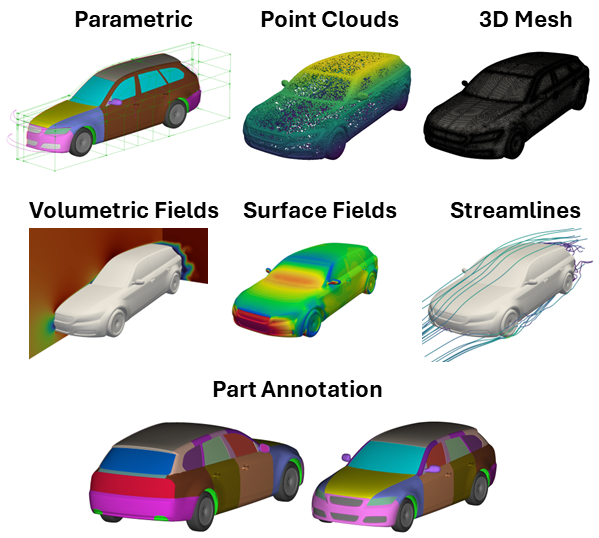
We present DrivAerNet++, the largest and most comprehensive multimodal dataset for aerodynamic car design. DrivAerNet++ comprises 8,000 diverse car designs modeled with high-fidelity computational fluid dynamics (CFD) simulations. The dataset includes diverse car configurations such as fastback, notchback, and estateback, with different underbody and wheel designs to represent both internal combustion engines and electric vehicles. Each entry in the dataset features detailed 3D meshes, parametric models, aerodynamic coefficients, and extensive flow and surface field data, along with segmented parts for car classification and point cloud data. This dataset supports a wide array of machine learning applications including data-driven design optimization, generative modeling, surrogate model training, CFD simulation acceleration, and geometric classification. With more than 39 TB of publicly available engineering data, DrivAerNet++ fills a significant gap in available resources, providing high-quality, diverse data to enhance model training, promote generalization, and accelerate automotive design processes. Along with rigorous dataset validation, we also provide ML benchmarking results on the task of aerodynamic drag prediction, showcasing the breadth of applications supported by our dataset. This dataset is set to significantly impact automotive design and broader engineering disciplines by fostering innovation and improving the fidelity of aerodynamic evaluations. Dataset and code available at: https://github.com/Mohamedelrefaie/DrivAerNet.
研究动机与目标
- 提供一个大规模、多样化、高保真度的多模态汽车设计数据集,用于数据驱动的气动设计研究。
- 使基于几何和参数模型的 ML 基准评估在拖曳预测和其他气动指标上可进行比较。
- 通过代理建模基准和跨类别泛化分析来展示数据集的实用性。
- 提供包括 3D 网格、点云、CFD 场、参数数据和注释在内的数据模态,以支持多样化的 ML 任务。
提出的方法
- 通过对基于 DrivAer 的参数模型进行形态变换,使用 26 个参数覆盖底盘下部、轮胎、后部及其他部件来进行 8,000 车设计的程序化生成。
- 采用 SnappyHexMesh 进行高保真 CFD 网格剖分,每个案例约 2400 万个单元,并使用 OpenFOAM v11 稳态 k-omega SST 模拟。
- 全面的数据模态:3D STL 网格、ANSA 参数模型、表格参数、CFD 场、表面场,以及带注释的标签。
- 使用 3D 几何深度学习(PointNet、GCNN、RegDGCNN)以及表格型 AutoML/ML 模型(XGBoost、LightGBM、RF)对气动阻力进行代理模型基准。
- 评估指标包括 MSE、MAE、Max AE 和 R^2,用于比较不同设计下模型的精度和泛化能力。
实验结果
研究问题
- RQ1一个大型多模态汽车数据集是否能够在多样化的汽车配置中实现对气动阻力的稳健代理建模?
- RQ2在单一类别与多类别汽车设计中,几何基 ML 方法与参数化 ML 方法在预测阻力方面的比较如何?
- RQ3数据集的多样性在跨类别对阻力预测模型的泛化能力有多大影响?
- RQ4在 3D 网格与参数数据驱动的阻力预测之间,模型精度与计算时间的权衡有哪些?
主要发现
- DrivAerNet++ 包含 8,000 个汽车设计,每个案例 24M 网格单元,总数据量为 39 TB。
- 几何深度学习模型的表现各异:RegDGCNN 在 DrivAerNet(Table 2)上获得最佳 MSE/MAE/Max AE/R^2,MSE 8.01e-5,MAE 6.91e-3,Max AE 8.80e-3,R^2 0.901。
- 在 DrivAerNet++(全部汽车)上,RegDGCNN 的 MSE 14.2e-5,MAE 9.31e-3,Max AE 12.79e-3,R^2 0.641,表明在跨越多样化设计进行泛化时性能下降。
- AutoML/参数化模型在数据集规模增加时展现出跨数据集性能的提升;XGBoost 的 R^2 从 ~0.35 提升到 ~0.55,当训练数据从 640 增加到 3,200 样本。
- 研究强调了一个显著的泛化挑战:在仅针对单一汽车类别训练的模型,在对所有汽车设计进行测试时,R^2 降至 ~0.60(原先在 0.82-0.90 之间)。
- 该数据集支持多种任务,除了阻力代理建模外,还包括 CFD 加速、形状/部件分类和 3D 重建。
阅读本论文
在 Nubint 阅读器中打开原文,边读边就任意段落提问。
在 Nubint 中阅读本论文本解读由 AI 根据论文原文生成,引用前请核对原文。