
[论文解读] DriveMLM: Aligning Multi-Modal Large Language Models with Behavioral Planning States for Autonomous Driving
DriveMLM 引入一个与模块化自主驾驶行为规划器对齐的多模态大模型规划器,能够在 CARLA 中实现闭环驾驶并为决策提供解释,在 Town05 Long 上性能优于 Apollo。
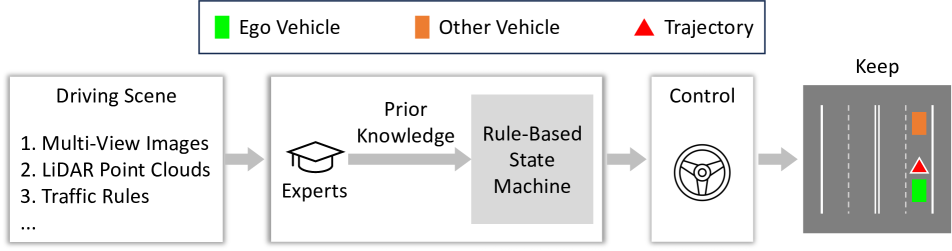
Large language models (LLMs) have opened up new possibilities for intelligent agents, endowing them with human-like thinking and cognitive abilities. In this work, we delve into the potential of large language models (LLMs) in autonomous driving (AD). We introduce DriveMLM, an LLM-based AD framework that can perform close-loop autonomous driving in realistic simulators. To this end, (1) we bridge the gap between the language decisions and the vehicle control commands by standardizing the decision states according to the off-the-shelf motion planning module. (2) We employ a multimodal LLM (MLLM) to model the behavior planning module of a module AD system, which uses driving rules, user commands, and inputs from various sensors (e.g., camera, lidar) as input and makes driving decisions and provide explanations; This model can plug-and-play in existing AD systems such as Autopilot and Apollo for close-loop driving. (3) We design an effective data engine to collect a dataset that includes decision state and corresponding explanation annotation for model training and evaluation. We conduct extensive experiments and show that replacing the decision-making modules of the Autopilot and Apollo with DriveMLM resulted in significant improvements of 3.2 and 4.7 points on the CARLA Town05 Long respectively, demonstrating the effectiveness of our model. We hope this work can serve as a baseline for autonomous driving with LLMs.
研究动机与目标
- 通过将大语言模型输出与行为规划状态对齐,弥合语言决策与车辆控制之间的差距。
- 开发一个多模态的大语言模型规划器,输入多视角图像、雷达、规则和指令,以预测驾驶决策和解释。
- 创建一个高效的数据引擎,用于收集带有决策状态和解释的驾驶数据,以用于训练和评估。
- 在真实感的仿真器中演示闭环驾驶,并在标准基准上与 Apollo 进行比较。
提出的方法
- 将行为规划状态与 LLM 输出对齐,以在 Apollo 风格的规划器中映射为可执行的速度和路径决策。
- 多模态 LLMP 规划器将多模态分词器(用于图像的 Temporal QFormer、用于 LiDAR 的 SPT+QFormer,以及文本嵌入)与一个 LLM 解码器结合,以输出决策状态和解释。
- Temporal QFormer 的设计以高效处理时序的多视图图像,而不产生线性增长的标记数。
- 数据引擎生成 280 小时的 CARLA 数据,含决策状态和解释,使用专家驾驶和 GPT-3.5 进行标注增强。
- 使用 LLaMA-7B 作为训练设置,配备 ViT-g/14 视觉编码器,图像令牌 32 次查询,LiDAR 使用 GD-MAE,优化器为 AdamW,学习率 5e-5,训练 2 轮,批量大小 256。
- 评估指标包括 Driving Score (DS)、Route Completion (RC)、Infraction Score (IS)、Miles Per Intervention (MPI),以及用于解释的基于 NLP 的指标(BLEU-4、CIDEr、METEOR)。
实验结果
研究问题
- RQ1基于 LLM 的规划器是否能够与传统行为规划的决策状态对齐,从而实现闭环自动驾驶?
- RQ2与基于规则的 FSM 基线相比,多模态 LLM 规划器是否能提高决策准确性和驾驶安全性?
- RQ3驾驶决策及其解释是否可通过语言条件提示进行解释和控制?
- RQ4传感器模态(图像、LiDAR)及时序处理如何影响决策准确性和可解释性?
主要发现
- DriveMLM 在 CARLA Town05 Long 上实现 76.1 Driving Score,超越 Apollo 4.7 DS 点。
- DriveMLM 获得 98.1 Route Completion 和 0.78 Infraction Score,MPI 0.96,表明更少的人为接管。
- 决策预测准确度和决策类型 F1 分数,DriveMLM 高于 Apollo 与此前的 LLM 基线。
- DriveMLM 提供高质量的解释,BLEU-4 0.89、CIDEr 0.91、METEOR 0.61。
- 消融实验表明,多视图图像结合 Temporal QFormer 能得到最佳性能(Path F1 和 Speed F1 提升;准确度提升约 18.2%)。
- DriveMLM 在 nuScenes 上展示零-shot 推理能力,以及对指令影响的灵活性(例如对救护车让行或交通规则调整的响应)。
阅读本论文
在 Nubint 阅读器中打开原文,边读边就任意段落提问。
在 Nubint 中阅读本论文本解读由 AI 根据论文原文生成,引用前请核对原文。