
[论文解读] Dual-path Mamba: Short and Long-term Bidirectional Selective Structured State Space Models for Speech Separation
本文提出 DPMamba,一种双路径、双向选择性状态空间模型,用于单通道语音分离,在参数量显著更少、内存占用更低的情况下,达到与基于 Transformer 的 SOTA 模型相媲美甚至超越的性能,并在 WSJ0-2mix 上刷新了 SI-SNRi 记录。
Transformers have been the most successful architecture for various speech modeling tasks, including speech separation. However, the self-attention mechanism in transformers with quadratic complexity is inefficient in computation and memory. Recent models incorporate new layers and modules along with transformers for better performance but also introduce extra model complexity. In this work, we replace transformers with Mamba, a selective state space model, for speech separation. We propose dual-path Mamba, which models short-term and long-term forward and backward dependency of speech signals using selective state spaces. Our experimental results on the WSJ0-2mix data show that our dual-path Mamba models of comparably smaller sizes outperform state-of-the-art RNN model DPRNN, CNN model WaveSplit, and transformer model Sepformer. Code: https://github.com/xi-j/Mamba-TasNet
研究动机与目标
- 推动超越 Transformer 架构的高效长序列语音分离。
- 提出能够处理短期与长期依赖的双路径 Mamba 架构。
- 在前向与后向上下文中引入双向 Mamba 结构以利用双向信息。
- 在 WSJ0-2mix 上针对模型规模对比 CNN、RNN、Transformer 与混合 SOTA 方法的性能。
提出的方法
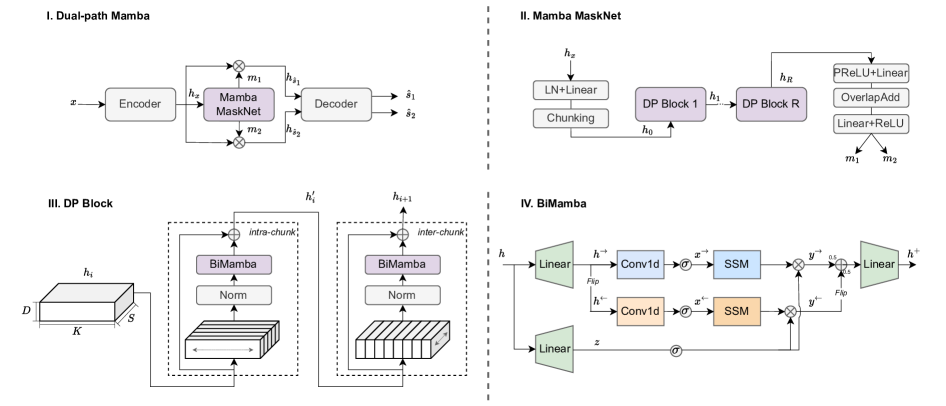
- 用 Mamba 选择性状态空间模型替换 Transformer 层,构建双路径、分块框架。
- 将长语音分割成块,分别应用块内与块间的 Mamba 处理。
- 在前向与后向流中使用双向 BiMamba,并通过一个学得的机制对输出进行门控。
- 使用数据扩增与 RMSNorm 进行训练,采用编码器–掩码器–解码器流程。
- 提供四种模型尺寸(XS、S、M、L),以评估性能与参数数量的关系。
实验结果
研究问题
- RQ1选择性状态空间模型(Mamba)是否能够在 WSJ0-2mix 上实现与基于 Transformer 的语音分离模型相竞争或更优的表现?
- RQ2双路径、双向 Mamba 架构是否在单通道语音分离中对建模短期与长期依赖具有优势?
- RQ3与 SOTA 模型相比,DPMamba 在模型规模、内存使用与分离性能之间的权衡如何?
- RQ4消融研究(双向性、动态混合、归一化)是否显著影响性能?
主要发现
- DPMamba (L) 在 59.8M 参数下实现了 SI-SNRi = 24.4 dB、SDRi = 24.6 dB,在 WSJ0-2mix 的公开结果中设定了新的 SOTA。
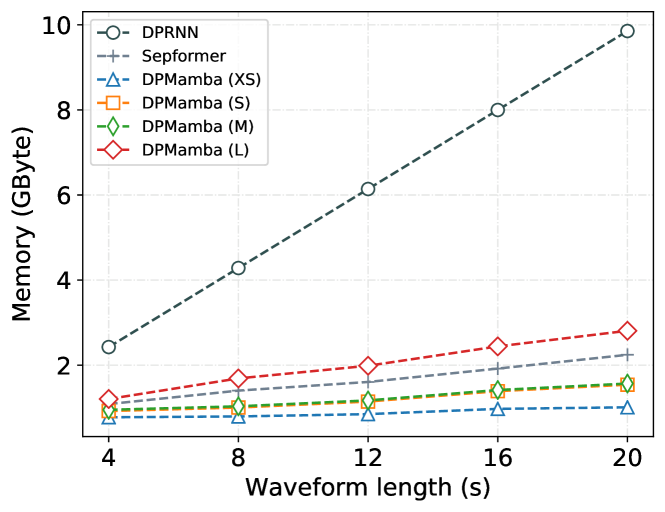
- DPMamba (M) 以约 60% 的参数量达到与 Sepformer 相当的性能;DPMamba (S) 在步幅更大时优于 VSUNOS;DPMamba XS 在内存更低的情况下优于 DPRNN。
- 在不同尺寸下,所有 DPMamba 变体在其参数预算与内存效率内均优于或达到 SOTA;DPMamba (L) 在 SI-SNRi 上比 Mossformer2 (L) 高出 0.3 dB。
- 消融研究表明,后向 SSM 相较于仅前向的模型可带来 >3 dB 的增益;训练过程中的动态混合带来 +1.3 dB 的 SI-SNRi 与 +1.2 dB 的 SDRi。
阅读本论文
在 Nubint 阅读器中打开原文,边读边就任意段落提问。
在 Nubint 中阅读本论文本解读由 AI 根据论文原文生成,引用前请核对原文。