
[论文解读] Dynamic Field of View Reduction Related to Subjective Sickness Measures in an HMD-based Data Analysis Task
本文在头戴显示设备(HMD)任务中测试以健康状态为驱动的极端视场(FoV)缩减以降低网络综合症(cybersickness);结果显示并无显著的疾病减少或对存在感的改变,但在极大 FoV 变化下出现了更多探索。
Various factors influence the degree of cybersickness a user can suffer in an immersive virtual environment, some of which can be controlled without adapting the virtual environment itself. When using HMDs, one example is the size of the field of view. However, the degree to which factors like this can be manipulated without affecting the user negatively in other ways is limited. Another prominent characteristic of cybersickness is that it affects individuals very differently. Therefore, to account for both the possible disruptive nature of alleviating factors and the high interpersonal variance, a promising approach may be to intervene only in cases where users experience discomfort symptoms, and only as much as necessary. Thus, we conducted a first experiment, where the field of view was decreased when people feel uncomfortable, to evaluate the possible positive impact on sickness and negative influence on presence. While we found no significant evidence for any of these possible effects, interesting further results and observations were made.
研究动机与目标
- 探究在基于HMD的数据信息分析任务中,动态、健康状态驱动的FoV缩减是否能够在不损害存在感的情况下减少 cybersickness。
- 评估基于自我报告的健康状态,在应用大幅FoV缩减时的可行性与用户感知。
- 在动态FoV条件下,研究主观疾病感、存在感与任务执行之间的相关性。
提出的方法
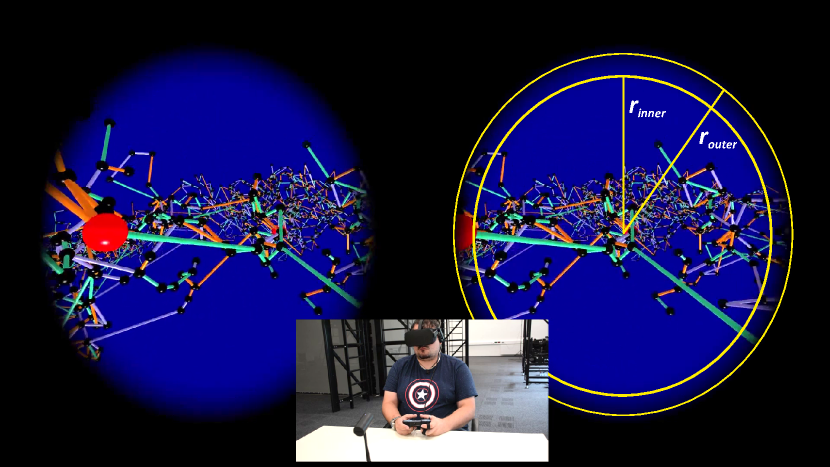
- 实现一个基于着色器的全屏黑色FoV缩减,具有可调的内部半径和外部半径,以创建具有屏幕空间透明性的动态视野。
- 使用一个坐姿桌面VR任务(图遍历),配备4自由度游戏手柄控制;实验组根据自我报告的健康状况体验动态 FoV 变化,对照组则不变。
- 在每个任务后收集健康/福祉评分,以及先验/后验SSQ和存在感量表。
- 使用独立样本t检验比较实验组与对照组,在方差不同时采用Welch修正。
- 记录任务表现指标、行进距离以及头部/虚拟旋转,以评估FoV操控下的行为变化。
实验结果
研究问题
- RQ1与无 FoV 变化的对照条件相比,健康驱动的 FoV 缩减是否会降低 cybersickness 相关指标?
- RQ2与标准 FoV 相比,动态 FoV 缩减是否影响存在感或任务执行?
- RQ3参与者是否注意到或感到被动态 FoV 缩减干扰?
主要发现
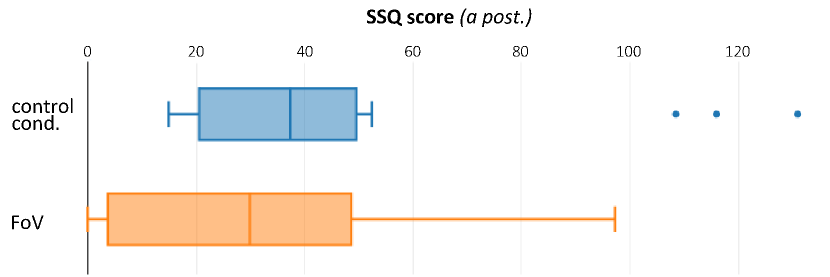
- 在SSQ分数、主观疾病指标、存在感或任务执行方面,实验组与对照组之间无显著差异。
- 实验组的行进距离显著更长,且环顾四周的次数多于对照组。
- 头部旋转在两组之间存在差异,实验组的旋转幅度更大,而其他旋转指标未显示显著变化。
- 若干主观指标(如互动的自然性)在对照组存在差异,提示存在与疾病减轻无关的副作用。
- 主观健康/易感性与疾病指标相关,而年龄或VR经验没有显示出一致的相关性。
阅读本论文
在 Nubint 阅读器中打开原文,边读边就任意段落提问。
在 Nubint 中阅读本论文本解读由 AI 根据论文原文生成,引用前请核对原文。