
[论文解读] Earliest Galaxies in the JADES Origins Field: Luminosity Function and Cosmic Star-Formation Rate Density 300 Myr after the Big Bang
本研究使用 JWST/JADES Origins Field 数据来识别 z = 11.5–15 的八个星系候选体,前向建模演化的 UV 光度函数,并将宇宙星形成率密度约束到 z ~ 14–15。
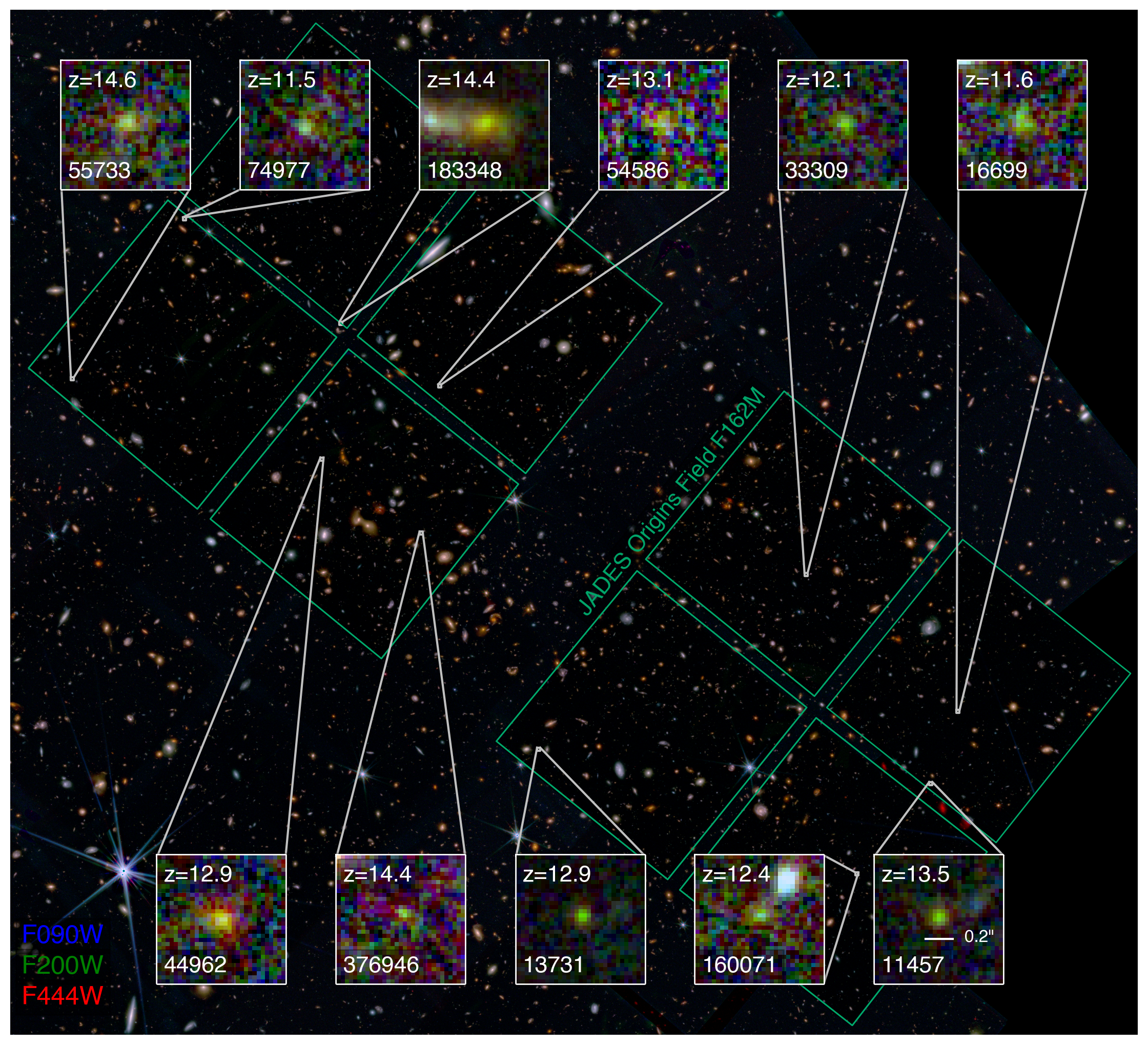
We characterize the earliest galaxy population in the JADES Origins Field (JOF), the deepest imaging field observed with JWST. We make use of the ancillary Hubble optical images (5 filters spanning $0.4-0.9μ\mathrm{m}$) and novel JWST images with 14 filters spanning $0.8-5μ\mathrm{m}$, including 7 medium-band filters, and reaching total exposure times of up to 46 hours per filter. We combine all our data at $>2.3μ\mathrm{m}$ to construct an ultradeep image, reaching as deep as $\approx31.4$ AB mag in the stack and 30.3-31.0 AB mag ($5σ$, $r=0.1"$ circular aperture) in individual filters. We measure photometric redshifts and use robust selection criteria to identify a sample of eight galaxy candidates at redshifts $z=11.5-15$. These objects show compact half-light radii of $R_{1/2}\sim50-200$pc, stellar masses of $M_{\star}\sim10^7-10^8 M_{\odot}$, and star-formation rates of $\mathrm{SFR}\sim0.1-1\,M_{\odot}\,\mathrm{yr}^{-1}$. Our search finds no candidates at $15
研究动机与目标
- 使用 JWST 和辅助的 HST 数据表征 JADES Origins Field(JOF)中的最早星系群体。
- 测量光度红移并在污染最小的情况下选择稳健的 z>11 星系候选体。
- 在没有红移或光度分箱的情况下对演化的 UV 光度函数进行前向建模。
- 推断 UV 光度密度及其演化至 z~20,并讨论对早期结构形成的影响。
提出的方法
- 将 14 过滤器的 JWST/NIRCam 成像(0.8–5 μm)与 HST 光学数据(0.4–0.9 μm)结合,创建 >2 μm 方向上最深的成像。
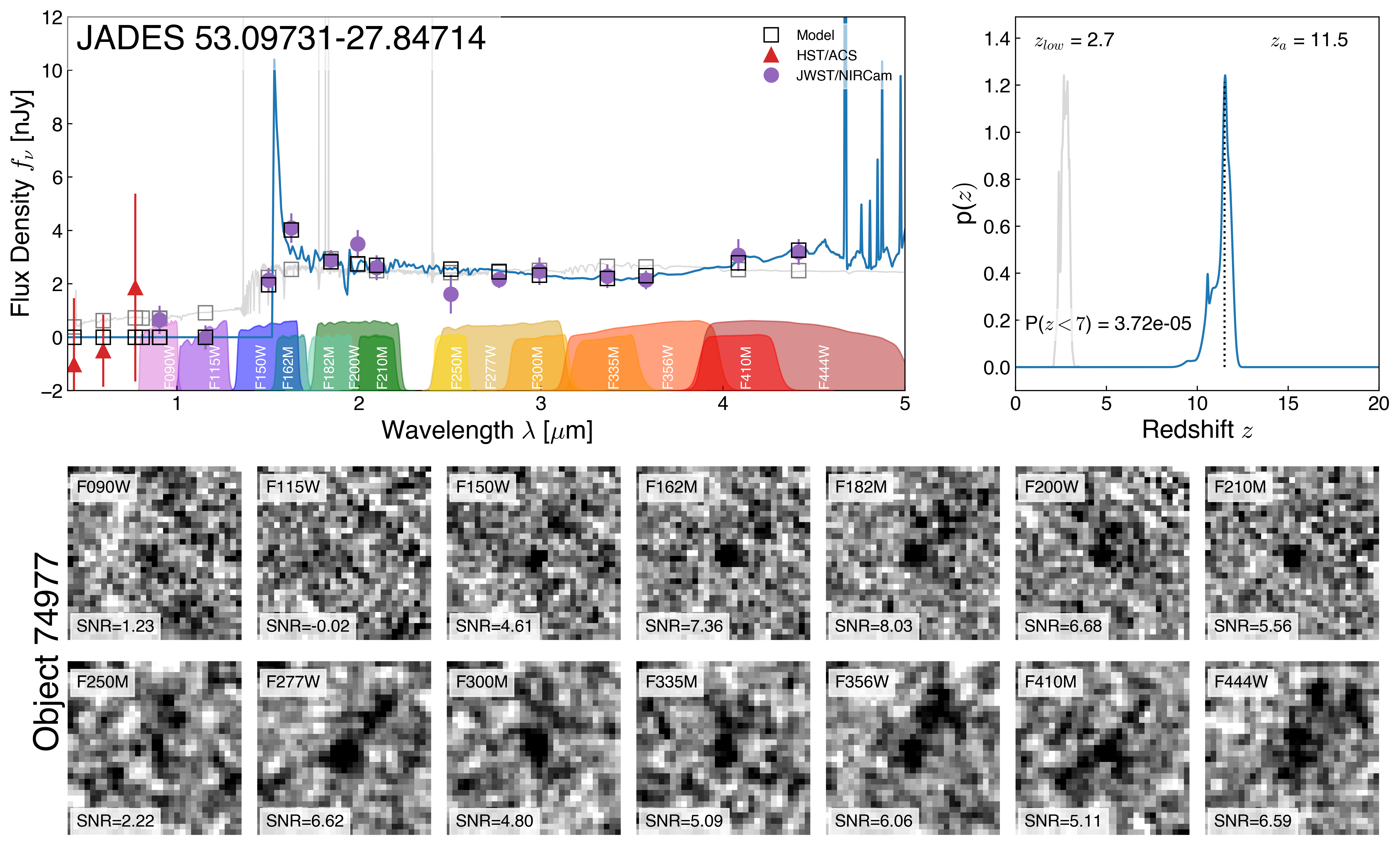
- 使用 EAZY 对光度红移进行估计,模板中包含强发射线和各种 UV 连续体。
- 应用严格的高红移选择标准,在考虑非探测的情况下识别稳健的 z>11 候选体。
- 对星系群体进行前向建模,以推断演化的光度函数,并对光度红移不确定性进行边际化处理。
- 用 Forcepho 建模表面光度轮廓以提取结构参数(如半光半径)。
- 通过零点校验、PSF 建模以及与独立的 HST 数据简化结果的交叉检查来验证光度测量。
实验结果
研究问题
- RQ1在 JOF 的最深 JWST/NIRCam 数据下,z>12 的星系 abundances 与性质如何?
- RQ2从 z~12 到更高 redshift(z~14–20)UV 光度函数如何演化?
- RQ3在最早时期对应的 UV 光度密度和隐含的宇宙星形成率密度是多少?
- RQ4观测到的丰度是否与暗物质晗质量函数演化和星系形成模型的预测一致?
主要发现
- 在 JOF 主要样本中,通过质量筛选后识别出 z=11.5–15 的八个星系候选体。
- 测得紧致的半光半径 R1/2 ~ 50–200 pc,恒星质量 M⋆ ~ 10^7–10^8 Msun,恒星形成率 ~0.1–1 Msun yr^−1。
- 在 15<z<20 的区间未发现候选体,给出此红移范围内的上限。
- 前向建模表明 z=12 的 UV 光度函数与先前结果高度一致,且从 z=12 到 z=14 的 UV 光度密度下降约为 2.5 倍。
- 推断的光度函数归一化随红移演化,揭示早期星系群体的增长及其与暗物质晃质量函数的联系。
- 场区考虑:质量筛选后的有效 survey 面积约为 7.06 平方角分,较低 redshift 的辅助/贡献样本亦存在。
阅读本论文
在 Nubint 阅读器中打开原文,边读边就任意段落提问。
在 Nubint 中阅读本论文本解读由 AI 根据论文原文生成,引用前请核对原文。