
[论文解读] Edge Directionality Improves Learning on Heterophilic Graphs
Dir-GNN 将任意 MPNN 扩展到有向图,通过将入边和出边聚合分开,在异质性图上提升性能,同时在同质性图上保持结果。它达到与 Directed Weisfeiler-Lehman 表达能力等同,并在若干有向异质性基准测试上达到最新水平。
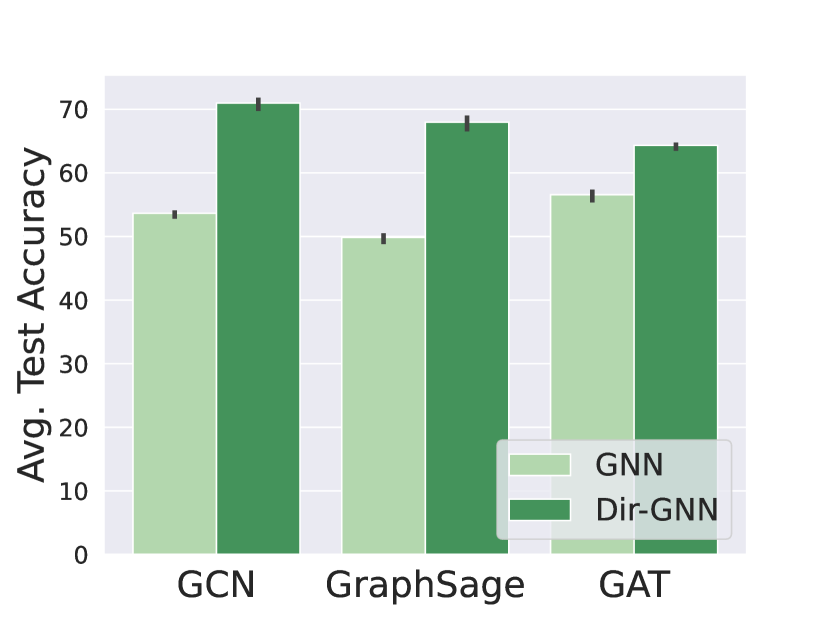
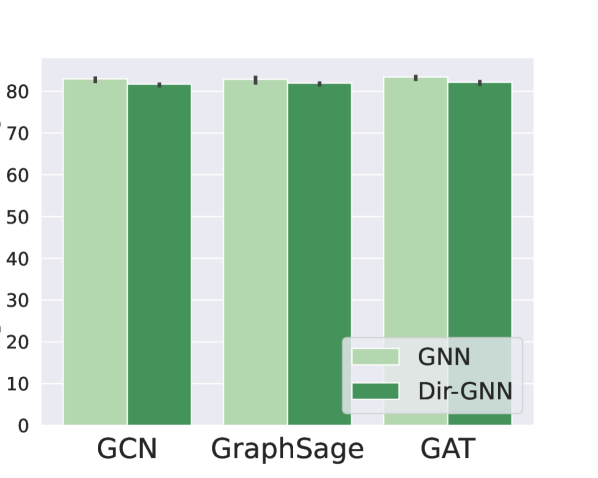
Graph Neural Networks (GNNs) have become the de-facto standard tool for modeling relational data. However, while many real-world graphs are directed, the majority of today's GNN models discard this information altogether by simply making the graph undirected. The reasons for this are historical: 1) many early variants of spectral GNNs explicitly required undirected graphs, and 2) the first benchmarks on homophilic graphs did not find significant gain from using direction. In this paper, we show that in heterophilic settings, treating the graph as directed increases the effective homophily of the graph, suggesting a potential gain from the correct use of directionality information. To this end, we introduce Directed Graph Neural Network (Dir-GNN), a novel general framework for deep learning on directed graphs. Dir-GNN can be used to extend any Message Passing Neural Network (MPNN) to account for edge directionality information by performing separate aggregations of the incoming and outgoing edges. We prove that Dir-GNN matches the expressivity of the Directed Weisfeiler-Lehman test, exceeding that of conventional MPNNs. In extensive experiments, we validate that while our framework leaves performance unchanged on homophilic datasets, it leads to large gains over base models such as GCN, GAT and GraphSage on heterophilic benchmarks, outperforming much more complex methods and achieving new state-of-the-art results.
研究动机与目标
- 动机:在图中利用边的方向性,特别是在异质性设置中的重要性。
- 介绍 Dir-GNN 作为一个通用框架,通过双向入聚合和出聚合,将任意 MPNN 扩展到有向图。
- 在理论上分析 Dir-GNN 的表达能力并与有向 WL 测试进行比较。
- 在异质性和同质性数据集上进行实证验证,展示在异质性基准上的改进以及在同质性基准上的稳定性。
提出的方法
- 通过对入邻居和出邻居执行分离聚合(参数可能独立)来将 MPNN 扩展到有向图。
- 使用两个消息传递矩阵 S_→ 和 S_←,归一化为 S_→ = D_→^{-1/2} A D_←^{-1/2},S_← = S_→^T。
- 引入一个可学习的 α,用以加权两个方向的贡献。
- 在单射性条件下证明 Dir-GNN 与有向 WL 测试同等表达能力,并且严格大于 MPNN-U 或 MPNN-D。
- 证明 Dir-GCN、Dir-SAGE 和 Dir-GAT 在每层计算复杂度保持相似的同时,由于分离的方向权重,参数量增加。
实验结果
研究问题
- RQ1边的方向性是否提高了图的有效同质性,特别是在异质性设置中?
- RQ2一个通用的 Dir-GNN 框架是否可以将任意 MPNN 扩展到有向图并提升性能?
- RQ3Dir-GNN 的表达能力是否与有向 Weisfeiler-Lehman 测试相当,并且是否比传统的 MPNN 更强?
- RQ4Dir-GNN 的扩展是否在异质性基准上提升准确性,同时不损害同质性基准?
主要发现
- 使用有向图在异质性图中增加了有效同质性,对同质性图几乎无影响。
- Dir-GNN 通过入聚合和出聚合的双向扩展,将实践中聚合朝向更同质化。
- Dir-GNN 在五个有向异质基准测试(Chameleon、Squirrel、Arxiv-Year、Snap-Patents、Roman-Empire)上达到最先进结果。
- Dir-GNN 在有向异质数据集上优于更复杂的异质性特定方法,并在同质数据集上保持性能。
- 该框架在理论上与有向 Weisfeiler-Lehman 测试同等表达能力,且严格优于标准 MPNNs。
阅读本论文
在 Nubint 阅读器中打开原文,边读边就任意段落提问。
在 Nubint 中阅读本论文本解读由 AI 根据论文原文生成,引用前请核对原文。