
[论文解读] Effect of the degree of an initial mutant in Moran processes in structured populations
本研究通过使用Erdős-Rényi和Barabási-Albert随机图,探究了初始突变体度数对结构化种群中固定概率以及灭绝/固定时间的影响。通过随机模拟和平均场近似方法,发现高阶初始突变体的固定概率较低且灭绝时间更短,而固定时间不受初始度数影响——凸显了初始位置在复杂网络进化动力学中的关键作用。
We study the effect of the mutant's degree on the fixation probability, extinction and fixation times, in the Moran process on Erdös-Rényi and Barabási-Albert graphs. We performed stochastic simulations and use mean-field type approximations to obtain analytical formulas. We showed that the initial placement of a mutant has a significant impact on the fixation probability and extinction time, while it has no effect on the fixation time. In both types of graphs, an increase in the degree of a initial mutant results in a decreased fixation probability and a shorter time to extinction.
研究动机与目标
- 探究初始突变体度数对结构化种群中固定概率及固定/灭绝时间的影响。
- 分析网络结构(特别是Erdős-Rényi和Barabási-Albert图)对进化动力学的影响。
- 评估突变体的初始位置,尤其是其度数,是否会影响长期进化结果。
- 针对复杂网络拓扑结构,利用平均场和对偶近似方法开发解析近似。
- 在相同条件下,比较无标度(Barabási-Albert)与随机(Erdős-Rényi)网络中固定与灭绝动力学的差异。
提出的方法
- 将Moran过程建模为固定种群规模和突变体适应度r > 1的随机图上的连续时间马尔可夫链。
- 在Erdős-Rényi和Barabási-Albert网络上执行随机模拟,以估计固定与灭绝概率及时间。
- 利用平均场和对偶近似技术推导出具有i个和j个突变体的状态之间转移概率的解析近似。
- 使用转移率矩阵,通过首次通过时间的递归求和计算期望固定与灭绝时间。
- 将固定时间T^f_i和灭绝时间T^e_i的解析表达式表述为从状态1到i及从状态1到N的首次通过时间之差。
- 将解析结果与模拟数据进行验证,尤其评估在不同r值和网络类型下的准确性。
实验结果
研究问题
- RQ1初始突变体的度数在结构化种群中如何影响固定概率?
- RQ2在复杂网络的Moran过程中,初始突变体的度数是否会影响期望固定时间?
- RQ3在结构化种群中,初始突变体的度数如何影响期望灭绝时间?
- RQ4网络拓扑结构(Erdős-Rényi与Barabási-Albert)以及枢纽节点的存在在多大程度上调节了初始突变体度数的影响?
- RQ5平均场和对偶近似方法在预测复杂网络结构的固定与灭绝时间方面准确性如何?
主要发现
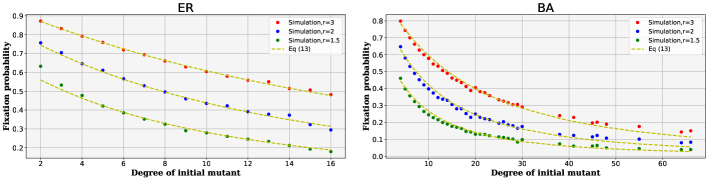
- 初始突变体度数的增加在Erdős-Rényi和Barabási-Albert网络中均显著降低固定概率。
- 高阶初始突变体经历显著更短的灭绝时间,表明其在种群中被更快地消除。
- 固定时间与初始突变体的度数无关,因为该过程取决于整个种群动力学而非起始节点。
- 在相同大小和平均度数的网络中,当比较相同初始度数的突变体时,Erdős-Rényi图的固定概率高于Barabási-Albert图。
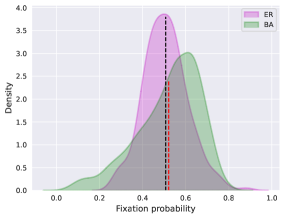
- 尽管高阶突变体的个体固定概率较低,但由于枢纽节点的存在,Barabási-Albert网络中所有初始位置的平均固定概率更高。
- 随着突变体适应度r的增加,解析近似变得更加准确,因为突变体数量在初始增长后减少的可能性降低。
阅读本论文
在 Nubint 阅读器中打开原文,边读边就任意段落提问。
在 Nubint 中阅读本论文本解读由 AI 根据论文原文生成,引用前请核对原文。