
[论文解读] Efficient Intrusion Detection: Combining $χ^2$ Feature Selection with CNN-BiLSTM on the UNSW-NB15 Dataset
本文提出一种轻量级CNN-BiLSTM混合模型,结合χ²特征选择,用于在资源受限的物联网设备上实现高效的入侵检测,基于UNSW-NB15数据集。通过减少输入特征并优化模型架构,该方法在二分类任务中实现97.90%的准确率,在多分类任务中实现97.09%的准确率,推理时间分别为1.1秒和2.10秒,显著优于先前方法,效率大幅提升。
Intrusion Detection Systems (IDSs) have played a significant role in the detection and prevention of cyber-attacks in traditional computing systems. It is not surprising that this technology is now being applied to secure Internet of Things (IoT) networks against cyber threats. However, the limited computational resources available on IoT devices pose a challenge for deploying conventional computing-based IDSs. IDSs designed for IoT environments must demonstrate high classification performance, and utilize low-complexity models. Developing intrusion detection models in the field of IoT has seen significant advancements. However, achieving a balance between high classification performance and reduced complexity remains a challenging endeavor. In this research, we present an effective IDS model that addresses this issue by combining a lightweight Convolutional Neural Network (CNN) with bidirectional Long Short-Term Memory (BiLSTM). Additionally, we employ feature selection techniques to minimize the number of features inputted into the model, thereby reducing its complexity. This approach renders the proposed model highly suitable for resource-constrained IoT devices, ensuring it meets their computation capability requirements. Creating a model that meets the demands of IoT devices and attains enhanced precision is a challenging task. However, our suggested model outperforms previous works in the literature by attaining a remarkable accuracy rate of 97.90% within a prediction time of 1.1 seconds for binary classification. Furthermore, it achieves an accuracy rate of 97.09% within a prediction time of 2.10 seconds for multiclassification.
研究动机与目标
- 为解决在处理能力、内存和能源受限的物联网设备上部署高性能入侵检测系统(IDS)的挑战。
- 通过特征选择和架构优化,降低模型复杂度和推理时间,同时保持高分类准确率。
- 通过使用加权损失函数,提升在UNSW-NB15等类别不平衡数据集上的多分类性能,优先检测少数攻击类别。
- 证明结合χ²特征选择与轻量级CNN-BiLSTM架构,可实现高效、准确且可部署的入侵检测系统,适用于真实物联网环境。
提出的方法
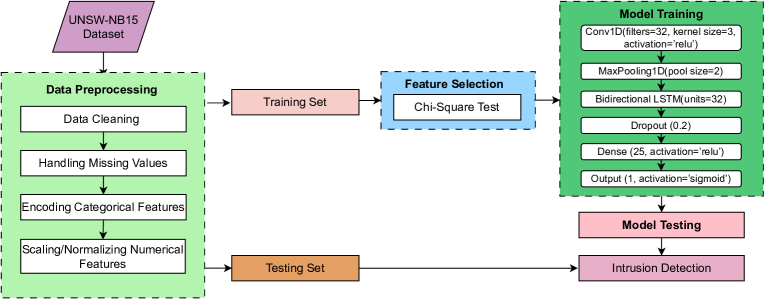
- 设计了一种轻量级CNN-BiLSTM混合架构,通过减少层数和参数量,最大限度降低物联网部署的计算开销。
- 应用χ²特征选择以减少输入特征数量,降低模型复杂度和推理时间。
- 在训练过程中使用加权损失函数,以缓解UNSW-NB15数据集中类别不平衡的问题,提升对罕见攻击类型(如“Analysis”和“Shellcode”)的检测能力。
- 在UNSW-NB15数据集上对模型进行二分类和多分类任务的训练与评估,采用准确率、精确率、召回率和F1-score等标准指标。
- 测量推理时间以评估实时适用性,并与使用完整特征集的先前工作进行对比。
实验结果
研究问题
- RQ1结合χ²特征选择的轻量级CNN-BiLSTM架构是否能在保持适用于资源受限物联网设备部署的同时,实现高入侵检测准确率?
- RQ2特征选择在UNSW-NB15数据集上对基于深度学习的IDS推理时间和整体效率有何影响?
- RQ3在多分类设置中,加权损失函数在多大程度上提升了对少数攻击类别的检测性能?
- RQ4与使用完整特征集的现有CNN-BiLSTM方法相比,所提模型在准确率和推理速度方面表现如何?
主要发现
- 所提模型在二分类任务中实现97.90%的准确率,预测时间仅1.1秒,展现出高效率和高性能。
- 在多分类任务中,模型达到97.09%的准确率、97.09%的精确率、97.62%的召回率和97.27%的F1-score,优于UNSW-NB15数据集上的现有模型。
- 使用χ²特征选择后,推理时间从基线的3.20秒降低至2.10秒,显著提升了实时适用性。
- 模型成功识别出9种蠕虫中的8种,以及76种沙盒代码攻击中的75种,仅出现1例假阴性,表明由于加权损失函数的引入,对少数类别表现出色。
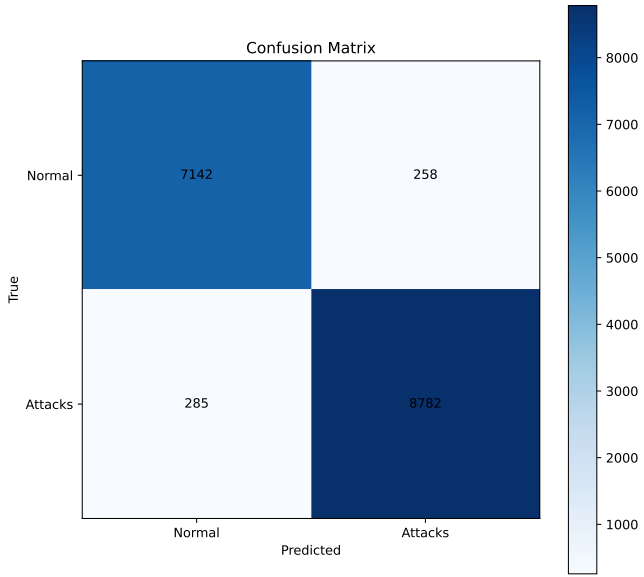
- 混淆矩阵显示对角线强度高,尤其是“Normal”类别,表明整体分类具有高度可靠性与模型鲁棒性。
阅读本论文
在 Nubint 阅读器中打开原文,边读边就任意段落提问。
在 Nubint 中阅读本论文本解读由 AI 根据论文原文生成,引用前请核对原文。