
[论文解读] EmbodiedGPT: Vision-Language Pre-Training via Embodied Chain of Thought
EmbodiedGPT 是一个端到端的10B参数多模态基础模型,用于具身AI,它使用 EgoCOT 来训练链式思维规划,并从高层规划到低层控制闭环,在具身任务中达到最先进或可比的结果。
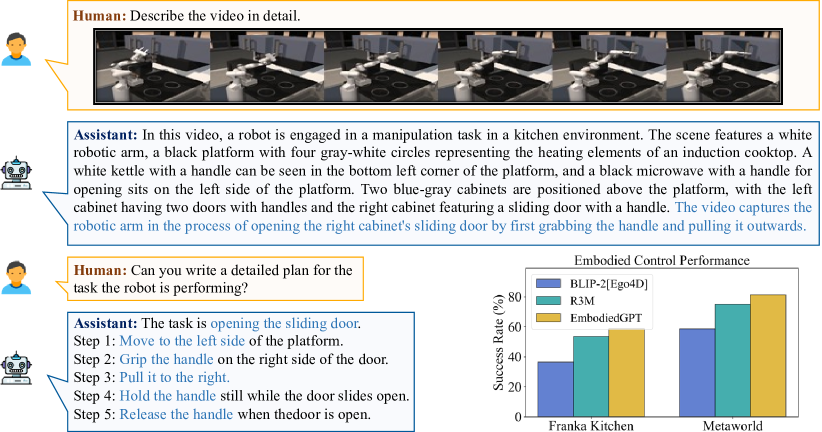
Embodied AI is a crucial frontier in robotics, capable of planning and executing action sequences for robots to accomplish long-horizon tasks in physical environments. In this work, we introduce EmbodiedGPT, an end-to-end multi-modal foundation model for embodied AI, empowering embodied agents with multi-modal understanding and execution capabilities. To achieve this, we have made the following efforts: (i) We craft a large-scale embodied planning dataset, termed EgoCOT. The dataset consists of carefully selected videos from the Ego4D dataset, along with corresponding high-quality language instructions. Specifically, we generate a sequence of sub-goals with the "Chain of Thoughts" mode for effective embodied planning. (ii) We introduce an efficient training approach to EmbodiedGPT for high-quality plan generation, by adapting a 7B large language model (LLM) to the EgoCOT dataset via prefix tuning. (iii) We introduce a paradigm for extracting task-related features from LLM-generated planning queries to form a closed loop between high-level planning and low-level control. Extensive experiments show the effectiveness of EmbodiedGPT on embodied tasks, including embodied planning, embodied control, visual captioning, and visual question answering. Notably, EmbodiedGPT significantly enhances the success rate of the embodied control task by extracting more effective features. It has achieved a remarkable 1.6 times increase in success rate on the Franka Kitchen benchmark and a 1.3 times increase on the Meta-World benchmark, compared to the BLIP-2 baseline fine-tuned with the Ego4D dataset.
研究动机与目标
- 激发并使具身 AI 代理能够使用多模态输入逐步规划。
- 创建高质量、可执行的规划数据(EgoCOT),与第一视角视频和语言保持对齐。
- 通过前缀微调开发一种高效的训练方法,将基础 LLM 适配为具身规划。
- 构建一个闭环架构,将高层规划与低层控制连接起来,以提升任务执行。
提出的方法
- 通过获取 Ego4D 视频、生成具有子目标的链式思维计划,并通过语义筛选和人工验证来构建 EgoCOT。
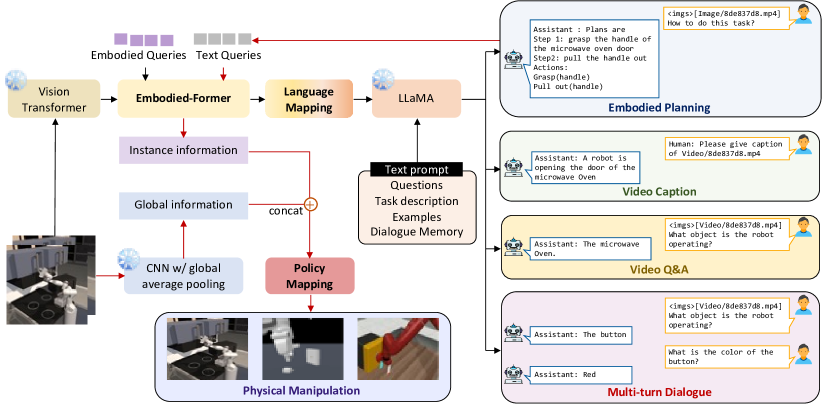
- 采用前缀微调使冻结的 LLaMA-7B 模型能够从 EgoCOT 提示中执行规划。
- 设计 Embodied-former,将视觉和规划查询映射到语言模型输入,并提取用于控制的任务相关特征。
- 使策略网络能够从实例级特征和全局上下文生成低级动作。
- 在进行基于 EgoCOT 的视频对齐训练之前,先用图文数据对视觉和语言组件进行预训练。
- 通过用第一视角 VQA 数据扩展 Ego4D,丰富多模态训练,创建 EgoVQA。
实验结果
研究问题
- RQ1如何有效生成并利用链式思维规划来完成具身任务?
- RQ2是否一个从规划到控制闭环的统一视觉-语言模型能够提升具身规划和操控性能?
- RQ3基于 EgoCOT 的训练对基准任务中的低级控制成功率有何影响?
- RQ4在具身描述、VQA、规划和控制方面,EmbodiedGPT 与现有基线相比如何?
主要发现
- EmbodiedGPT 在具身设置中实现了比更大模型或基线模型更优秀或相当的视觉描述和 VQA 质量。
- 基于 EgoCOT 的训练和闭环设计显著提升了 Franka Kitchen 和 Meta-World 基准测试中的具身控制成功率。
- EmbodiedGPT 在 Franka Kitchen 上超越在 Ego4D 上微调的 BLIP-2 和 R3M(差异为 22.1% 和 5.5%),以及在 Meta-World 上(差异为 22.5% 和 4.2%)。
- 消融研究表明,链式思维训练和闭环的规划到控制对性能提升有显著贡献。
阅读本论文
在 Nubint 阅读器中打开原文,边读边就任意段落提问。
在 Nubint 中阅读本论文本解读由 AI 根据论文原文生成,引用前请核对原文。