
[论文解读] Emergent World Models and Latent Variable Estimation in Chess-Playing Language Models
本论文表明,仅通过下一词预测训练的棋类语言模型,会涌现出世界模型,包括棋盘状态的内部表征和潜在玩家技能的估计。通过线性探测和激活干预,作者通过编辑模型的内部状态并观察其对棋力表现的影响,验证了这些表征,实现最高达2.6倍的胜率提升,方法为技能向量干预。
Language models have shown unprecedented capabilities, sparking debate over the source of their performance. Is it merely the outcome of learning syntactic patterns and surface level statistics, or do they extract semantics and a world model from the text? Prior work by Li et al. investigated this by training a GPT model on synthetic, randomly generated Othello games and found that the model learned an internal representation of the board state. We extend this work into the more complex domain of chess, training on real games and investigating our model's internal representations using linear probes and contrastive activations. The model is given no a priori knowledge of the game and is solely trained on next character prediction, yet we find evidence of internal representations of board state. We validate these internal representations by using them to make interventions on the model's activations and edit its internal board state. Unlike Li et al's prior synthetic dataset approach, our analysis finds that the model also learns to estimate latent variables like player skill to better predict the next character. We derive a player skill vector and add it to the model, improving the model's win rate by up to 2.6 times.
研究动机与目标
- 探究仅在真实棋局转录文本上训练的语言模型,是否能在未提供游戏规则或显式监督的情况下,发展出内部世界模型。
- 确定此类模型是否能通过估计潜在变量(如玩家技能)来提升下一词预测性能。
- 通过在模型激活上实施因果干预(如修改棋盘状态或技能水平),验证其内部表征。
- 在类似国际象棋这类真实世界规则性领域中,比较探测与干预技术的有效性。
提出的方法
- 在Lichess数据库中的1600万局真实棋局上,训练一个8层和一个16层的GPT模型,仅使用下一词预测目标。
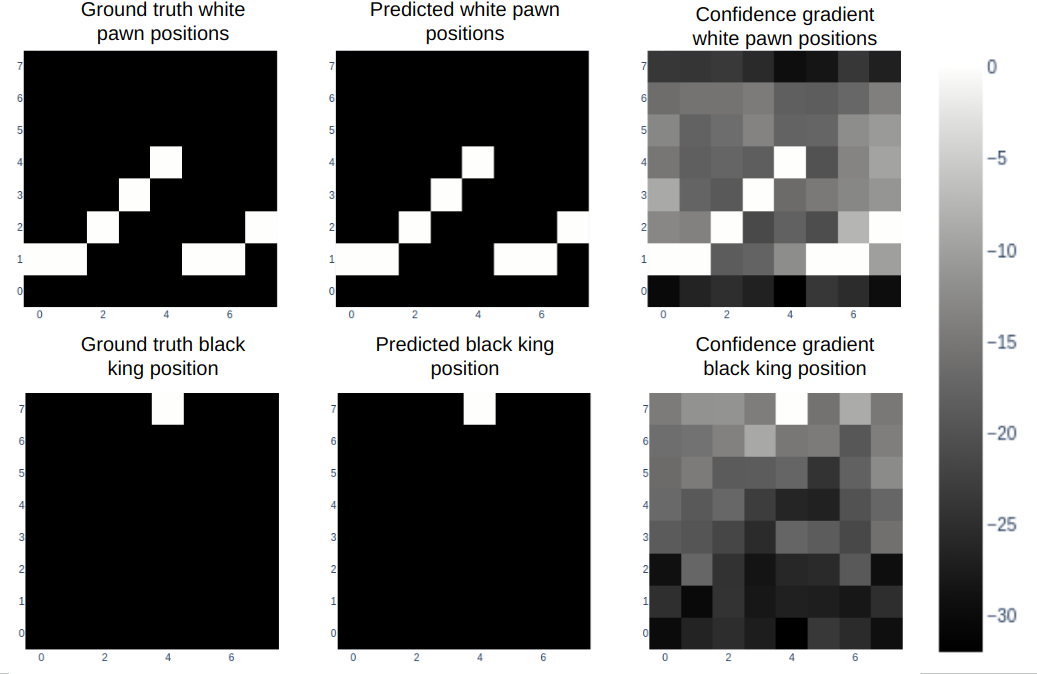
- 使用线性探测从模型激活中提取棋盘状态和玩家技能的内部表征。
- 通过修改模型隐藏状态实施因果干预:注入或减去技能向量以改变性能表现。
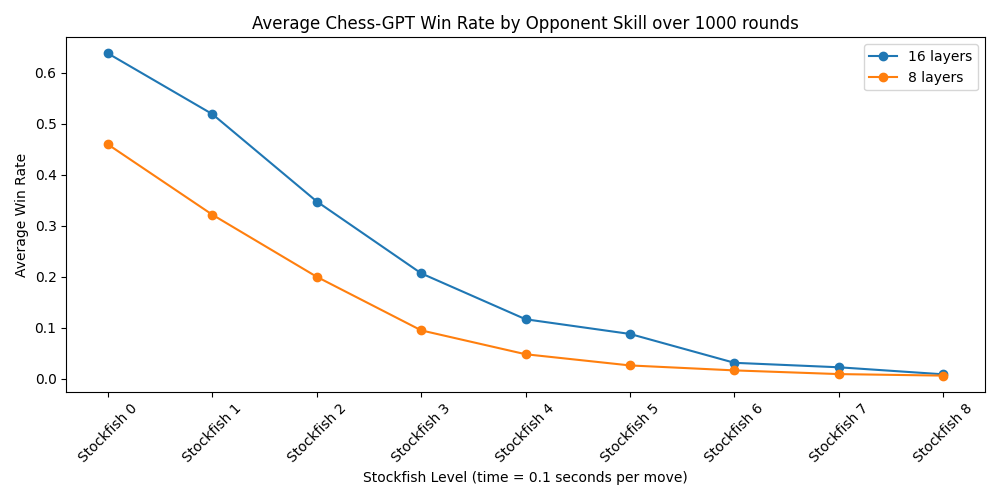
- 通过在标准棋局和随机初始化棋局下,与Stockfish 16对弈,测量胜率来验证干预效果。
- 使用基于梯度的探测方法识别并操纵潜在变量(如Elo等级分),实现对模型行为的可控调整。
- 使用胜率和走法合法性(干预后98%以上的走法合法)评估模型性能。
实验结果
研究问题
- RQ1在未预先知晓游戏规则的情况下,仅在真实棋局转录文本上训练的语言模型,能否发展出对棋盘状态的内部表征?
- RQ2模型是否能通过学习潜在变量(如玩家技能)来提升下一词预测性能?
- RQ3线性探测是否能成功恢复并操控模型的内部棋盘状态与技能表征?
- RQ4对模型激活的因果干预在多大程度上能提升或降低其国际象棋对弈表现?
- RQ5在技能向量干预后,当模型从标准开局位置与随机移动位置启动时,其表现有何差异?
主要发现
- 通过线性探测验证,模型学习到了稳健的棋盘状态内部表征,能以高置信度重建棋子位置。
- 模型通过潜在向量估计玩家技能,该向量可被探测并操控以改变性能表现。
- 在随机初始化棋局中,向16层模型注入正向技能向量,使其对Stockfish 16的胜率最高提升2.6倍。
- 在相同条件下,8层模型的胜率提升2倍,表明技能向量干预具有可扩展的影响。
- 干预后走法合法性得到保持,超过98%的走法仍合法,证实行为的可控性。
- 模型将99.4%的随机初始化棋局分类为低技能,支持其能从上下文推断玩家实力的假设。
阅读本论文
在 Nubint 阅读器中打开原文,边读边就任意段落提问。
在 Nubint 中阅读本论文本解读由 AI 根据论文原文生成,引用前请核对原文。