
[论文解读] EMO: Emote Portrait Alive -- Generating Expressive Portrait Videos with Audio2Video Diffusion Model under Weak Conditions
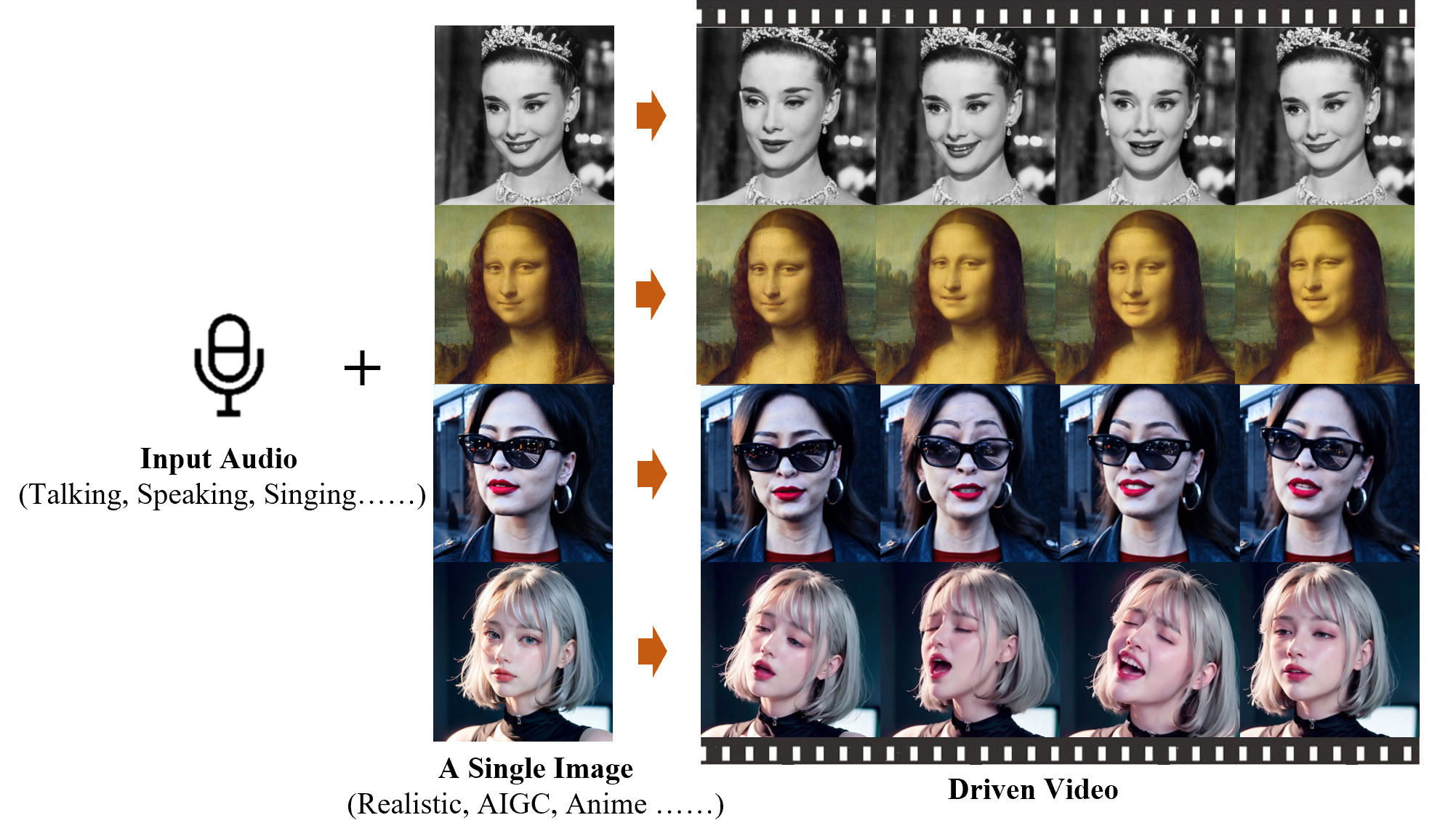
EMO 提出了一种基于扩散模型的音频到视频生成框架,用于生成富有表现力的说话头像视频,直接从音频映射到面部动作,无需中间的3D模型或关键点。通过集成速度控制器、面部区域控制器和帧编码(FrameEncoding)以保持身份一致性,该方法在真实感、身份保留和表现力方面达到最先进水平,尤其在演唱和动态头部运动方面表现优异,在FID、FVD和E-FID指标上均优于SOTA方法。
In this work, we tackle the challenge of enhancing the realism and expressiveness in talking head video generation by focusing on the dynamic and nuanced relationship between audio cues and facial movements. We identify the limitations of traditional techniques that often fail to capture the full spectrum of human expressions and the uniqueness of individual facial styles. To address these issues, we propose EMO, a novel framework that utilizes a direct audio-to-video synthesis approach, bypassing the need for intermediate 3D models or facial landmarks. Our method ensures seamless frame transitions and consistent identity preservation throughout the video, resulting in highly expressive and lifelike animations. Experimental results demonsrate that EMO is able to produce not only convincing speaking videos but also singing videos in various styles, significantly outperforming existing state-of-the-art methodologies in terms of expressiveness and realism.
研究动机与目标
- 为解决现有说话头像模型依赖3D模型或面部关键点所带来的表现多样性受限和自然运动受限的问题。
- 实现在无需中间表示形式的情况下,直接从音频和单张参考图像生成高保真、富有表现力的视频。
- 提升视频稳定性,减少在音频驱动生成过程中出现的抖动或面部失真等伪影。
- 在多种肖像风格(如写实、动漫、3D)和长时长音频输入下,保持身份与风格的一致性。
- 在表现力、真实感和同步性方面,相比最先进方法实现更优性能。
提出的方法
- 采用直接的音频到视频扩散模型,从音频和单张参考图像生成视频帧,跳过3D或基于关键点的中间表示形式。
- 引入速度控制器和面部区域控制器作为稳定超参数,以在扩散采样过程中抑制帧级抖动和面部失真。
- 设计了FrameEncoding——一种受ReferenceNet启发的参考编码模块,用于在整个视频序列中保持身份与风格一致性。
- 在包含超过250小时多样化音视频内容(如演讲、电影、多语言演唱)的大规模数据集上进行训练。
- 使用运动帧将视频生成扩展至初始序列之外,实现与输入音频长度对齐的长时长输出。
- 该框架支持生成具有丰富面部表情和多样头部姿态的说话和演唱视频。
实验结果
研究问题
- RQ1基于扩散模型的音频到视频生成方法是否能够不依赖3D模型或面部关键点监督,生成富有表现力且逼真的说话头像视频?
- RQ2如何在扩散采样过程中稳定音频到视频生成,以防止面部抖动和失真?
- RQ3在仅使用单张参考图像的情况下,身份和肖像风格在多种视觉风格(如写实、动漫、3D)之间能在多大程度上保持一致?
- RQ4该模型能否在长时长音频(如演唱)上实现泛化,同时保持同步性和表现力动态?
- RQ5与现有SOTA方法相比,该方法在真实感、身份保真度和表现力方面的定量与定性表现如何?
主要发现
- EMO 在FID指标上达到新的SOTA成绩8.76,显著优于Wav2Lip(9.38)、SadTalker(10.31)和DreamTalk(58.80)。
- 模型在FVD指标上取得最低分数67.66,表明其在视频质量和时间连贯性方面优于基线方法。
- EMO 在E-FID指标上达到最佳成绩0.116,证明其在面部动作表现力方面(尤其是微表情和动态变化)具有显著优势。
- 定性结果表明,EMO 生成的头部运动更自然,面部表情更丰富,优于Wav2Lip、SadTalker和DreamTalk,尤其在演唱场景中表现突出。
- 该方法成功生成长达1分钟的长时长视频,保持身份一致性且口型同步,即使在具有音调变化的音频(如演唱)下也表现稳定。
- 尽管在SyncNet指标上并非领先,但EMO在表现力和真实感方面表现出色,经用户研究和定性评估验证。

阅读本论文
在 Nubint 阅读器中打开原文,边读边就任意段落提问。
在 Nubint 中阅读本论文本解读由 AI 根据论文原文生成,引用前请核对原文。