
[论文解读] Empirical evidence of Large Language Model's influence on human spoken communication
本研究分析来自 280,000 条 YouTube 字幕,覆盖 20k+ 学术频道,并发现后 ChatGPT 显著增加使用与 ChatGPT 编辑文本相关的词汇,表明人类在口语交流中越来越模仿 LLM 语言。
From the invention of writing and the printing press, to television and social media, human history is punctuated by major innovations in communication technology, which fundamentally altered how ideas spread and reshaped our culture. Recent chatbots powered by generative artificial intelligence constitute a novel medium that encodes cultural patterns in their neural representations and disseminates them in conversations with hundreds of millions of people. Understanding whether these patterns transmit into human language, and ultimately shape human culture, is a fundamental question. While fully quantifying the causal impact of a chatbot like ChatGPT on human culture is very challenging, lexicographic shift in human spoken communication may offer an early indicator of such broad phenomenon. Here, we apply econometric causal inference techniques to 740,249 hours of human discourse from 360,445 YouTube academic talks and 771,591 conversational podcast episodes across multiple disciplines. We detect a measurable and abrupt increase in the use of words preferentially generated by ChatGPT, such as delve, comprehend, boast, swift, and meticulous, after its release. These findings suggest a scenario where machines, originally trained on human data and subsequently exhibiting their own cultural traits, can, in turn, measurably reshape human culture. This marks the beginning of a closed cultural feedback loop in which cultural traits circulate bidirectionally between humans and machines. Our results motivate further research into the evolution of human-machine culture, and raise concerns over the erosion of linguistic and cultural diversity, and the risks of scalable manipulation.
研究动机与目标
- 评估 AI 系统是否在写作以外影响人类口语语言。
- 在大规模学术视频集中量化 ChatGPT 发布后的词汇使用变化。
- 考察 GPT 独特性词汇与口语语言采用之间的关系。
提出的方法
- 构建来自学术机构的 360,445 条 YouTube 视频数据集,筛选到 279,480 条英语字幕。
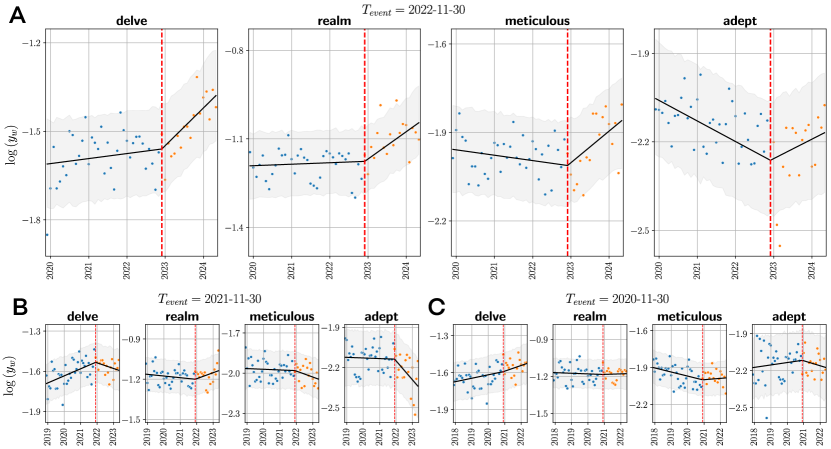
- 使用层级贝叶斯高斯回归建模每月词频趋势,评估自然与事件后变化。
- 使用 Liang 等人数据集识别 GPT 独特词,并计算 log-频率比 log(P_w,GPT / P_w,human)。
- 在 ChatGPT 发布后(T_event = 2022-11-30)对 18 个月内的趋势变化系数 beta_w,GPT 进行计算。
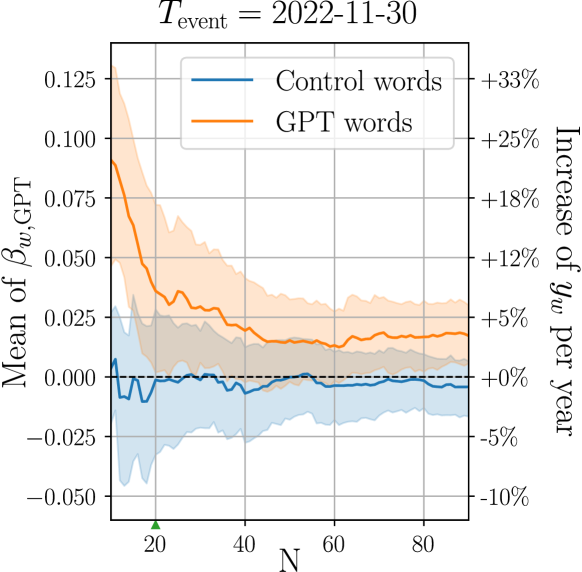
- 评估 GPT 词的独特性与口语采用之间的相关性,聚焦前 N 个 GPT 词(例如前 20)。
- 通过对 N 与变点的敏感性分析验证鲁棒性。
实验结果
研究问题
- RQ1人类在接触到像 ChatGPT 这样的语言模型后,是否会在口语中改变,而不仅仅是写作?
- RQ2在学术口语交流中,是否存在与 ChatGPT 编辑文本特征相关的词汇使用频率的可测量转变?
- RQ3在 ChatGPT 发布后,更具 ChatGPT 特征的词是否更可能在口语中被更快采用?
- RQ4GPT 词的独特性与采用之间的关联在不同词集与观测窗口下的表现有何差异?
主要发现
- 后 ChatGPT,某些 GPT 词在口语中显示出更快的采用(例如 beta_w,GPT 约为 0.11–0.12,95% HDI [0.04, 0.18], [0.02, 0.22])。
- GPT 词在 18 个月后相较于事件前基线,趋势大约提高了 35–51%。
- 存在 ChatGPT 独特词与口语采用之间的显著关联,当仅考虑前 20 个 GPT 词时最强相关性(r = 0.63, p < 0.01)。
- 对照词(底部 N)在事件后未显示显著的趋势变化,表明这些效应特异于 GPT 词。
- 观察到的趋势变化在发布时间后几个月才出现,需要 ChatGPT 之后的数据来检测效应。
阅读本论文
在 Nubint 阅读器中打开原文,边读边就任意段落提问。
在 Nubint 中阅读本论文本解读由 AI 根据论文原文生成,引用前请核对原文。