
[论文解读] Empowering Time Series Analysis with Large Language Models: A Survey
本综述系统性地回顾了大语言模型(LLMs)在时间序列分析中的应用,将方法分类为五种途径:直接查询、分词、提示设计、微调和模型集成。它强调了概念漂移和非平稳性等关键挑战,并指出了未来的研究方向,包括可解释性、多模态性、领域泛化性以及在关键任务应用中的安全性。
Recently, remarkable progress has been made over large language models (LLMs), demonstrating their unprecedented capability in varieties of natural language tasks. However, completely training a large general-purpose model from the scratch is challenging for time series analysis, due to the large volumes and varieties of time series data, as well as the non-stationarity that leads to concept drift impeding continuous model adaptation and re-training. Recent advances have shown that pre-trained LLMs can be exploited to capture complex dependencies in time series data and facilitate various applications. In this survey, we provide a systematic overview of existing methods that leverage LLMs for time series analysis. Specifically, we first state the challenges and motivations of applying language models in the context of time series as well as brief preliminaries of LLMs. Next, we summarize the general pipeline for LLM-based time series analysis, categorize existing methods into different groups (i.e., direct query, tokenization, prompt design, fine-tune, and model integration), and highlight the key ideas within each group. We also discuss the applications of LLMs for both general and spatial-temporal time series data, tailored to specific domains. Finally, we thoroughly discuss future research opportunities to empower time series analysis with LLMs.
研究动机与目标
- 为解决由于数据量大、多样性高以及非平稳性带来的从零开始训练通用时间序列模型的挑战。
- 探索尽管存在概念漂移和分布偏移,预训练的大语言模型如何被适应用于时间序列任务。
- 提供一个系统性的分类法,将基于大语言模型的时间序列分析方法划分为五类:直接查询、分词、提示设计、微调和模型集成。
- 考察大语言模型在医疗、金融、交通和环境科学等领域的特定应用场景。
- 识别并讨论在可解释性、多模态性、领域泛化性和时间序列大语言模型安全性方面的新兴研究机遇。
提出的方法
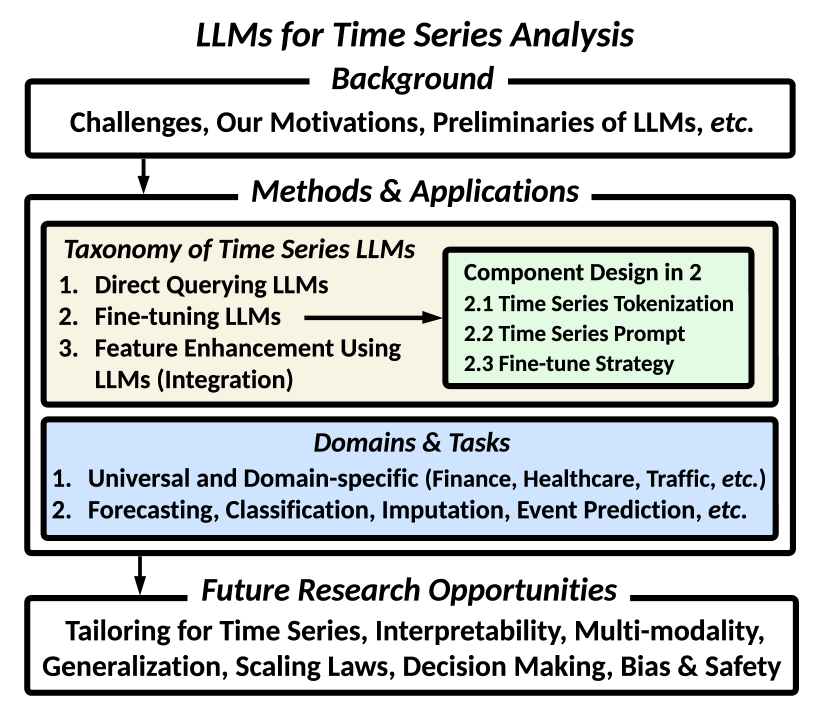
- 将基于大语言模型的时间序列方法划分为五种不同的方法论:直接查询、分词、提示设计、微调和模型集成。
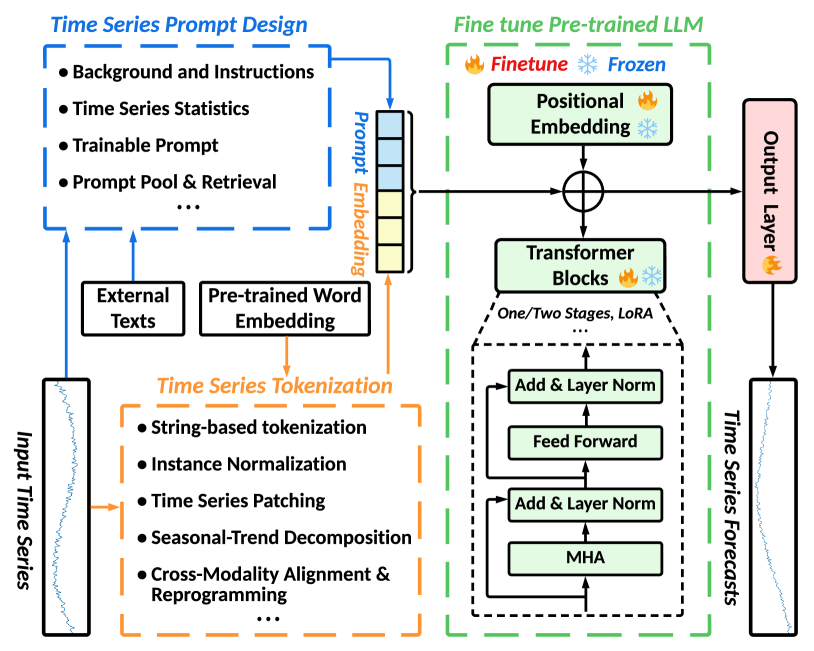
- 提出一个将大语言模型适配时间序列的框架,通过将序列数据视为分词序列,从而支持自然语言处理技术的应用。
- 回顾提示工程策略,包括 few-shot 和 zero-shot 提示,以在不进行微调的情况下引导大语言模型完成时间序列任务。
- 研究微调策略,以将大语言模型适配于特定的时间序列任务,如预测、异常检测和分类。
- 探索模型集成技术,将大语言模型与专用的时间序列模型结合,以提升性能和鲁棒性。
- 引入一个综合表格,总结21种代表性方法,包括其建模策略、任务类型和应用领域。
实验结果
研究问题
- RQ1尽管存在数据非平稳性和概念漂移的挑战,如何有效利用预训练的大语言模型进行时间序列分析?
- RQ2应用于时间序列的大语言模型的关键方法类别是什么?它们在设计和性能上如何不同?
- RQ3如何将大语言模型适配以处理金融、医疗和环境监测等不同领域中的多样化时间序列数据?
- RQ4在基于大语言模型的时间序列模型中,可解释性、多模态性和领域泛化性的关键开放挑战是什么?
- RQ5当大语言模型应用于时间序列数据时,缩放定律和代理式行为如何产生,这对未来开发有何影响?
主要发现
- 通过提示设计和微调等方法,大语言模型即使不从头开始训练,也能有效应用于时间序列任务。
- 在多个频率(如每日、每小时、每秒)上编码时间滞后关系的分词策略,可提升模型对时间序列结构的理解。
- 基于 Wang 等人(2022)的提示学习架构,可用于自动学习特定任务的提示,从而提升性能。
- 可解释性仍是主要挑战,但基于原型的方法和基于梯度的方法,以及知识蒸馏,为解释大语言模型输出提供了有前景的路径。
- 多模态融合——将时间序列与文本、表格和图像数据结合——是关键前沿,尤其在医疗领域尤为重要。
- 领域泛化能力和对分布偏移的鲁棒性至关重要,元学习和不变表示学习正成为关键策略。
阅读本论文
在 Nubint 阅读器中打开原文,边读边就任意段落提问。
在 Nubint 中阅读本论文本解读由 AI 根据论文原文生成,引用前请核对原文。