
[论文解读] Enhanced Controllability of Diffusion Models via Feature Disentanglement and Realism-Enhanced Sampling Methods
该论文通过基于解耦的内容与风格潜在码进行条件控制,增强了扩散模型的可控性,采用广义可组合扩散框架(GCDM),支持依赖性条件输入和时间步依赖的权重调度。该方法实现了比以往方法更精细、更真实的图像转换,具有更好的解耦性和更平滑的插值效果。
As Diffusion Models have shown promising performance, a lot of efforts have been made to improve the controllability of Diffusion Models. However, how to train Diffusion Models to have the disentangled latent spaces and how to naturally incorporate the disentangled conditions during the sampling process have been underexplored. In this paper, we present a training framework for feature disentanglement of Diffusion Models (FDiff). We further propose two sampling methods that can boost the realism of our Diffusion Models and also enhance the controllability. Concisely, we train Diffusion Models conditioned on two latent features, a spatial content mask, and a flattened style embedding. We rely on the inductive bias of the denoising process of Diffusion Models to encode pose/layout information in the content feature and semantic/style information in the style feature. Regarding the sampling methods, we first generalize Composable Diffusion Models (GCDM) by breaking the conditional independence assumption to allow for some dependence between conditional inputs, which is shown to be effective in realistic generation in our experiments. Second, we propose timestep-dependent weight scheduling for content and style features to further improve the performance. We also observe better controllability of our proposed methods compared to existing methods in image manipulation and image translation.
研究动机与目标
- 提升扩散模型的可控性,超越无条件或单条件生成的范畴。
- 解决现有方法中假设条件输入相互独立或缺乏细粒度控制的局限性。
- 通过学习独立但可组合的内容与风格潜在空间,实现实质性、解耦的图像翻译。
- 开发推理时技术,实现在采样过程中对内容、风格及其联合分布的动态控制。
- 通过在时间步上调度条件引导,利用扩散模型的归纳偏置,提升特征组合效果。
提出的方法
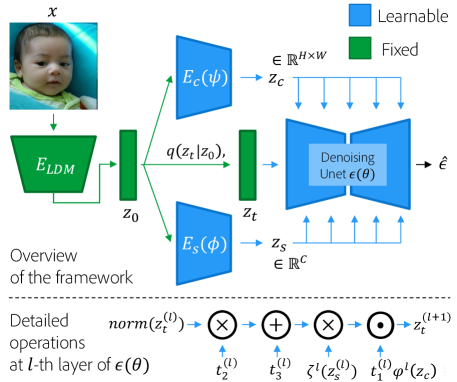
- 训练一个基于两个独立潜在码的潜在扩散模型:空间布局掩码(内容)和展平的语义嵌入(风格),通过专用编码器学习。
- 以不同方式将内容和风格码注入UNet架构,以保留结构与外观等不同语义因子。
- 提出广义可组合扩散模型(GCDM),用于处理依赖性条件输入,实现对内容、风格及其相互作用的联合控制。
- 引入时间步依赖的权重调度,主要在去噪早期应用风格引导,后期应用内容引导,模拟专家混合机制。
- 使用Sigmoid函数实现内容与风格引导之间的平滑过渡,提升生成质量和可控性。
- 将该框架应用于图像到图像翻译和文本到图像生成,证明其在不同任务间的泛化能力。
实验结果
研究问题
- RQ1能否有效学习并使用解耦的内容与风格潜在码,以增强扩散模型的可控性?
- RQ2在生成过程中,如何有意义地组合非独立的条件输入(如脸型与性别)?
- RQ3时间步依赖的条件引导调度是否能提升基于扩散模型的图像翻译中的图像质量和解耦性?
- RQ4GCDM能否在生成真实、语义一致的图像方面优于标准的可组合扩散模型?
- RQ5在多大程度上可以利用去噪过程的归纳偏置,通过调度提升特征组合效果?
主要发现
- 所提出的GCDM框架在图像质量与真实感方面显著优于标准CDM,尤其在依赖性条件输入的情况下表现更优。
- 采用Sigmoid函数的时间步调度策略,相比独占或线性调度策略,生成结果更加自然。
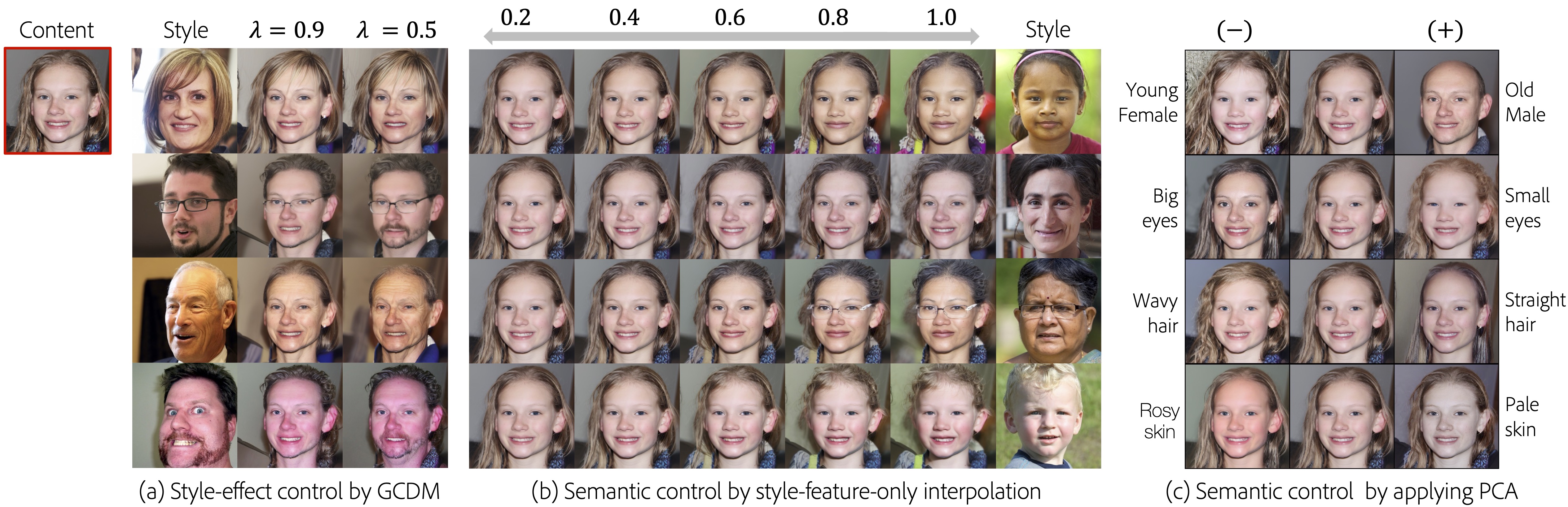
- 模型实现了内容结构保持不变的同时,在风格码之间实现平滑、解耦的插值,PCA分析验证了学习到的风格码的解耦性。
- 内容与风格潜在码实现有效解耦:风格码捕捉了眼镜、发色等属性,内容掩码则保持布局与姿态不变。
- 在训练中应用时间步调度可提升解耦性与模型特化程度,表明存在隐式的专家混合行为。
- 通过可学习超参数λ,可实现对风格转换幅度的精细控制,无需重新训练。
阅读本论文
在 Nubint 阅读器中打开原文,边读边就任意段落提问。
在 Nubint 中阅读本论文本解读由 AI 根据论文原文生成,引用前请核对原文。