
[论文解读] Enhancing IoT Security with CNN and LSTM-Based Intrusion Detection Systems
一个用于物联网流量的CNN-LSTM混合入侵检测模型,在CICIoT2023数据上训练,在CICIDS2017上验证,在二元的正常/恶意分类中达到高准确率和低损失。
Protecting Internet of things (IoT) devices against cyber attacks is imperative owing to inherent security vulnerabilities. These vulnerabilities can include a spectrum of sophisticated attacks that pose significant damage to both individuals and organizations. Employing robust security measures like intrusion detection systems (IDSs) is essential to solve these problems and protect IoT systems from such attacks. In this context, our proposed IDS model consists on a combination of convolutional neural network (CNN) and long short-term memory (LSTM) deep learning (DL) models. This fusion facilitates the detection and classification of IoT traffic into binary categories, benign and malicious activities by leveraging the spatial feature extraction capabilities of CNN for pattern recognition and the sequential memory retention of LSTM for discerning complex temporal dependencies in achieving enhanced accuracy and efficiency. In assessing the performance of our proposed model, the authors employed the new CICIoT2023 dataset for both training and final testing, while further validating the model's performance through a conclusive testing phase utilizing the CICIDS2017 dataset. Our proposed model achieves an accuracy rate of 98.42%, accompanied by a minimal loss of 0.0275. False positive rate(FPR) is equally important, reaching 9.17% with an F1-score of 98.57%. These results demonstrate the effectiveness of our proposed CNN-LSTM IDS model in fortifying IoT environments against potential cyber threats.
研究动机与目标
- 推动针对多样化网络攻击的物联网安全性增强,以及在物联网环境中对有效入侵检测系统的需求。
- 开发一个CNN-LSTM混合入侵检测系统,以利用空间特征和时序特征实现更高的检测性能。
- 在CICIoT2023和CICIDS2017数据集上评估模型,以评估性能和泛化能力。
- 通过标准指标(准确率、损失、精确率、召回、F1分数、FPR)展示性能。
提出的方法
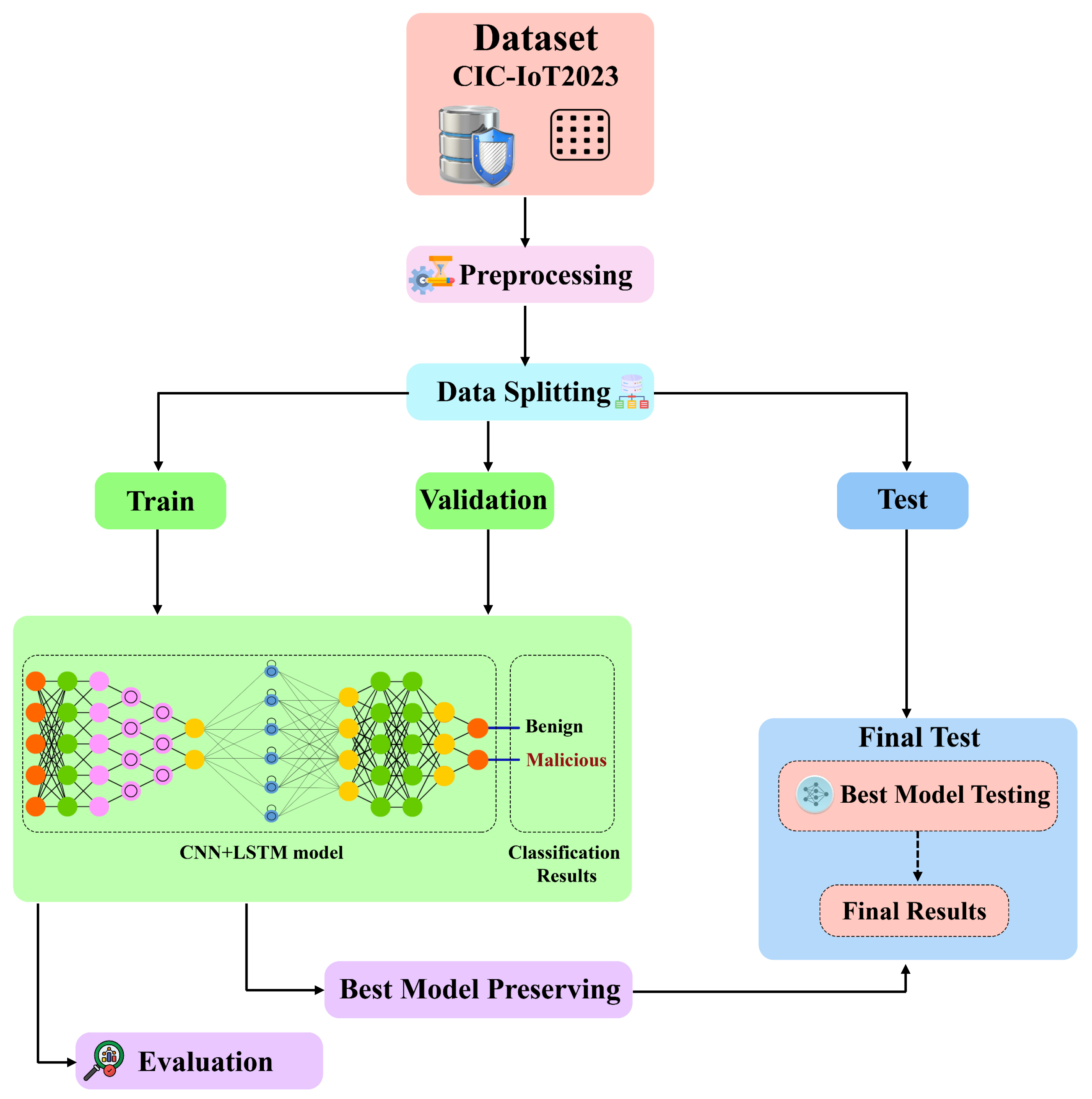
- 将物联网流量数据预处理为45特征向量,并将标签转换为二元形式。
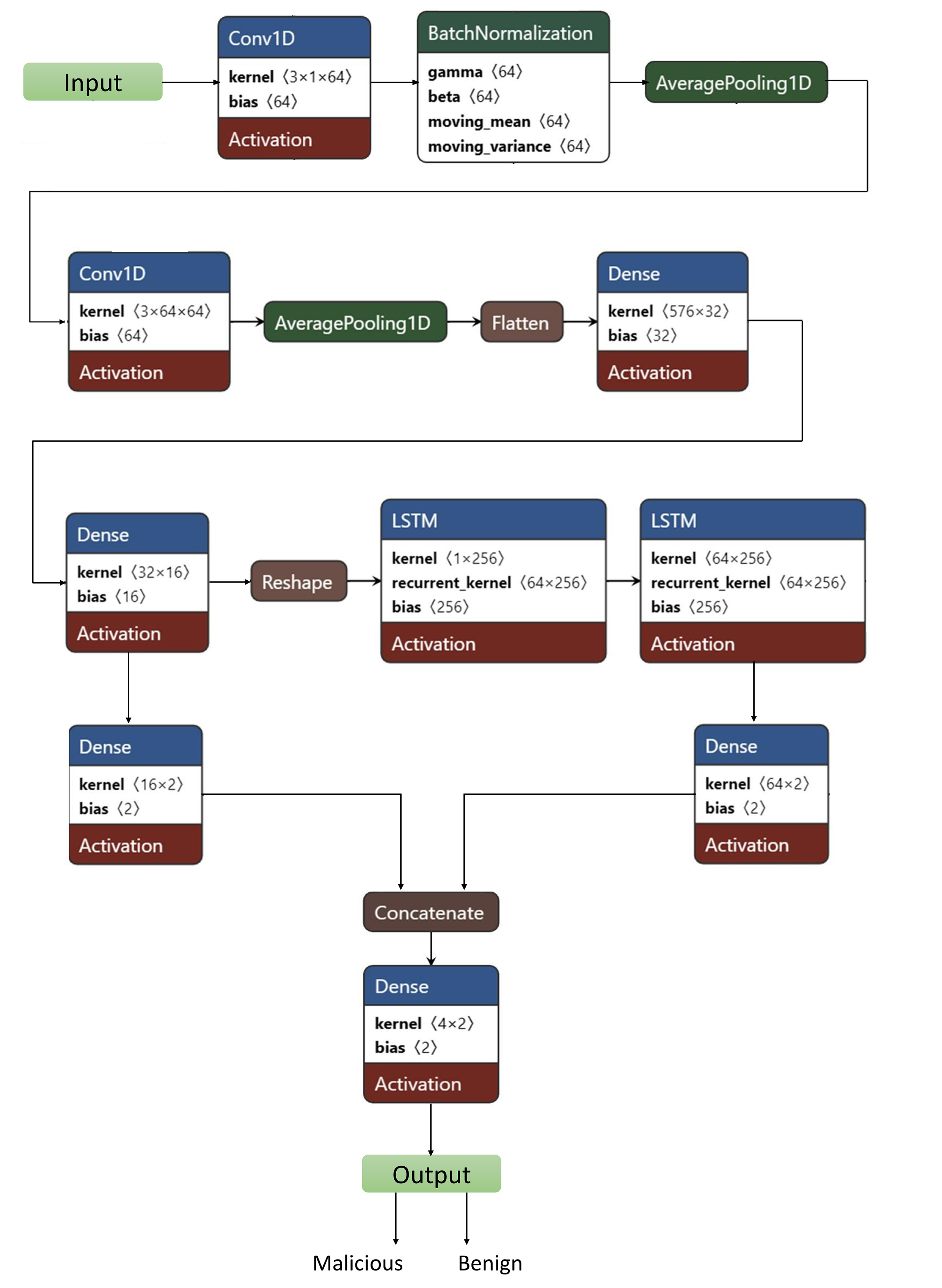
- 设计一个带批量归一化和平均池化的CNN-1D特征提取器,以捕捉空间模式。
- 将CNN输出与LSTM层结合,以建模序列相关性并产生二元的 benign/malicious 决策。
- 在CICIoT2023子集上使用Adam优化器,以80/20的训练/验证分割进行25个时期训练;在额外的CICIoT2023子集和CICIDS2017上评估泛化性。
- 使用准确率、损失、精确率、召回、F1-score和FPR评估性能;报告ROC/混淆矩阵分析。
实验结果
研究问题
- RQ1在物联网入侵检测的二分类任务中,CNN-LSTM混合模型能否优于单一模型方法?
- RQ2CNN-LSTM入侵检测系统在不同物联网流量数据集(CICIoT2023子集和CICIDS2017)上的泛化能力如何?
- RQ3在所提方法中,检测准确率与假阳性率之间的权衡是什么?
- RQ4该模型是否能有效利用时空特征区分物联网正常流量与恶意流量?
主要发现
- CNN-LSTMIDS在CICIoT2023第一子集上达到98.42%准确率,损失为0.0275。
- 在CICIoT2023第二子集上的泛化测试获得98.43%准确率,0.0275的损失和9.17%的FPR。
- 在CICIDS2017上,模型达到97.45%准确率、0.06损失、97.17%精确度、97.15%召回、97.07% F1分数和2.08% FPR。
- 混淆矩阵显示正常流量约90%的准确率,攻击流量约99%的准确率。
- ROC分析显示高真正率与低假阳性率,表明对类别的区分度很强。
- 与最先进的方法相比,CNN-LSTM在CICIoT2023和CICIDS2017上的方法在所报告的指标上显示出更优越的总体性能。
阅读本论文
在 Nubint 阅读器中打开原文,边读边就任意段落提问。
在 Nubint 中阅读本论文本解读由 AI 根据论文原文生成,引用前请核对原文。