
[论文解读] Enhancing LLM Factual Accuracy with RAG to Counter Hallucinations: A Case Study on Domain-Specific Queries in Private Knowledge-Bases
论文提出一个端到端的基于RAG的问答系统,通过CMU/LTI私有知识库来提高领域特定查询的事实准确性,同时消融实验显示在嵌入和核心模型微调有助于还是有害于性能。
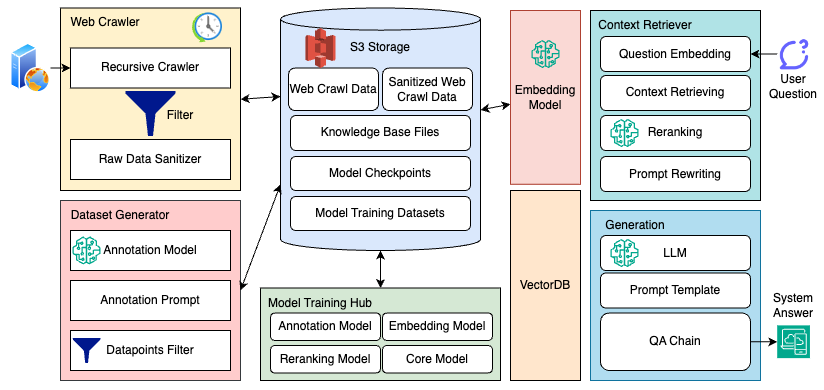
We proposed an end-to-end system design towards utilizing Retrieval Augmented Generation (RAG) to improve the factual accuracy of Large Language Models (LLMs) for domain-specific and time-sensitive queries related to private knowledge-bases. Our system integrates RAG pipeline with upstream datasets processing and downstream performance evaluation. Addressing the challenge of LLM hallucinations, we finetune models with a curated dataset which originates from CMU's extensive resources and annotated with the teacher model. Our experiments demonstrate the system's effectiveness in generating more accurate answers to domain-specific and time-sensitive inquiries. The results also revealed the limitations of fine-tuning LLMs with small-scale and skewed datasets. This research highlights the potential of RAG systems in augmenting LLMs with external datasets for improved performance in knowledge-intensive tasks. Our code and models are available on Github.
研究动机与目标
- 通过利用外部数据源,减少领域特定和时效性查询中的LLM幻觉。
- 创建一个面向CMU/LTI的专门数据集和评估框架,以支持基于RAG的问答。
- 开发并评估一个结合检索与生成的RAG管线,用于给出事实性、具上下文感知的答案。
- 研究嵌入模型微调和核心模型微调对系统性能的影响,以及小规模、偏见数据集的局限性。
提出的方法
- 构建一个RAG问答管线,包含一个上下文检索器和一个使用LLaMA-2作为核心生成器的生成模型。
- 通过网络爬虫、预处理和自动标注来策划一个面向CMU/LTI的数据集,以生成问答对。
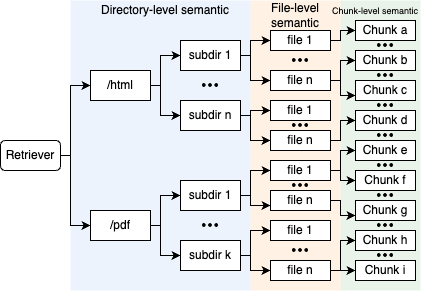
- 使用两阶段检索:先按相似性筛选前5个片段,然后用跨编码器重新排序器进行再排序。
- 在QA数据集上微调嵌入和核心模型;使用Recall、F1、Cosine Similarity和BLEU等指标进行评估。
- 通过消融研究和案例研究评估系统,以评估各组件的影响。
实验结果
研究问题
- RQ1外部CMU/LTI上下文的检索是否能提升领域特定问题的LLM生成答案的事实准确性?
- RQ2嵌入模型微调和核心模型微调如何影响RAG设置中的检索质量和答案生成?
- RQ3所提出的端到端RAG系统在时效性领域查询上的性能提升与局限性有哪些?
- RQ4哪些质量度量(IAA/Cohen’s Kappa)能指示用于训练/微调的整理数据集的可信度?
主要发现
- 基于RAG的问答管线在没有RAG的基线相比,提升了Recall和F1分数。
- 嵌入模型微调在召回和F1上带来提升,表明语义理解更好。
- 核心模型微调提供召回提升,但由于数据集规模或偏见,可能降低F1,指示过拟合或生成问题。
- 将嵌入和核心模型微调与RAG结合,与仅嵌入相比,带来边际收益或F1下降,凸显小规模、偏见数据集的权衡。
- 该数据集达到了相当高的标注者一致性(Cohen’s Kappa = 0.67)。
阅读本论文
在 Nubint 阅读器中打开原文,边读边就任意段落提问。
在 Nubint 中阅读本论文本解读由 AI 根据论文原文生成,引用前请核对原文。