
[论文解读] Enhancing Short-Term Wind Speed Forecasting using Graph Attention and Frequency-Enhanced Mechanisms
本文提出GFST-WSF,一种新颖的图注意力增强、频域增强的Transformer模型,用于短期风速预测,通过将图注意力网络(GAT)与改进的FEDformer结合,捕捉复杂的时空依赖关系。通过采用动态复数邻接矩阵来建模风电场之间的时滞空间相关性,该模型在6小时预测中相比现有深度学习方法将MSE降低了高达14%。
The safe and stable operation of power systems is greatly challenged by the high variability and randomness of wind power in large-scale wind-power-integrated grids. Wind power forecasting is an effective solution to tackle this issue, with wind speed forecasting being an essential aspect. In this paper, a Graph-attentive Frequency-enhanced Spatial-Temporal Wind Speed Forecasting model based on graph attention and frequency-enhanced mechanisms, i.e., GFST-WSF, is proposed to improve the accuracy of short-term wind speed forecasting. The GFST-WSF comprises a Transformer architecture for temporal feature extraction and a Graph Attention Network (GAT) for spatial feature extraction. The GAT is specifically designed to capture the complex spatial dependencies among wind speed stations to effectively aggregate information from neighboring nodes in the graph, thus enhancing the spatial representation of the data. To model the time lag in wind speed correlation between adjacent wind farms caused by geographical factors, a dynamic complex adjacency matrix is formulated and utilized by the GAT. Benefiting from the effective spatio-temporal feature extraction and the deep architecture of the Transformer, the GFST-WSF outperforms other baselines in wind speed forecasting for the 6-24 hours ahead forecast horizon in case studies.
研究动机与目标
- 为应对风能发电中高变异性与随机性的问题,通过提升短期风速预测精度来应对挑战。
- 建模地理分布的风电场之间复杂的时空依赖关系,这些关系在传统单风电场预测模型中常被忽略。
- 将基于频域增强的Transformer(FEDformer)的时序建模与图注意力网络(GAT)的空间特征提取相结合。
- 开发一种动态复数邻接矩阵,以捕捉由于地理因素导致的风电场之间时滞相关的风速关联。
- 通过协同的时空表征学习,在6小时、12小时和24小时预测时长上提升预测性能。
提出的方法
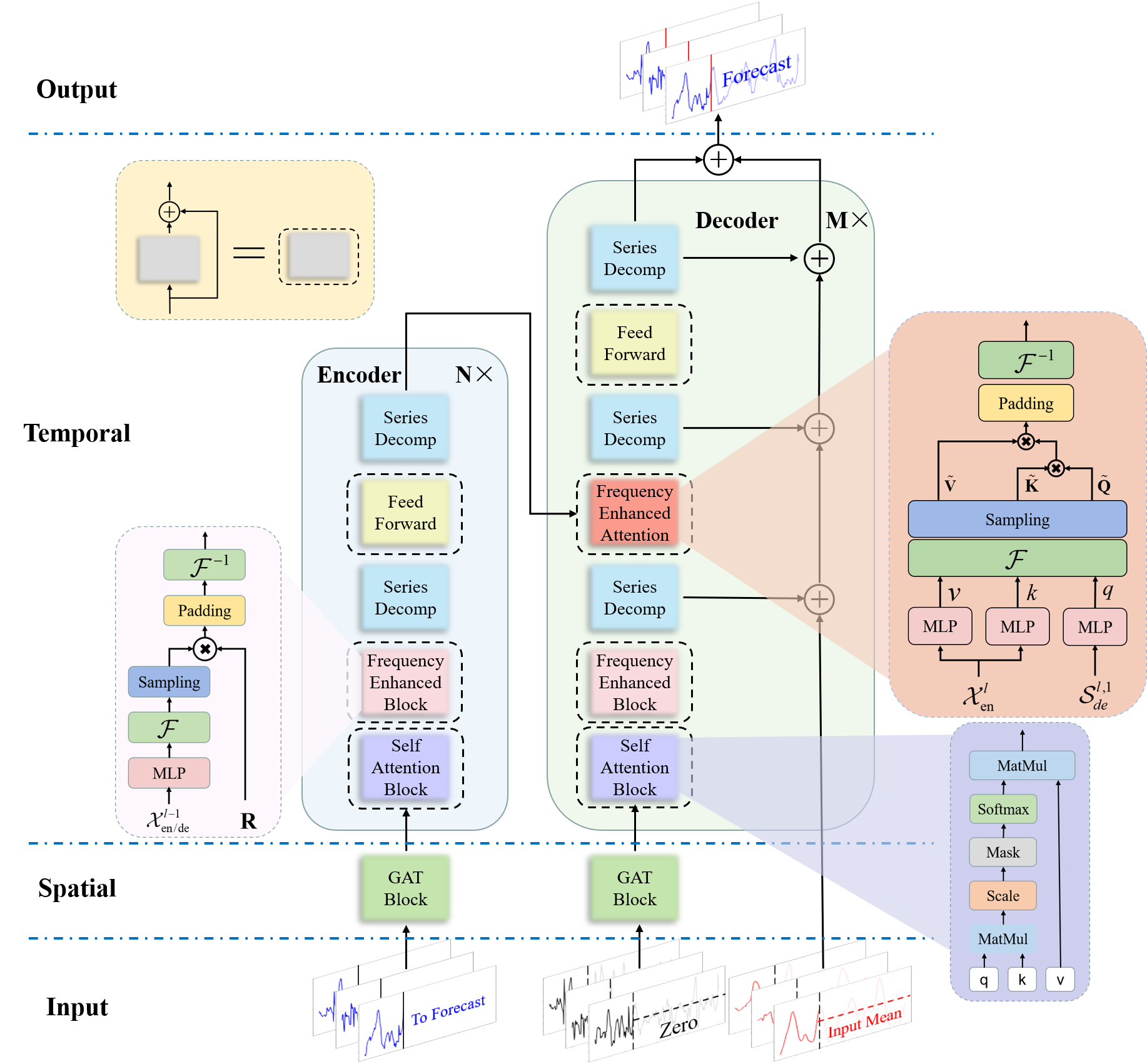
- 该模型采用基于Transformer的架构,利用FEDformer进行时序特征提取,有效建模风速序列中的长程依赖关系。
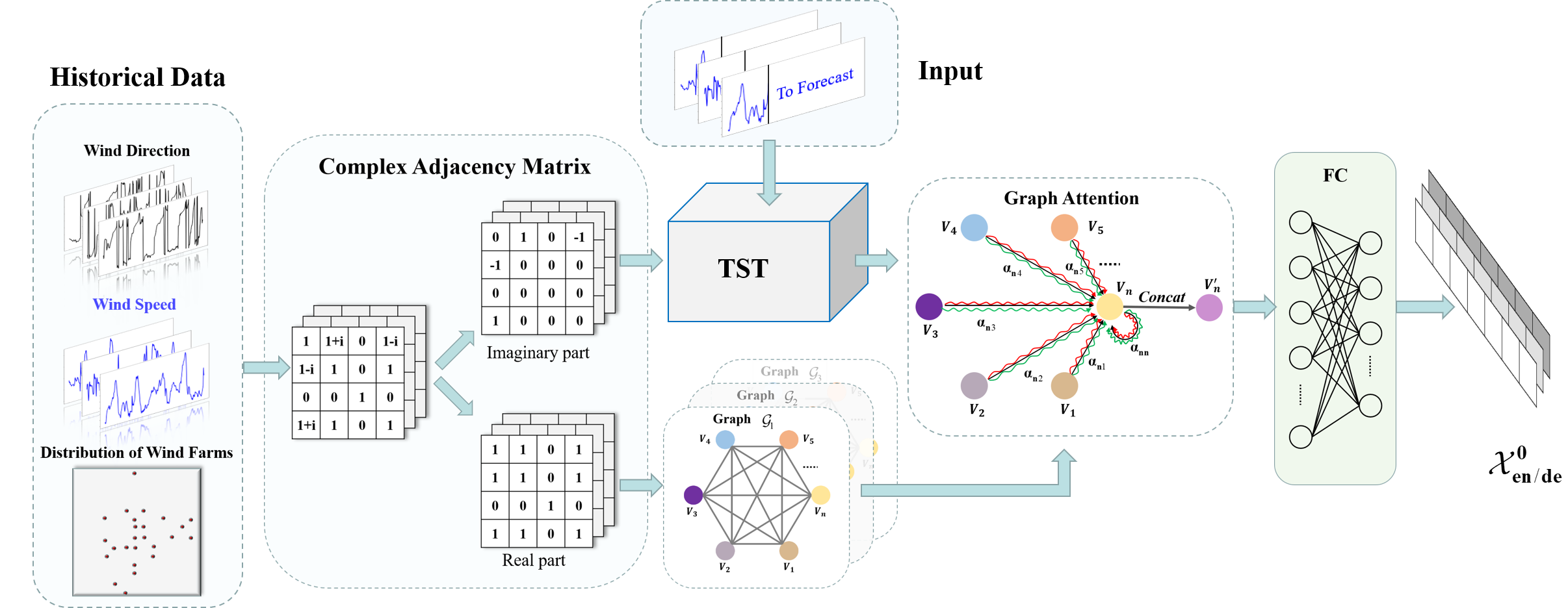
- 采用图注意力网络(GAT)通过将风速站点间的关系建模为图结构并学习注意力权重,来提取空间特征。
- 引入一种动态复数邻接矩阵以表示演化的空间相关性,同时结合风速相似性与因地理风传播导致的时间滞后。
- 邻接矩阵基于实时风速和风向数据动态更新,从而提升空间表征的准确性。
- 通过晚期融合策略将时序与空间编码相结合,实现对时空表征的联合优化。
- 该架构利用时间域和频域分解中的多头自注意力机制,增强对风数据中噪声和不确定性的鲁棒性。
实验结果
研究问题
- RQ1与传统基线相比,能够联合建模时序与空间依赖关系的深度学习模型是否能提升短期风速预测精度?
- RQ2在模型中引入考虑风电场之间时滞相关性的动态复数邻接矩阵,对预测性能有何影响?
- RQ3将FEDformer与GAT结合,对风速序列在时域与频域中的表征学习能力提升程度如何?
- RQ4所提出的GFST-WSF模型是否在多个预测时长(6小时、12小时、24小时)上均保持优越性能?
- RQ5通过消融实验验证,各组件(GAT、FEDformer、动态邻接矩阵)对整体预测精度的贡献程度如何?
主要发现
- 与最先进模型相比,GFST-WSF在6小时预测中实现了14%的MSE降低,在12小时预测中实现了12%的MSE降低。
- 在24小时预测中,MSE降低了8%,表明在更长预测时长上也保持了稳定的性能提升。
- 消融实验确认,若移除任一组件(GAT、FEDformer或动态邻接矩阵),预测性能均显著下降。
- 模型表现出高度的训练稳定性,100次重新训练实例中MSE与MAE的标准差均低于0.5%,表明收敛性稳健。
- 基于FEDformer的时序建模在长预测时长下优于LSTM,凸显注意力机制在长序列建模中的优势。
- 将GAT与动态邻接矩阵结合,显著提升了空间特征学习能力,尤其在捕捉相邻风电场之间的时滞相关性方面。
阅读本论文
在 Nubint 阅读器中打开原文,边读边就任意段落提问。
在 Nubint 中阅读本论文本解读由 AI 根据论文原文生成,引用前请核对原文。