
[论文解读] Entanglement entropy of higher rank topological phases
本文研究具有偶极子对称性的高秩拓扑物相中的纠缠熵,此类物相属于类似编织子的拓扑序。通过稳定子码形式化与图论方法,表明次主导的拓扑纠缠熵在系统尺寸变化时保持恒定,与任意任何任何子的总量子维度和拓扑纠缠熵之间的传统关系相矛盾。
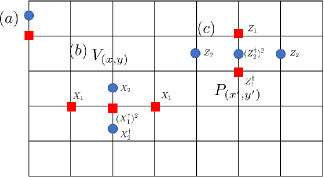
We study entanglement entropy of unusual $\mathbb{Z}_N$ topological stabilizer codes which admit fractional excitations with restricted mobility constraint in a manner akin to fracton topological phases. It is widely known that the sub-leading term of the entanglement entropy of a disk geometry in conventional topologically ordered phases is related to the total number of the quantum dimension of the fractional excitations. We show that, in our model, such a relation does not hold, i.e, the total number of the quantum dimension varies depending on the system size, whereas the sub-leading term of the entanglement entropy takes a constant number irrespective to the system size. We give a physical interpretation of this result in the simplest case of the model. More thorough analysis on the entanglement entropy of the model on generic lattices is also presented.
研究动机与目标
- 理解具有多极对称性的高秩拓扑物相的纠缠熵特性,特别是偶极子对称性的影响。
- 研究在这些新型拓扑物相中,标准的拓扑纠缠熵与总量子维度之间的关系是否仍然成立。
- 分析在具有受限移动性激发的稳定子码中,纠缠熵对晶格几何与系统尺寸的依赖关系。
- 建立纠缠熵与图论不变量(如拉普拉斯矩阵的不变因子)之间的联系,适用于一般晶格。
提出的方法
- 采用稳定子码形式化方法,计算具有偶极子对称性的 $\rvert\text{Z}_N\text{topological stabilizer codes}$ 中的纠缠熵。
- 应用图论将晶格建模为图,其中顶点代表量子比特,边代表相互作用,从而实现对子图纠缠的分析。
- 利用子图的拉普拉斯矩阵表征连通性,并推导纠缠熵的贡献。
- 基于子系统周围顶点数与拉普拉斯矩阵的不变因子,使用组合方法推导纠缠熵。
- 对圆盘及其他几何形状进行显式计算,并与传统拓扑序的结果进行比较。
- 对 $N=2$ 情况进行分析,以提供对拓扑纠缠熵非普遍行为的直观物理解释。
实验结果
研究问题
- RQ1在具有偶极子对称性的高秩拓扑物相中,标准的拓扑纠缠熵与总量子维度之间的关系是否仍然成立?
- RQ2在这些物相中,纠缠熵如何随系统尺寸与晶格几何变化而演化?
- RQ3拉普拉斯矩阵的不变因子在决定次主导纠缠熵项中起什么作用?
- RQ4为何尽管总量子维度随系统尺寸变化,拓扑纠缠熵仍保持恒定?
- RQ5能否通过图论与稳定子码技术系统地计算此类物相的纠缠熵?
主要发现
- 次主导的拓扑纠缠熵 $\gamma = -2\log N$ 在系统尺寸变化时保持恒定,尽管总量子维度随 $n_x$、$n_y$ 和 $\gcd(N,n_x)$ 等参数变化。
- 标准关系 $\gamma = \log\left(\sqrt{\sum_a d_a^2}\right)$ 在高秩拓扑物相中不成立。
- 在环面上的 $\mathbb{Z}_N$ 模型中,基态 degeneracy (GSD) 为 $[N \times \gcd(N,n_x) \times \gcd(N,n_y) \times \gcd(N,n_x,n_y)]^2$,其依赖于系统尺寸。
- 在一般晶格中,纠缠熵由面积律项与一个依赖于顶点数及拉普拉斯矩阵不变因子的常数项共同决定。
- 在 $N=2$ 情况下,该模型可被分解或重构,从而为 $\gamma$ 的恒定性提供物理解释,即使任意任何子的量子维度发生变化。
- 该结果表明,与传统拓扑序存在根本性差异,后者中 $\gamma$ 与任意任何子的量子维度普遍相关。
阅读本论文
在 Nubint 阅读器中打开原文,边读边就任意段落提问。
在 Nubint 中阅读本论文本解读由 AI 根据论文原文生成,引用前请核对原文。