
[论文解读] Estimate Deformation Capacity of Non-Ductile RC Shear Walls using Explainable Boosting Machine
本研究采用可解释增强机器学习模型(Explainable Boosting Machines, EBM)开发了一种完全可解释的机器学习模型,用于高精度、高透明度地预测非延性钢筋混凝土剪力墙的变形能力。该模型在测试集上实现了0.92的R²和1.05的预测值与实际值之比,提供了可靠且可解释的预测结果,与物理行为一致,并在准确性和可解释性方面优于黑箱模型。
Machine learning is becoming increasingly prevalent for tackling challenges in earthquake engineering and providing fairly reliable and accurate predictions. However, it is mostly unclear how decisions are made because machine learning models are generally highly sophisticated, resulting in opaque black-box models. Machine learning models that are naturally interpretable and provide their own decision explanation, rather than using an explanatory, are more accurate in determining what the model actually computes. With this motivation, this study aims to develop a fully explainable machine learning model to predict the deformation capacity of non-ductile reinforced concrete shear walls based on experimental data collected worldwide. The proposed Explainable Boosting Machines (EBM)-based model is an interpretable, robust, naturally explainable glass-box model, yet provides high accuracy comparable to its black-box counterparts. The model enables the user to observe the relationship between the wall properties and the deformation capacity by quantifying the individual contribution of each wall property as well as the correlations among them. The mean coefficient of determination R2 and the mean ratio of predicted to actual value based on the test dataset are 0.92 and 1.05, respectively. The proposed predictive model stands out with its overall consistency with scientific knowledge, practicality, and interpretability without sacrificing high accuracy.
研究动机与目标
- 解决非延性RC剪力墙变形能力预测中缺乏可靠且可解释模型的问题。
- 通过确保模型透明性和物理一致性,克服地震工程中黑箱机器学习模型的局限性。
- 开发一种玻璃盒模型,使工程师能够理解并验证变形能力预测背后的决策过程。
- 通过以数据驱动、高精度且可解释的预测替代过于保守的规范规定,提升抗震性能评估水平。
- 证明高精度预测可以在不牺牲可解释性的前提下实现,从而推动其在设计与加固工程中的实际应用。
提出的方法
- 采用可解释增强机器学习(EBM)模型,这是一种玻璃盒式、加法模型,通过各特征贡献项实现内在可解释的预测。
- 基于全球范围的非延性RC剪力墙试验数据集训练EBM模型,以墙体属性为输入,极限位移为输出。
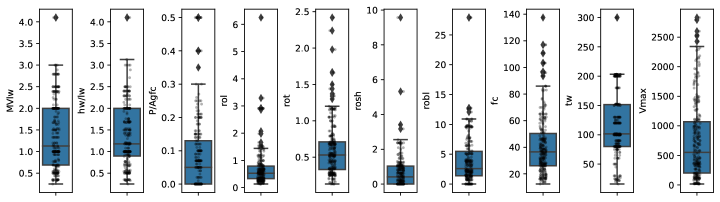
- 应用特征选择方法识别最具影响力的参数,包括剪力墙长细比(M/Vl_w)、厚度(t_w)、轴压比(P/A_g f_c)以及最大剪力(V_max)。
- 通过十次随机训练-测试划分评估模型性能,计算R²、相对误差(RE)和预测准确率(PA),以确保结果稳健性。
- 采用标准化指标将EBM模型与黑箱模型(XGBoost、Gradient Boost、Random Forest)及玻璃盒模型(决策树、岭回归)进行对比。
- 通过分析各特征项的贡献并检测异常关系(如低预测情况下V_max呈现正向影响),验证模型可解释性,确保其与物理认知一致。
实验结果
研究问题
- RQ1可解释的机器学习模型是否能在保持完全可解释性的同时,实现对非延性RC剪力墙变形能力的高精度预测?
- RQ2哪些墙体参数对变形能力影响最为显著?它们如何单独及协同作用?
- RQ3在准确性、稳健性及与物理行为的一致性方面,EBM模型相较于黑箱和玻璃盒模型表现如何?
- RQ4在不牺牲预测能力的前提下,能否通过仅保留最相关特征对模型进行简化?
- RQ5由于决策过程透明,工程师是否能够信任并验证模型的预测结果,从而减少对事后解释工具(如SHAP或LIME)的依赖?
主要发现
- EBM模型在测试集上实现了0.92的平均决定系数(R²)和1.05的预测值与实际值之比,表明预测具有高精度且偏差极小。
- 对变形能力影响最大的预测因子为墙体厚度(t_w)、弯剪比(M/Vl_w)、轴压比(P/A_g f_c)以及最大剪力(V_max),而曲率类型和混凝土抗压强度的影响最小。
- 即使仅保留四个关键输入变量,模型仍保持高性能,R²达0.92,PA为1.05,证明其具备实际应用价值和低计算成本。
- EBM在所有性能指标上均优于黑箱模型(XGBoost、Gradient Boost、Random Forest)和玻璃盒模型(决策树、岭回归),表现出更低的离散度和更高的稳健性。
- 总体而言,模型预测与物理行为一致,仅存在可被工程师有意义地解释和验证的例外情况(如低预测情形下V_max呈现正向影响)。
- 与黑箱模型不同,EBM无需依赖SHAP或LIME等事后解释工具,避免了近似误差,实现了模型决策的直接、精确可理解性。

阅读本论文
在 Nubint 阅读器中打开原文,边读边就任意段落提问。
在 Nubint 中阅读本论文本解读由 AI 根据论文原文生成,引用前请核对原文。