
[论文解读] eVAE: Evolutionary Variational Autoencoder
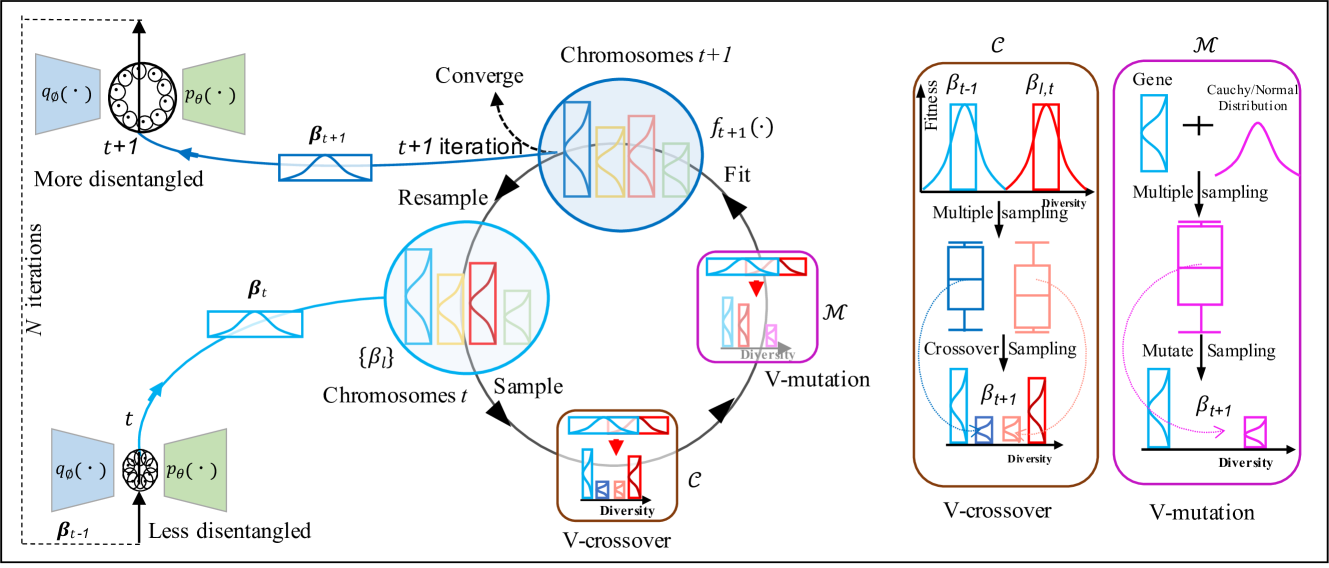
eVAE 提出了一种新颖的进化变分自编码器,通过将变分遗传算法整合到 VAE 中,实现无需超参数调优的重建与表征学习的动态平衡。通过采用变分突变、模拟二进制交叉以及内-外联合训练,eVAE 有效缓解了 KL 消失问题,提升了表征解耦性,并在图像生成与重建质量方面优于当前最先进方法。
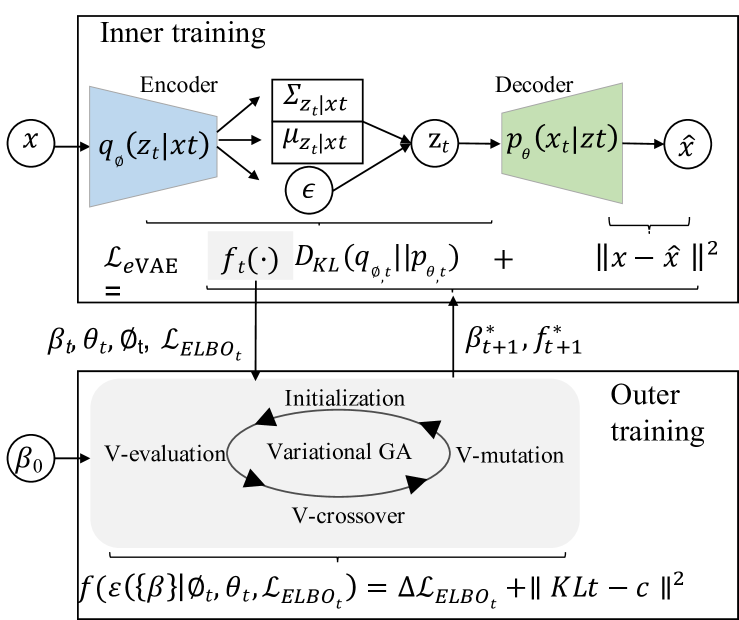
The surrogate loss of variational autoencoders (VAEs) poses various challenges to their training, inducing the imbalance between task fitting and representation inference. To avert this, the existing strategies for VAEs focus on adjusting the tradeoff by introducing hyperparameters, deriving a tighter bound under some mild assumptions, or decomposing the loss components per certain neural settings. VAEs still suffer from uncertain tradeoff learning.We propose a novel evolutionary variational autoencoder (eVAE) building on the variational information bottleneck (VIB) theory and integrative evolutionary neural learning. eVAE integrates a variational genetic algorithm into VAE with variational evolutionary operators including variational mutation, crossover, and evolution. Its inner-outer-joint training mechanism synergistically and dynamically generates and updates the uncertain tradeoff learning in the evidence lower bound (ELBO) without additional constraints. Apart from learning a lossy compression and representation of data under the VIB assumption, eVAE presents an evolutionary paradigm to tune critical factors of VAEs and deep neural networks and addresses the premature convergence and random search problem by integrating evolutionary optimization into deep learning. Experiments show that eVAE addresses the KL-vanishing problem for text generation with low reconstruction loss, generates all disentangled factors with sharp images, and improves the image generation quality,respectively. eVAE achieves better reconstruction loss, disentanglement, and generation-inference balance than its competitors.
研究动机与目标
- 解决 VAE 中表征压缩与任务拟合之间的动态权衡问题,该问题在不同数据和网络设置下仍不稳定。
- 克服现有 VAE 方法依赖固定超参数或受限架构来平衡重建与推理的局限性。
- 开发一种自适应调优机制,通过进化算子实时调整 ELBO 权衡,避免人工调优与早熟收敛。
- 将变分信息瓶颈理论与进化学习相结合,实现在深度生成模型中的鲁棒、自适应优化。
- 通过潜在空间中的概率化、进化化搜索,改善 VAE 中生成与推理的平衡性及表征质量。
提出的方法
- 提出一种变分遗传算法(VGA),通过概率化染色体表示,在 VAE 的证据下界(ELBO)目标内演化超参数。
- 设计基于柯西分布的变分突变算子,实现对超参数空间的稳定、非均匀探索,避免随机搜索。
- 实现模拟二进制交叉(SBX)算子,以组合有前景的超参数配置,加速收敛。
- 开发一种内-外联合训练机制,交替优化 VAE 的生成模型与最优权衡参数的进化搜索。
- 在信息瓶颈框架下应用变分推断,确保潜在表征在压缩性与重建保真度之间达到平衡。
- 使用概率化染色体选择策略,维持多样性,防止在 VAE 目标进化优化过程中过早收敛。
实验结果
研究问题
- RQ1进化优化能否在无需固定超参数的情况下,动态平衡 VAE 中的重建与表征学习权衡?
- RQ2集成变分遗传算法在缓解 KL 消失与模式崩溃方面,如何提升 VAE 的稳定性和性能?
- RQ3像 SBX 和柯西突变这样的进化算子,在多大程度上能增强 VAE 的解耦性与生成质量?
- RQ4eVAE 中的内-外联合训练机制是否在重建质量与解耦性方面优于标准 VAE 训练及现有的退火或控制方法?
- RQ5eVAE 是否能在无需架构或超参数约束的前提下,泛化于多种数据类型与网络架构?
主要发现
- eVAE 在多个数据集上均显著低于基线 VAE(包括 β-VAE、InfoVAE 和 ControlVAE)的重建损失。
- 通过进化调优有效平衡 KL 散度与重建项,模型生成了更清晰、更解耦的图像。
- 在文本生成中,eVAE 通过动态调整权衡缓解了 KL 消失问题,从而提升了似然度与生成多样性。
- 内-外联合训练机制实现了稳定收敛,避免了早熟收敛,训练过程表现一致。
- 在 MIG 和 FID 等标准指标下,eVAE 在解耦性与生成-推理平衡方面均优于当前最先进方法。
- SBX 与柯西突变的集成显著提升了超参数空间中的搜索效率,减少了对随机或启发式调优的依赖。
阅读本论文
在 Nubint 阅读器中打开原文,边读边就任意段落提问。
在 Nubint 中阅读本论文本解读由 AI 根据论文原文生成,引用前请核对原文。