
[论文解读] Evaluating Large Language Models on a Highly-specialized Topic, Radiation Oncology Physics
本研究在一份100题放射治疗物理学考试中评估四种大型语言模型(LLMs),将其与医用物理师和非专家进行比较,并探讨提示策略、先解释再回答提示以及演绎推理测试。
We present the first study to investigate Large Language Models (LLMs) in answering radiation oncology physics questions. Because popular exams like AP Physics, LSAT, and GRE have large test-taker populations and ample test preparation resources in circulation, they may not allow for accurately assessing the true potential of LLMs. This paper proposes evaluating LLMs on a highly-specialized topic, radiation oncology physics, which may be more pertinent to scientific and medical communities in addition to being a valuable benchmark of LLMs. We developed an exam consisting of 100 radiation oncology physics questions based on our expertise at Mayo Clinic. Four LLMs, ChatGPT (GPT-3.5), ChatGPT (GPT-4), Bard (LaMDA), and BLOOMZ, were evaluated against medical physicists and non-experts. ChatGPT (GPT-4) outperformed all other LLMs as well as medical physicists, on average. The performance of ChatGPT (GPT-4) was further improved when prompted to explain first, then answer. ChatGPT (GPT-3.5 and GPT-4) showed a high level of consistency in its answer choices across a number of trials, whether correct or incorrect, a characteristic that was not observed in the human test groups. In evaluating ChatGPTs (GPT-4) deductive reasoning ability using a novel approach (substituting the correct answer with "None of the above choices is the correct answer."), ChatGPT (GPT-4) demonstrated surprising accuracy, suggesting the potential presence of an emergent ability. Finally, although ChatGPT (GPT-4) performed well overall, its intrinsic properties did not allow for further improvement when scoring based on a majority vote across trials. In contrast, a team of medical physicists were able to greatly outperform ChatGPT (GPT-4) using a majority vote. This study suggests a great potential for LLMs to work alongside radiation oncology experts as highly knowledgeable assistants.
研究动机与目标
- 推动在极其专业的主题上评估 LLMs,以避免数据丰富的考试偏差。
- 开发一份反映住院医师培训课程的 100 题放射治疗物理考试。
- 将多种 LLMs 与医用物理师和非专家进行比较。
- 研究提示设计、先解释再回答策略以及演绎推理能力。
提出的方法
- 设计一份100题的多项选择考试,涵盖基础物理、测量、治疗计划、成像、近距离放射治疗(brachytherapy)、高级规划,以及质控/安全。
- 在五次试验中测试四种 LLMs(ChatGPT GPT-3.5、ChatGPT GPT-4、Bard LaMDA、BLOOMZ)(BLOOMZ 仅一次)。
- 使用初始化和指令提示来控制响应格式,并在可能的情况下将问题分批执行,每批20道题。
- 将 LLM 的分数与两个人类组别进行比较:医用物理师和非专家,使用平均分、标准差和平均试验相关性。
- 评估 LLM 与人类的一致性,并应用多数表决汇聚来评估群体表现。
- 通过先要求解释再回答来提高 GPT-4 的准确性,并通过用 None of the above 替换正确答案来测试演绎推理能力。
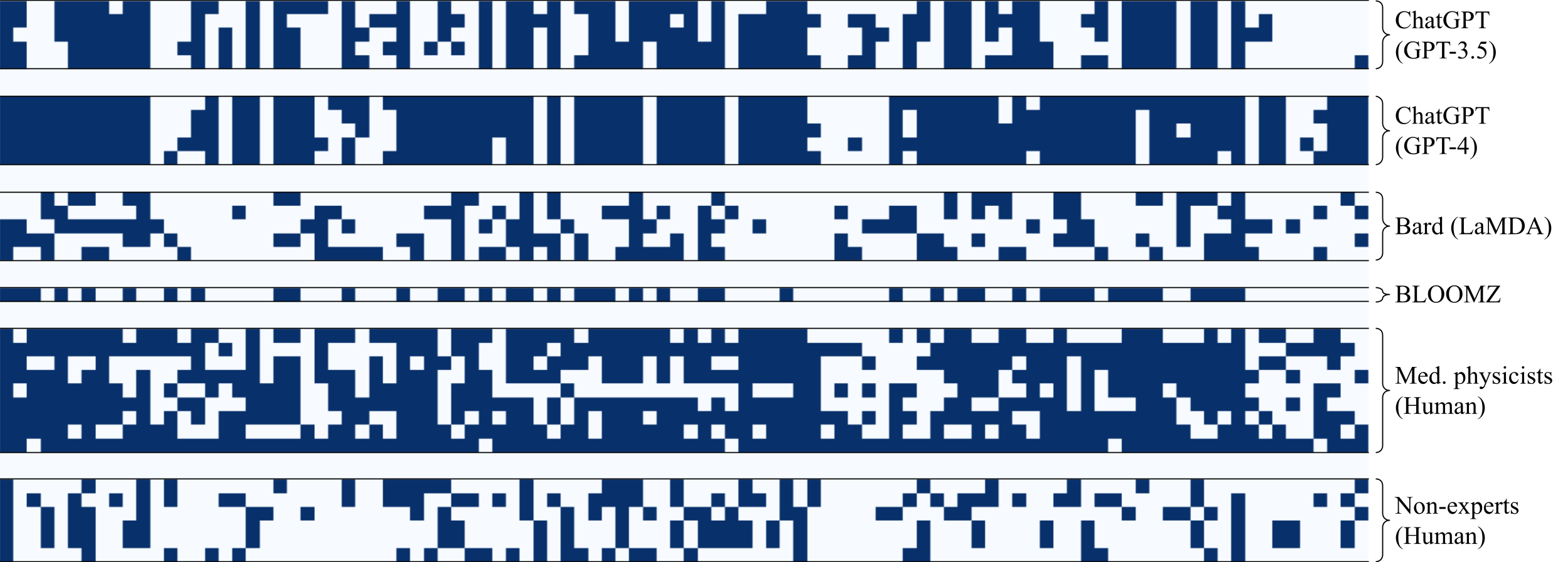
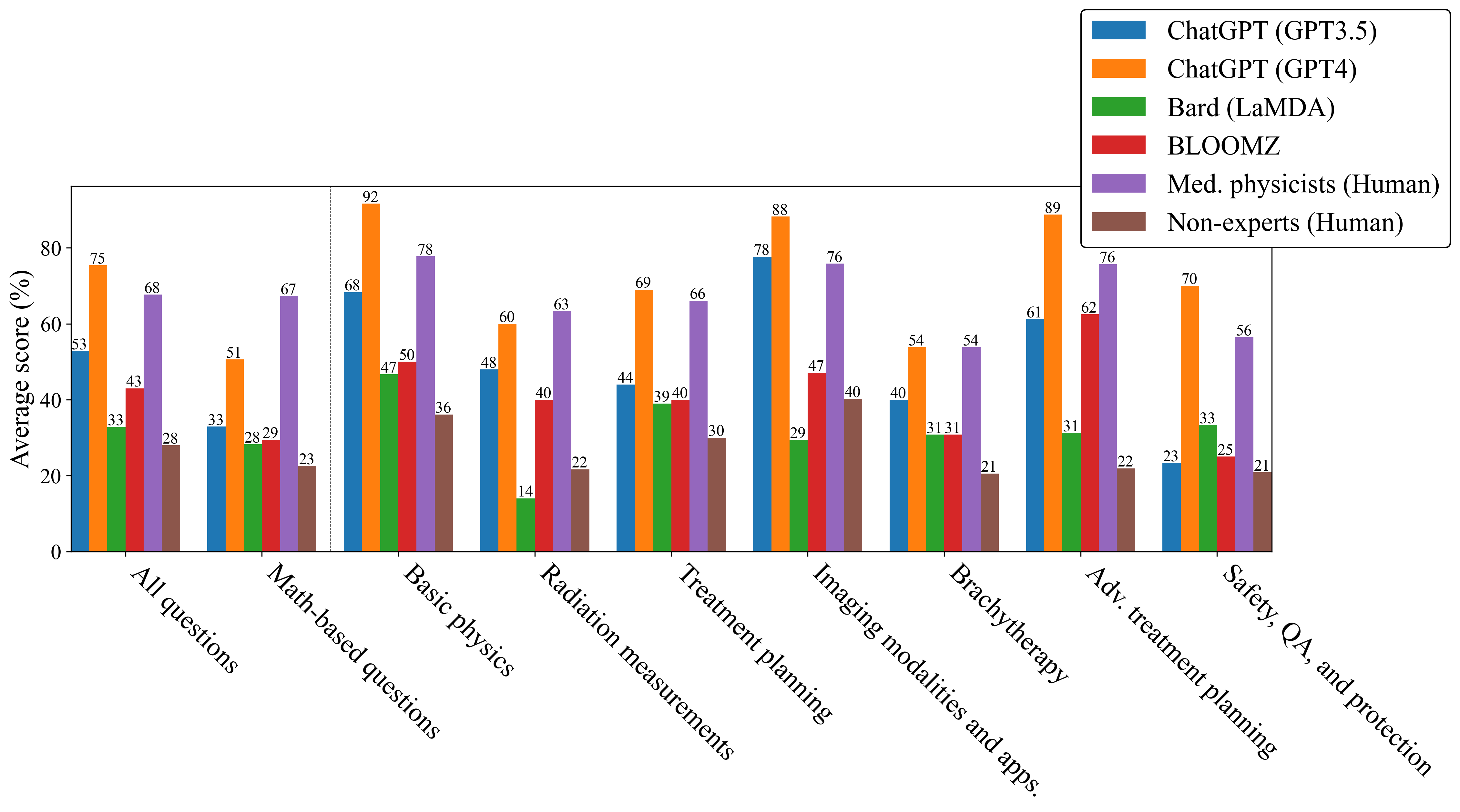
实验结果
研究问题
- RQ1与医用物理师和非专家相比,LLMs 能否准确回答高度专业化的放射治疗物理考试?
- RQ2提示设计和先解释再提示是否能提高 GPT-4 在专业医学物理内容上的准确性?
- RQ3面对情境简化的问题时,LLMs 是否展现出演绎推理能力?
- RQ4在人类或 LLM 之间的多数投票汇聚是否有助于提高准确性?
- RQ5在高度专业化领域中,LLM 演绎推理的涌现性质是什么?
主要发现
- GPT-4 在100题考试中平均表现超过所有其他 LLMs 与医用物理师。
- 指示 GPT-4 先解释再回答,整体准确性提升约5个百分点。
- 在正确答案被替换为 None of the above 的测试中,GPT-4 展现出显著的演绎推理能力,在 explain-then-answer 提示下总体达到 55%。
- 人类使用多数投票显著优于单独的 LLMs,其中医用物理师获得了 23% 的提升。
- LLMs 在各次试验中表现出高度的一致性,而非专业人员则类似随机猜测;医用物理师受益于小组一致。
阅读本论文
在 Nubint 阅读器中打开原文,边读边就任意段落提问。
在 Nubint 中阅读本论文本解读由 AI 根据论文原文生成,引用前请核对原文。