
[论文解读] Evaluating LLMs at Detecting Errors in LLM Responses
本文提出了 ReaLMistake,这是首个通过客观、真实且多样的错误类型,针对大语言模型(LLM)响应中的错误检测进行评估的基准,涵盖四个类别:推理正确性、指令遵循性、上下文忠实度和参数化知识。在 GPT-4 和 Llama 2 70B 的 900 个专家标注实例上进行评估后,研究发现即使是顶级 LLM 如 GPT-4 和 Claude 3,在错误检测任务中的召回率也极低,且基于 LLM 的检测器显著逊于人类,其解释不可靠,对提示变化的鲁棒性差。
With Large Language Models (LLMs) being widely used across various tasks, detecting errors in their responses is increasingly crucial. However, little research has been conducted on error detection of LLM responses. Collecting error annotations on LLM responses is challenging due to the subjective nature of many NLP tasks, and thus previous research focuses on tasks of little practical value (e.g., word sorting) or limited error types (e.g., faithfulness in summarization). This work introduces ReaLMistake, the first error detection benchmark consisting of objective, realistic, and diverse errors made by LLMs. ReaLMistake contains three challenging and meaningful tasks that introduce objectively assessable errors in four categories (reasoning correctness, instruction-following, context-faithfulness, and parameterized knowledge), eliciting naturally observed and diverse errors in responses of GPT-4 and Llama 2 70B annotated by experts. We use ReaLMistake to evaluate error detectors based on 12 LLMs. Our findings show: 1) Top LLMs like GPT-4 and Claude 3 detect errors made by LLMs at very low recall, and all LLM-based error detectors perform much worse than humans. 2) Explanations by LLM-based error detectors lack reliability. 3) LLMs-based error detection is sensitive to small changes in prompts but remains challenging to improve. 4) Popular approaches to improving LLMs, including self-consistency and majority vote, do not improve the error detection performance. Our benchmark and code are provided at https://github.com/psunlpgroup/ReaLMistake.
研究动机与目标
- 为解决当前缺乏用于评估 LLM 响应中二元错误检测的基准,特别是那些涉及客观、真实且多样的错误的任务。
- 克服以往基准的局限性,这些基准依赖主观或琐碎的任务(如单词排序)或有限的错误类型(如摘要中的忠实度问题)。
- 设计能够诱发强 LLM(如 GPT-4 和 Llama 2 70B)中自然发生且可客观评估错误的任务。
- 在真实、专家标注的基准上评估 12 种基于 LLM 的错误检测器的性能。
- 探究基于 LLM 的错误检测方法的可靠性、鲁棒性及其局限性。
提出的方法
- 设计三项自然语言生成(NLG)任务——数学应用题生成、细粒度事实验证和可回答性分类——系统性地诱发四类错误:推理正确性、指令遵循性、上下文忠实度和参数化知识。
- 收集 GPT-4-0613 和 Llama 2 70B 的 900 个 LLM 响应实例,均由专家标注,每个实例包含二元错误标签、错误类别和详细解释。
- 使用 ReaLMistake 基准评估 12 种基于 LLM 的错误检测器,采用标准提示模板,并引入变体以测试鲁棒性。
- 应用标准的 LLM 改进技术(如自一致性与多数投票)以评估其对错误检测性能的影响。
- 通过人工分析检测器输出,评估其解释的可靠性与二元标签的准确性。
- 通过避免模糊或主观的评估标准,聚焦于可验证的事实性与逻辑不一致,确保评估的客观性。
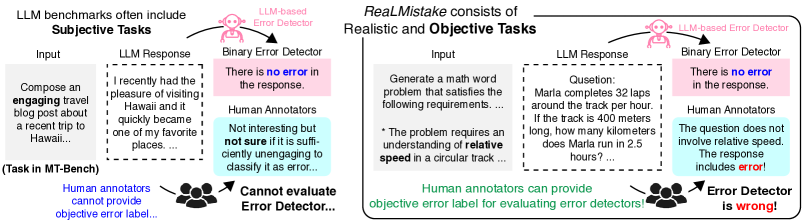
实验结果
研究问题
- RQ1基于 LLM 的错误检测器能否可靠地检测 LLM 响应中的错误,尤其是在错误可客观评估的情况下?
- RQ2基于 LLM 的错误检测器在检测 LLM 输出错误方面的表现与人类水平准确率相比如何?
- RQ3基于 LLM 的错误检测器所提供的解释在多大程度上反映了对错误的准确推理?
- RQ4基于 LLM 的错误检测器对微小提示变化的敏感程度如何?这种敏感性能否被缓解?
- RQ5既有的 LLM 改进策略(如自一致性与多数投票)是否能提升基于 LLM 的错误检测器的性能?
主要发现
- GPT-4 和 Claude 3 等顶级 LLM 在 LLM 响应中的错误检测任务中召回率极低,表明其在二元错误检测任务中表现极差。
- 所有评估的基于 LLM 的错误检测器在识别 LLM 响应中的错误方面,均显著劣于人类专家。
- 基于 LLM 的错误检测器所提供的解释往往不可靠,即使二元标签正确,其推理过程也常出现错误。
- 基于 LLM 的错误检测对微小提示变化高度敏感,且标准 LLM 优化技术(如自一致性或多数投票)无法提升其性能。
- ReaLMistake 基准成功捕捉了 LLM 响应中四类关键类别下多样、真实且可客观评估的错误。
- 本研究揭示了当前基于 LLM 的错误检测方法存在关键缺陷,凸显了开发更鲁棒、更可靠方法以保障 LLM 输出质量的迫切需求。

阅读本论文
在 Nubint 阅读器中打开原文,边读边就任意段落提问。
在 Nubint 中阅读本论文本解读由 AI 根据论文原文生成,引用前请核对原文。