
[论文解读] Evaluating Similitude and Robustness of Deep Image Denoising Models via Adversarial Attack
本文提出去噪-PGD 和 L2-去噪-PGD 对抗攻击方法,用于评估深度图像去噪模型在保持噪声分布情况下的鲁棒性。研究揭示了不同去噪模型之间存在高度可迁移性,表明其具有强烈的局部相似性;并发现数据驱动的非盲去噪模型最为鲁棒,而 BM3D 展现出对对抗扰动的固有抵抗能力。
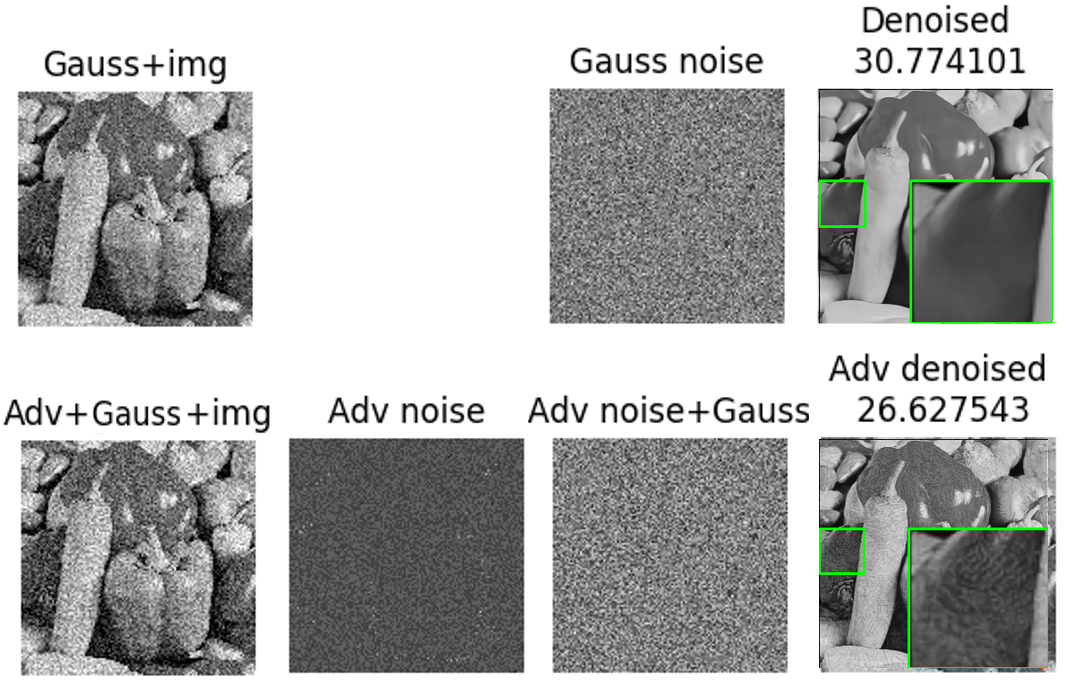
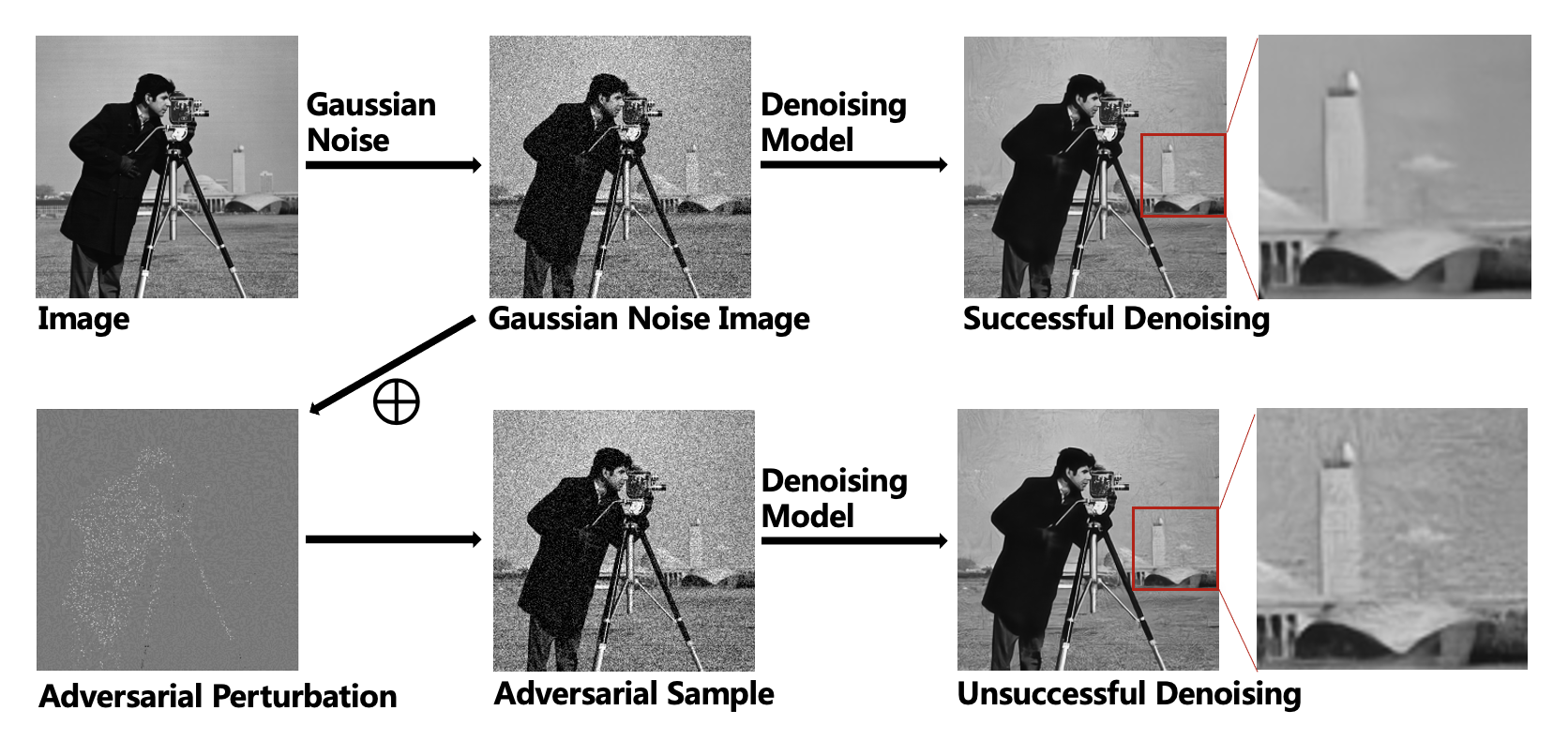
Deep neural networks (DNNs) have shown superior performance comparing to traditional image denoising algorithms. However, DNNs are inevitably vulnerable while facing adversarial attacks. In this paper, we propose an adversarial attack method named denoising-PGD which can successfully attack all the current deep denoising models while keep the noise distribution almost unchanged. We surprisingly find that the current mainstream non-blind denoising models (DnCNN, FFDNet, ECNDNet, BRDNet), blind denoising models (DnCNN-B, Noise2Noise, RDDCNN-B, FAN), plug-and-play (DPIR, CurvPnP) and unfolding denoising models (DeamNet) almost share the same adversarial sample set on both grayscale and color images, respectively. Shared adversarial sample set indicates that all these models are similar in term of local behaviors at the neighborhood of all the test samples. Thus, we further propose an indicator to measure the local similarity of models, called robustness similitude. Non-blind denoising models are found to have high robustness similitude across each other, while hybrid-driven models are also found to have high robustness similitude with pure data-driven non-blind denoising models. According to our robustness assessment, data-driven non-blind denoising models are the most robust. We use adversarial training to complement the vulnerability to adversarial attacks. Moreover, the model-driven image denoising BM3D shows resistance on adversarial attacks.
研究动机与目标
- 探究深度图像去噪模型对对抗攻击的脆弱性。
- 开发一种在保持原始噪声分布的同时进行对抗攻击的方法,以确保实验的有效性。
- 评估对抗样本在不同类型去噪模型(非盲、盲、即插即用、展开式)之间的可迁移性。
- 利用对抗扰动量化去噪模型之间的局部行为相似性(鲁棒性相似度)。
- 与数据驱动和混合驱动模型相比,评估模型驱动方法(如 BM3D)的鲁棒性。
提出的方法
- 提出去噪-PGD 方法,通过在去噪器损失函数上进行梯度更新,迭代地对含噪图像施加扰动。
- 引入 L2-去噪-PGD 方法,对扰动施加 L2 约束,以保持高斯噪声分布,提升实验严谨性。
- 在每次 PGD 迭代前使用随机高斯扰动初始化,以增强可迁移性,同时保持噪声分布保真度。
- 通过裁剪操作确保扰动保持在图像范围内,以稳定训练动态。
- 采用 Wasserstein 距离度量,定量比较对抗样本的噪声分布与真实高斯噪声的差异。
- 将鲁棒性相似度定义为模型之间共享的对抗样本集合程度,反映其局部行为相似性。
实验结果
研究问题
- RQ1能否在保持原始噪声分布的前提下,有效应用于深度图像去噪模型的对抗攻击?
- RQ2不同类型深度去噪模型(非盲、盲、即插即用、展开式)在多大程度上共享对抗样本,反映其行为相似性?
- RQ3鲁棒性相似度在不同模型类别之间如何变化,特别是数据驱动与混合驱动模型之间?
- RQ4与基于深度学习的模型相比,模型驱动方法(如 BM3D)是否表现出对对抗攻击的内在抵抗能力?
- RQ5架构相似性与图像去噪模型中对抗可迁移性之间存在何种关系?
主要发现
- L2-去噪-PGD 攻击保持了噪声分布的保真度,其与高斯噪声的 Wasserstein 距离为 0.0017,显著低于去噪-PGD 的 0.0024。
- 所有测试的深度去噪模型——非盲(DnCNN、FFDNet 等)、盲(DnCNN-B、Noise2Noise 等)、即插即用(DPIR、CurvPnP)和展开式(DeamNet)——在灰度和彩色图像上均共享几乎完全相同的对抗样本集合。
- 数据驱动的非盲去噪模型表现出最高的鲁棒性相似度,表明模型间具有强烈的局部行为相似性。
- 混合驱动模型(如 DPIR、CurvPnP)也表现出与纯数据驱动非盲模型相当高的鲁棒性相似度,表明其具有共享的决策边界。
- 经典模型驱动方法 BM3D 展现出对对抗攻击的强抵抗能力,在鲁棒性方面优于基于深度学习的模型。
- 对抗训练可提升鲁棒性,且对抗样本的高可迁移性表明,对抗区域在模型间形成了连续且共享的子空间。
阅读本论文
在 Nubint 阅读器中打开原文,边读边就任意段落提问。
在 Nubint 中阅读本论文本解读由 AI 根据论文原文生成,引用前请核对原文。