
[论文解读] Evaluating the Performance of Large Language Models for SDG Mapping (Technical Report)
本研究使用斯威本大学的1,000篇研究论文,评估开源大语言模型(LLMs)在可持续发展目标(SDG)映射任务中与GPT-4o的性能表现。通过在不同阈值水平下采用F1分数、精确率和召回率的微平均法进行评估,发现GPT-4o-mini、LLaMA 3和Qwen2表现最佳,而LLaMA 2和Gemma 2则表现出显著的性能差距,表明其在SDG映射任务中具有较强的微调潜力。
The use of large language models (LLMs) is expanding rapidly, and open-source versions are becoming available, offering users safer and more adaptable options. These models enable users to protect data privacy by eliminating the need to provide data to third parties and can be customized for specific tasks. In this study, we compare the performance of various language models on the Sustainable Development Goal (SDG) mapping task, using the output of GPT-4o as the baseline. The selected open-source models for comparison include Mixtral, LLaMA 2, LLaMA 3, Gemma, and Qwen2. Additionally, GPT-4o-mini, a more specialized version of GPT-4o, was included to extend the comparison. Given the multi-label nature of the SDG mapping task, we employed metrics such as F1 score, precision, and recall with micro-averaging to evaluate different aspects of the models' performance. These metrics are derived from the confusion matrix to ensure a comprehensive evaluation. We provide a clear observation and analysis of each model's performance by plotting curves based on F1 score, precision, and recall at different thresholds. According to the results of this experiment, LLaMA 2 and Gemma still have significant room for improvement. The other four models do not exhibit particularly large differences in performance. The outputs from all seven models are available on Zenodo: https://doi.org/10.5281/zenodo.12789375.
研究动机与目标
- 评估开源LLM在多标签SDG映射任务中的表现,其中论文被分配至多个可持续发展目标。
- 通过测试可本地部署的模型而非第三方API,解决敏感领域中的数据隐私挑战。
- 为研究人员在SDG映射任务中选择LLM提供基准参考,由于缺乏真实标签,使用GPT-4o输出作为代理基线。
- 通过微平均F1、精确率和召回率指标,分析模型在不同置信度阈值下的行为表现。
提出的方法
- 使用斯威本大学研究库中的1,000篇论文作为SDG映射的输入数据。
- 对所有模型应用标准化提示,以分配多个SDG并附带置信度分数和解释说明。
- 处理模型输出,仅提取目标标签和置信度分数,舍弃JSON或自由文本格式以确保一致性。
- 在0.1至0.9的阈值范围内,使用微平均F1、精确率和召回率对模型进行评估,以GPT-4o(阈值0.5)作为基线。
- 生成性能曲线,可视化不同阈值下F1、精确率和召回率的趋势,用于对比分析。
- 在斯威本HPC的GPU节点上,对六款模型(GPT-4o、GPT-4o-mini、Mixtral、LLaMA 2、LLaMA 3、Gemma 2和Qwen2)进行评估。
实验结果
研究问题
- RQ1在缺乏真实标签的情况下,开源LLM在多标签SDG映射任务中与GPT-4o相比表现如何?
- RQ2哪些LLM能在不同置信度阈值下保持较高的F1、精确率和召回率?
- RQ3使用不同LLM进行SDG映射时,平衡精确率与召回率的最佳阈值范围是什么?
- RQ4模型特定特征(如参数量、架构)如何影响其在SDG映射任务中的表现?
主要发现
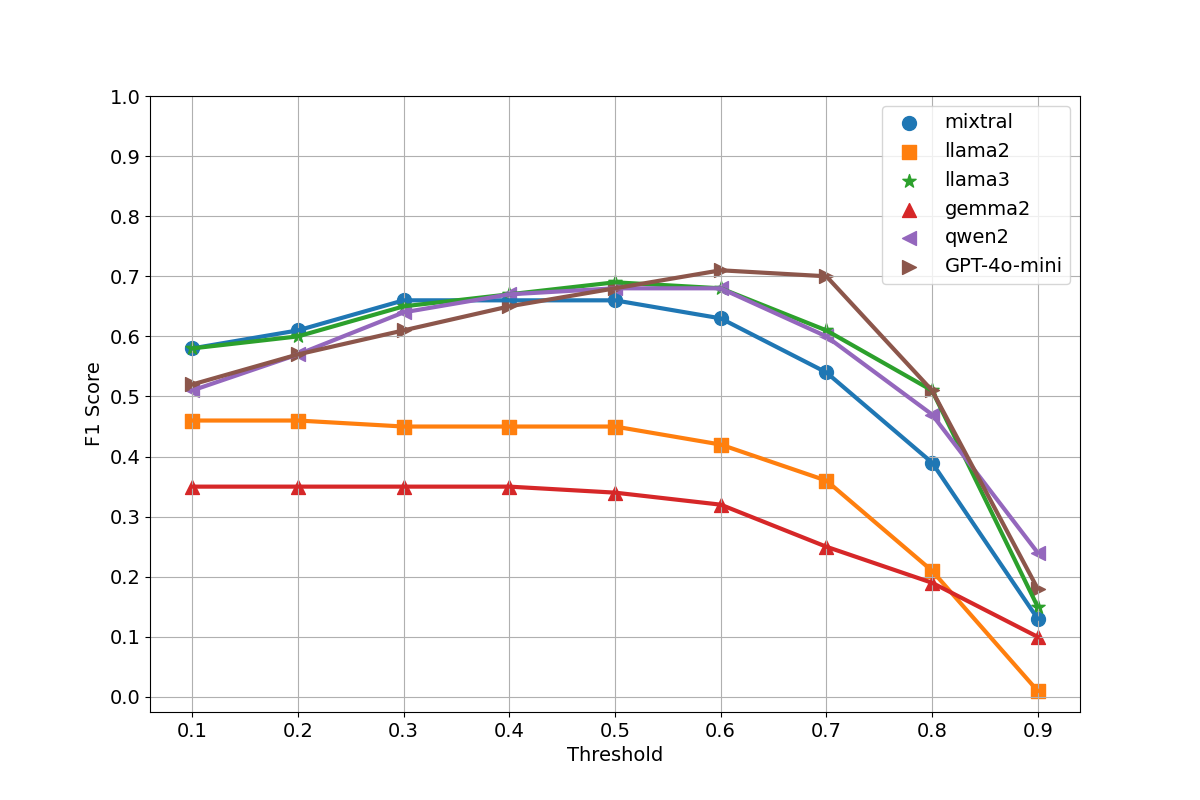
- GPT-4o-mini、LLaMA 3和Qwen2在大多数阈值下均保持最高的F1分数,表明其整体性能最优。
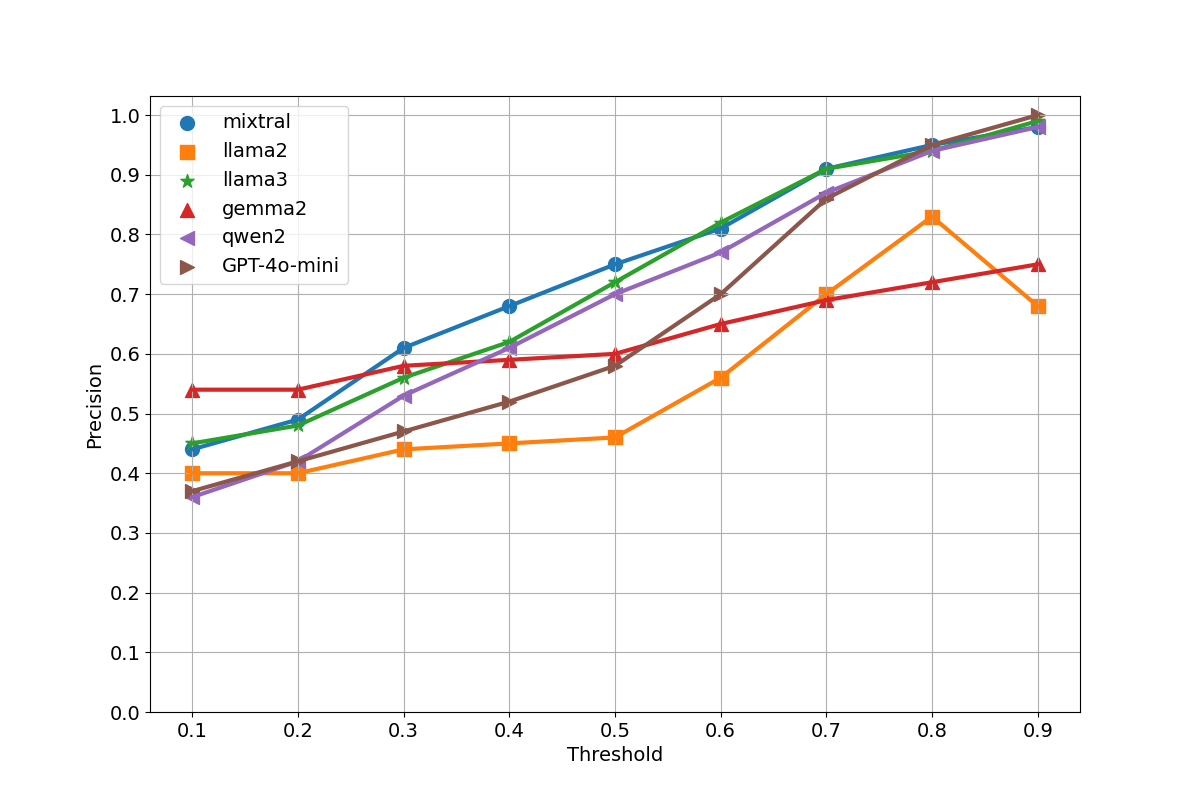
- Mixtral和LLaMA 3在各阈值下均表现出最高精确率,表明其误报率较低,且在减少错误SDG分配方面更具可靠性。
- GPT-4o-mini和Qwen2在召回率上表现最佳,使其在捕捉真实正样本SDG分配方面最为有效,尤其在高召回场景中。
- LLaMA 2和Gemma 2在所有阈值下F1、精确率和召回率均最低,表明其性能较差,且在SDG映射任务中适用性有限。
- 大多数模型(尤其是Mixtral、LLaMA 3、Qwen2和GPT-4o-mini)的最佳阈值范围为0.5至0.6,此时F1和精确率达到峰值。
- 性能曲线显示,当阈值超过0.6后,F1和精确率急剧下降,表明更高的阈值会降低模型在此任务中的有效性。
阅读本论文
在 Nubint 阅读器中打开原文,边读边就任意段落提问。
在 Nubint 中阅读本论文本解读由 AI 根据论文原文生成,引用前请核对原文。