
[论文解读] Evaluation of the CaloINN generative network - Fast detector simulation
该论文基准 CaloINN(INN)与一种 VAE+INN 方法,用于快速钨量计量能量淋浴仿真,评估在逐步增加的相空间维度上的表现,并报告时序与质量指标。
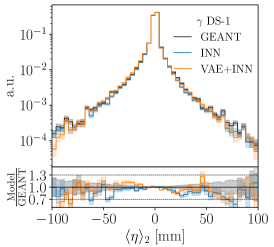
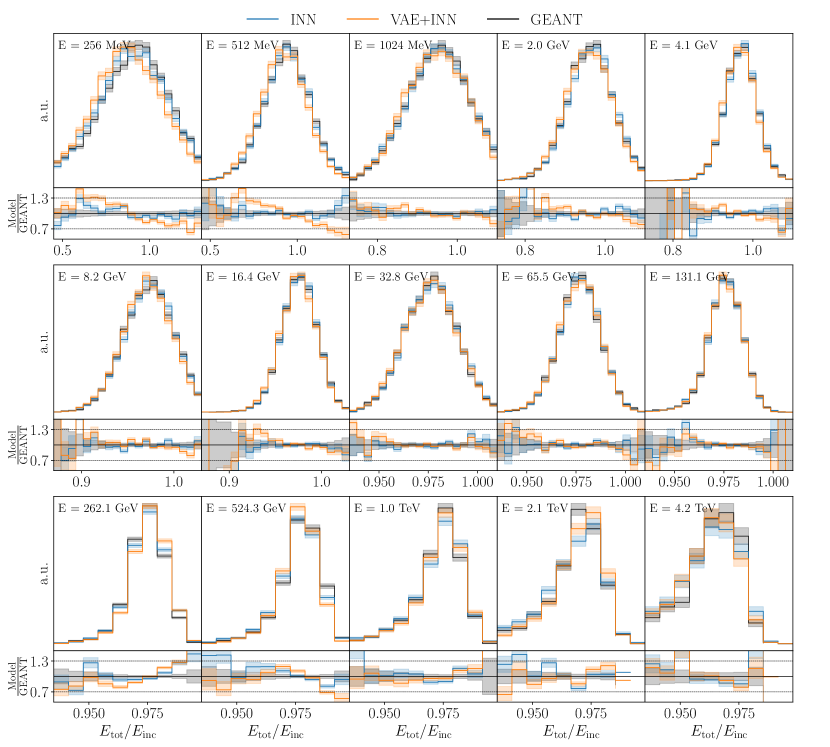
These are the sampled used in the paper "Normalizing Flows for High-Dimensional Detector Simulations" for the evaluation of the CaloINN and the CaloVAE+INN models. Each zip file contains the generated showers stored in the CaloChallenge format together with figures of high-level observables. We include the layer energy deposition, the center of energy, the width of the center of energy, the layer sparsity, the ratio E_tot/E_inc, and the full voxel energy distribution. For these features we provide: energy inclusive histograms for all the datasets; for dataset 1, three incident energies: 256 MeV, 8.192GeV, 262.144 GeV; for dataset 2 and 3, three incident energy windows, (1-10), (10-100), (100-1000) GeV; separation power between Geant4 and our samples calculatd from the histograms.
研究动机与目标
- 评估基于归一化流的替代模型(INN)在低到高维相空间中产生钨冷淬淬淬淬淬淬淬淬淬淬淬淬淬淬淬淬淬淬淬淬淬淬淬淬淬淬淬淬淬淬淬淬淬淬淬淬淬淬淬淬淬淬淬淬淬淬淬淬淬淬淬
- 评估在数据集 3 的可扩展性是否通过在 INN 之前对淋浴进行 VAE 压缩来改善。
- 提供感知物理的评估指标,以诊断 INN 与 VAE+INN 在何处成功或失败。
- 在数据集维度与硬件(GPU/CPU)下对生成速度进行基准。
提出的方法
- 使用两种体系结构:带耦合层的标准 INN,以及 VAE+INN 流程,其中 VAE 在 INN 将淋浴映射到高斯潜在空间之前对其进行压缩。
- 在 Geant4 派生的 CaloChallenge 数据集 1–3 上,使用以似然为基础的损失训练 INN,条件化为对数入射能量。
- 通过将层能量归一化并在每个 Eq. (4) 中附加能量编码变量来预处理淋浴。
- 对于数据集 3,附加一个 VAE 以降低维度,并在 VAE 潜在空间上训练 INN,采用两步训练(先 VAE,再 INN)。
- 使用高级物理特征和基于分类器的似然比度量来评估在相空间中模型对数据的欠抽样或过抽样的区域。
- 报告 GPU/CPU 上的生成时序,覆盖不同批量大小与数据集。
实验结果
研究问题
- RQ1 INN 基于归一化流在 Geant4 钙计淋浴重现到逐步增加的体素化(368、533、6,480、40,500 体素)时的表现如何?
- RQ2与纯 INN 相比,VAE+INN 混合是否提高对极高维钙计数据的可扩展性?
- RQ3在再现淋浴特征(形状、稀疏性、能量沉积)方面,INN 与 VAE+INN 在各数据集上的主要失败模式?
- RQ4在不同批量大小下,INN 与 VAE+INN 在 CPU 与 GPU 上的相对生成速度如何?
主要发现
- 在数据集 1(光子与介子)中,INN 能在大约 10% 的范围内再现高层特征,VAE+INN 未显示出明显优势。
- 在数据集 1 中,当以分类器加权度量评估时,Gamma 淮淀的 INN 性能优于 VAE+INN,AUC 分别为 0.601(INN)对比 0.936(VAE+INN)。
- 数据集 2(正电子,6,480 体素)显示 INN 相对于数据集 1 的性能下降,AUC 为 0.703(INN)对 0.916(VAE+INN);压缩有助于主要特征,但对低能量沉积和稀疏性有害。
- 数据集 3(正电子,40,500 体素)无法被纯 INN 有效建模;VAE+INN 仍然是可行选项,但就此维度而言总体精度-密度估计可能会失败。
- 时序结果表明在小批量大小下 INN 具有最先进的采样速度,而 VAE+INN 实现毫秒级生成时间;GPU 通常比 CPU 提供加速。
- 研究通过分类器权重识别出不同的失败模式,特别是在网络与数据集不同组合下,相空间区域的欠抽样或过抽样。
阅读本论文
在 Nubint 阅读器中打开原文,边读边就任意段落提问。
在 Nubint 中阅读本论文本解读由 AI 根据论文原文生成,引用前请核对原文。