
[论文解读] Event Stream GPT: A Data Pre-processing and Modeling Library for Generative, Pre-trained Transformers over Continuous-time Sequences of Complex Events
ESGPT 是一个开源库,能够在连续时间、多模态事件流(例如电子病历数据)上构建类似 GPT 的模型,提供端到端数据提取、预处理、高效深度学习表示,以及与 HuggingFace 兼容的模型 API,支持零样本评估。
Generative, pre-trained transformers (GPTs, a.k.a. "Foundation Models") have reshaped natural language processing (NLP) through their versatility in diverse downstream tasks. However, their potential extends far beyond NLP. This paper provides a software utility to help realize this potential, extending the applicability of GPTs to continuous-time sequences of complex events with internal dependencies, such as medical record datasets. Despite their potential, the adoption of foundation models in these domains has been hampered by the lack of suitable tools for model construction and evaluation. To bridge this gap, we introduce Event Stream GPT (ESGPT), an open-source library designed to streamline the end-to-end process for building GPTs for continuous-time event sequences. ESGPT allows users to (1) build flexible, foundation-model scale input datasets by specifying only a minimal configuration file, (2) leverage a Hugging Face compatible modeling API for GPTs over this modality that incorporates intra-event causal dependency structures and autoregressive generation capabilities, and (3) evaluate models via standardized processes that can assess few and even zero-shot performance of pre-trained models on user-specified fine-tuning tasks.
研究动机与目标
- 实现对连续时间、多模态事件流的 GPTs 的端到端构建。
- 以最小配置将多样化、规模庞大的数据集统一为基础模型规模的输入准备。
- 提供一个与 Hugging Face 兼容的建模 API,考虑事件内依赖关系和自回归生成。
- 为用户定义的任务对预训练模型提供标准化评估,包括少样本和零样本评估。
提出的方法
- 提供一个开放源代码的 ESGPT 库,通过简洁的 YAML 配置从多种来源摄取数据。
- 使用基于 Polars 的预处理来加速数据提取并降低存储占用。
- 输出一个具有内存高效、稀疏表示和预构建嵌入层的 PyTorch 数据集。
- 提供两种预定义模型架构(ConditionallyIndependent 和 NestedAttention),通过可配置的依赖图来捕捉事件内依赖。
- 公开一个与 Hugging Face 兼容的 API,用于模型构建和生成,支持时间感知的输出与多阶段生成,并提供用于损失/采样的统一输出对象。
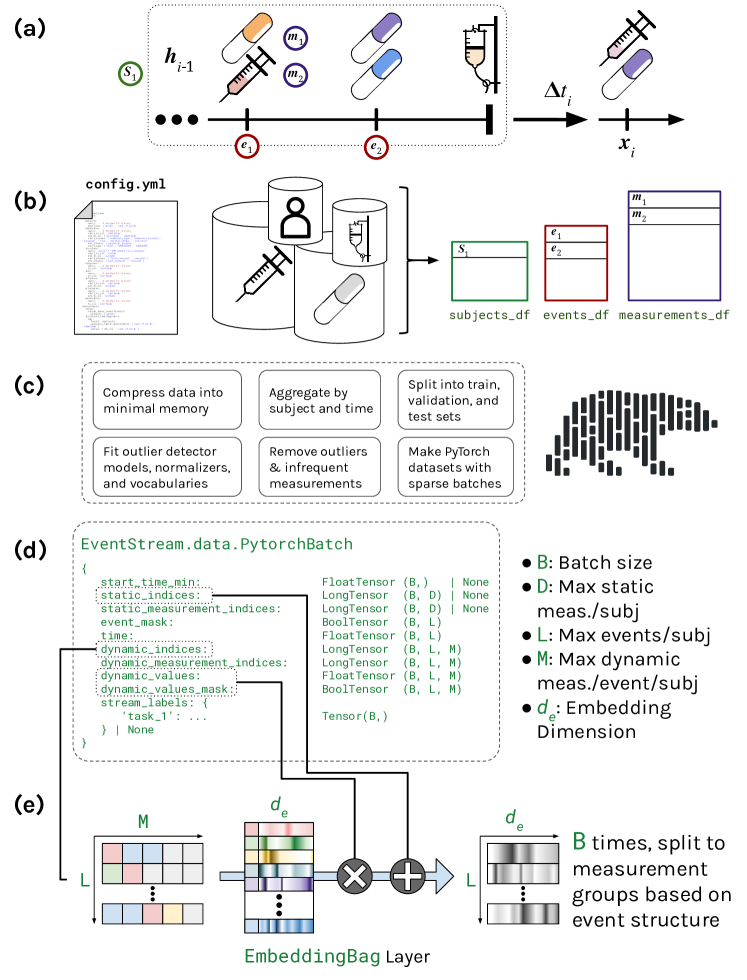
实验结果
研究问题
- RQ1如何在具有事件内依赖关系的连续时间复杂事件序列上有效构建 GPT 风格的模型?
- RQ2ESGPT 是否能够为大型 EHR 类数据集提供快速、可扩展的数据预处理和内存高效的表示?
- RQ3在对事件流数据进行训练的基础模型上,零样本评估是否可行且有信息量?
- RQ4可配置的事件内依赖图如何影响生成性能和下游任务的效用?
主要发现
- ESGPT 实现对大型事件流数据集的端到端预处理、数据集构建和嵌入,具有显著的速度和存储效率(例如,将完整的 30 万患者的 MIMIC-IV 数据集预处理到 1.2 GB 仅需约 30 分钟)。
- 该库提供了一个随观测事件规模化的内存高效、稀疏的深度学习表示,而非整个位面特征空间,将内存使用在 MIMIC-IV 示例中降至传统方法的约 1.3%。
- 两种模型架构(ConditionallyIndependent 和 NestedAttention)允许用户定义事件内依赖,从而实现符合多阶段协变量关系的生成。
- 兼容 HF 的 API 允许从头或使用预训练资源构建、训练和生成 ESGPT 模型,并提供用于采样和损失的统一输出对象。
- ESGPT 支持用于评估基础模型在事件流任务上的可行性的零样本评估管线,以及用于超参数优化和监控的工具。
阅读本论文
在 Nubint 阅读器中打开原文,边读边就任意段落提问。
在 Nubint 中阅读本论文本解读由 AI 根据论文原文生成,引用前请核对原文。