
[论文解读] Evidence of the quantum-optical nature of high-harmonic generation
该论文提供了实验证据,表明半导体中的高次谐波产生(HHG)可生成非经典光,通过二阶强度关联测量展示了两模压缩和柯西-施瓦茨不等式的违背。利用商用光纤激光器和标准半导体材料,研究发现随着激光强度增加,光子统计从超泊松分布过渡到泊松分布,证实了多体纠缠的存在,并确立了HHG作为室温下宽带、多模量子光源的平台。
High-harmonic generation is a light up-conversion process occurring in a strong laser field, leading to coherent bursts of extreme ultrashort broadband radiation [1]. As a new perspective, we propose that ultrafast strong-field electronic or photonic processes such as high-harmonic generation can potentially generate non-classical states of light well before the decoherence of the system occurs [2, 3]. This could address fundamental challenges in quantum technology such as scalability, decoherence or the generation of massively entangled states [4]. Here, we report experimental evidence of the non-classical nature of the harmonic emission in several semiconductors excited by a femtosecond infrared laser. By investigating single- and double beam intensity cross-correlation [5], we measure characteristic, non-classical features in the single photon statistics. We observe two-mode squeezing in the generated harmonic radiation, which depends on the laser intensity that governs the transition from Super-Poissonian to Poissonian photon statistics. The measured violation of the Cauchy-Schwarz inequality realizes a direct test of multipartite entanglement in high-harmonic generation [6]. This result is supported by the theory of multimodal detection and the Hamiltonian from which the effective squeezing modes of the harmonics can be derived [7, 8]. With this work, we show experimentally that high-harmonic generation is a new quantum bosonic platform that intrinsically produces non-classical states of light with unique features such as multipartite broadband entanglement or multimode squeezing. The source operates at room temperature using standard semiconductors and a standard commercial fiber laser, opening new routes for the quantum industry, such as optical quantum computing, communication and imaging.
研究动机与目标
- 研究半导体中高次谐波产生(HHG)的量子光学特性,作为非经典光的来源。
- 检验HHG在退相干发生前是否能够产生如压缩或纠缠光子等非经典态。
- 通过标准、紧凑的激光与半导体系统,实验演示HHG产生多体纠缠和多模压缩。
- 通过直接测量二阶强度关联函数,验证非经典关联的存在。
- 探索利用HHG作为可扩展、室温平台用于量子光子技术的可行性。
提出的方法
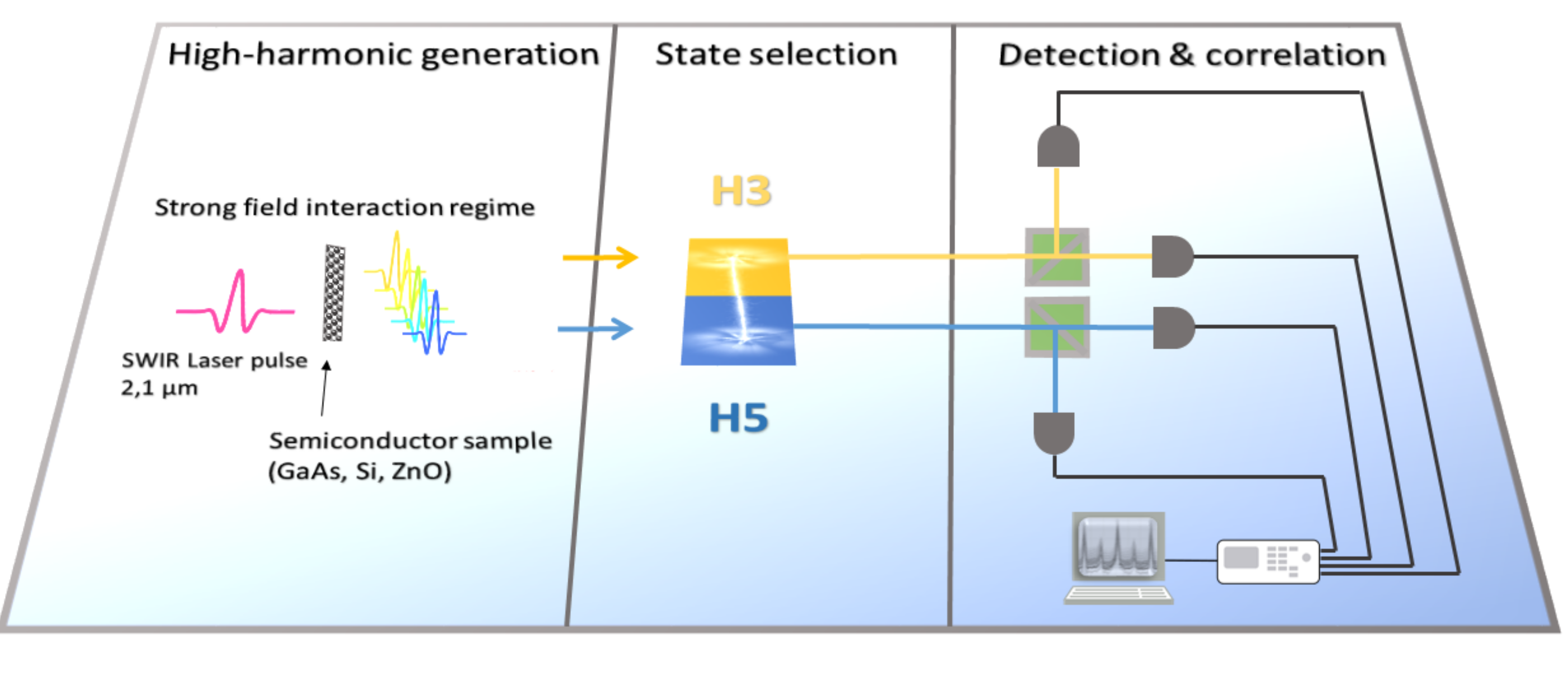
- 采用飞秒红外光纤激光器在室温下驱动ZnO、Si和GaAs中的高次谐波产生。
- 通过单光束和双光束哈纳布鲁克和特里斯(HBT)强度互相关测量提取二阶关联函数 $g^{(2)}$。
- 通过单光子计数测量光子统计,检测与经典行为的偏离,包括超泊松分布和泊松分布。
- 从实验数据计算 $R$ 参数,以检验经典柯西-施瓦茨不等式的违背,这是非经典多模关联的特征。
- 使用光谱滤波和偏振控制分离特定谐波阶次(H3和H5),以最小化背景噪声。
- 通过引入受控的光学损耗,进行损耗容忍型 $g^{(2)}$ 测量,以验证非经典信号的鲁棒性。
实验结果
研究问题
- RQ1半导体中的高次谐波产生能否产生如压缩或纠缠光子等非经典光态?
- RQ2随着激光强度增加,谐波发射的光子统计(如 $g^{(2)}$)如何演化?
- RQ3是否存在实验证据表明高次谐波发射中存在多体纠缠,表现为柯西-施瓦茨不等式的违背?
- RQ4能否在室温下使用标准、商用激光器和半导体材料观测到HHG中的非经典特征?
- RQ5测量的量子光学特性在检测链中面对光学损耗的鲁棒性如何?
主要发现
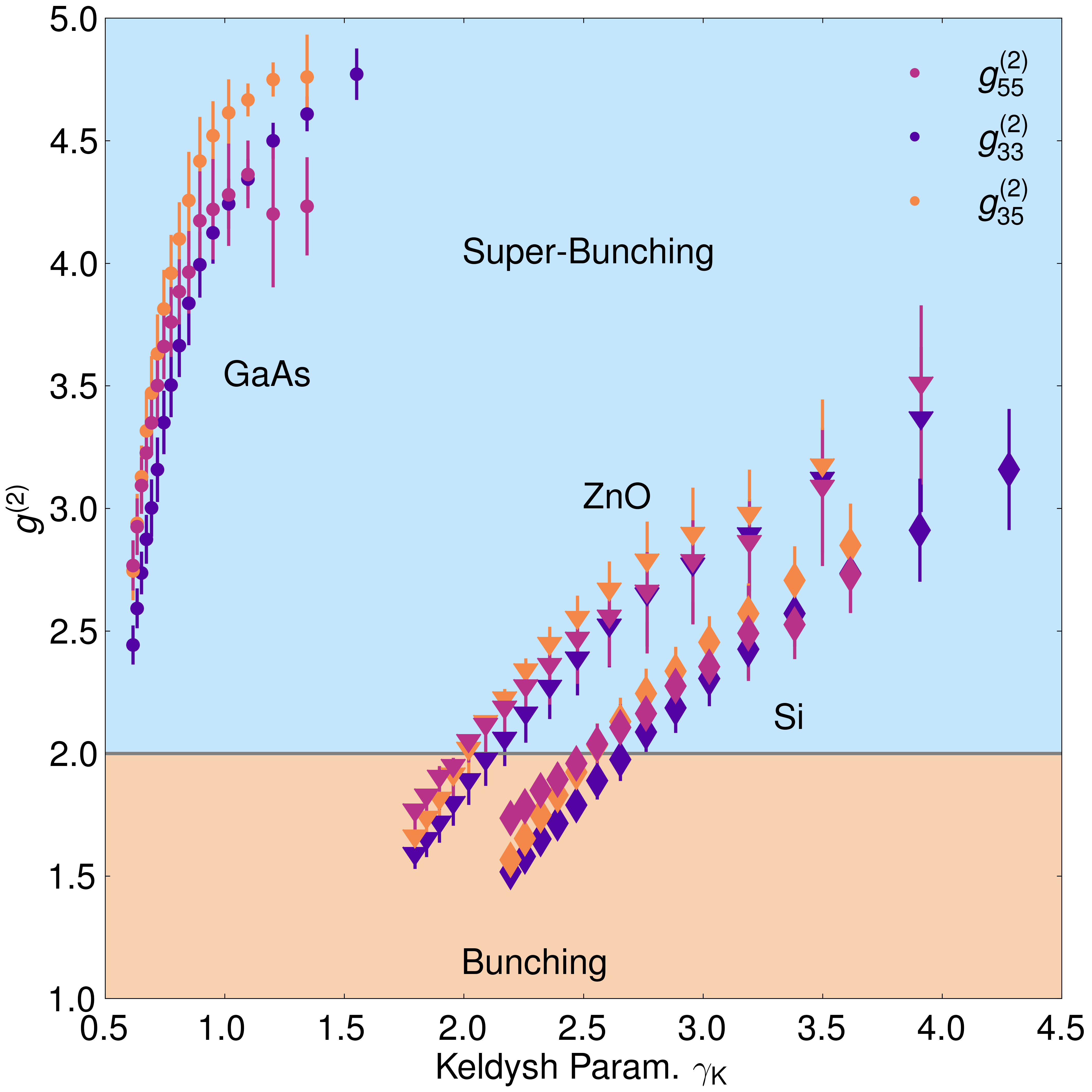
- 在ZnO和Si中,谐波发射的二阶关联函数 $g^{(2)}$ 随激光强度增加,从超泊松分布($g^{(2)} > 2$)降低至泊松分布($g^{(2)} \approx 1$),表明光子统计从经典向非经典转变。
- 实验观察到经典柯西-施瓦茨不等式被违背,$R > 1$ 在多个样品(ZnO、Si、GaAs)中均成立,证实了非经典多模关联的存在。
- $R$ 参数在所有测量的谐波对(H3–H5)中均超过经典极限1,直接证明了谐波发射中存在多体纠缠。
- 在受控光学损耗下,光子统计和 $g^{(2)}$ 值保持稳定,证实了非经典信号对探测器噪声和衰减的鲁棒性。
- 从微扰到非微扰HHG区域的转变,通过谐波光子产额的交叉点清晰标示,与 $g^{(2)}$ 行为的变化相关联。
- 结果在三种不同半导体材料(ZnO、Si、GaAs)中一致,其中GaAs表现出更强的光子聚集,表明材料依赖的非经典特性。
阅读本论文
在 Nubint 阅读器中打开原文,边读边就任意段落提问。
在 Nubint 中阅读本论文本解读由 AI 根据论文原文生成,引用前请核对原文。