
[论文解读] ExaRanker: Explanation-Augmented Neural Ranker
ExaRanker 提出了一种神经排序模型,通过在微调过程中生成自然语言解释和相关性标签,提升了检索性能,利用 GPT-3.5 等大语言模型为训练数据合成解释。该模型在仅使用三倍数据量的更大模型微调下性能相当,且推理成本为零,同时支持按需生成解释。
Recent work has shown that inducing a large language model (LLM) to generate explanations prior to outputting an answer is an effective strategy to improve performance on a wide range of reasoning tasks. In this work, we show that neural rankers also benefit from explanations. We use LLMs such as GPT-3.5 to augment retrieval datasets with explanations and train a sequence-to-sequence ranking model to output a relevance label and an explanation for a given query-document pair. Our model, dubbed ExaRanker, finetuned on a few thousand examples with synthetic explanations performs on par with models finetuned on 3x more examples without explanations. Furthermore, the ExaRanker model incurs no additional computational cost during ranking and allows explanations to be requested on demand.
研究动机与目标
- 通过引入自然语言解释作为额外监督信号,减少神经排序对大规模标注训练数据的依赖。
- 探究在相关性标签之前生成解释是否能提升检索任务中的模型性能。
- 通过利用 GPT-3.5 等大语言模型生成的合成解释,实现低资源检索设置下的性能提升。
- 在增加解释生成能力的同时,保持推理效率。
- 探索解释增强训练与现有方法(如 InPars 和 Promptagator)的互补作用。
提出的方法
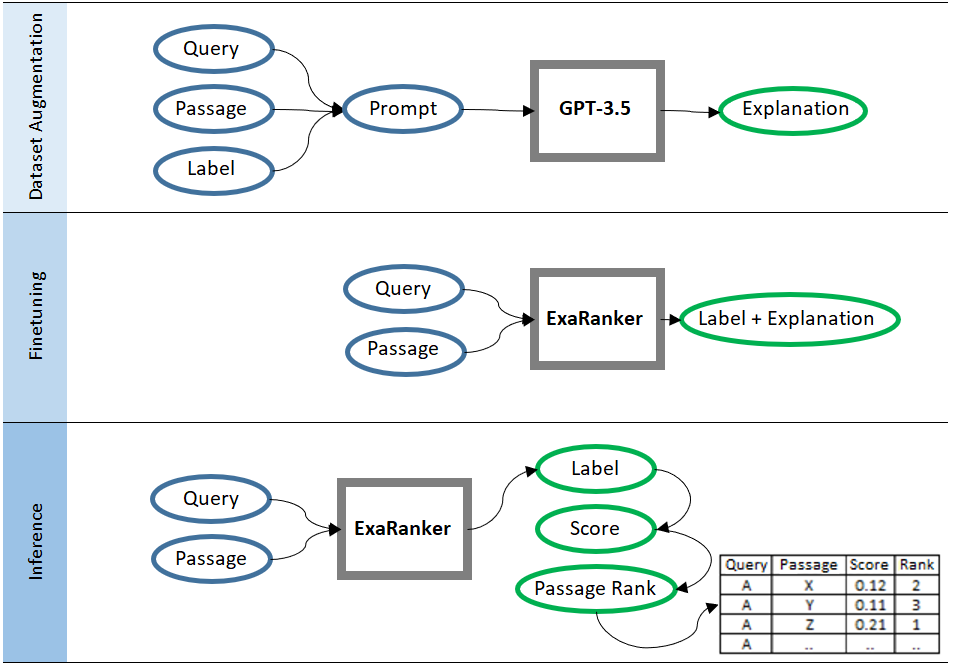
- 微调一个序列到序列模型,使其为查询-文档对生成相关性标签(是/否),随后生成自然语言解释。
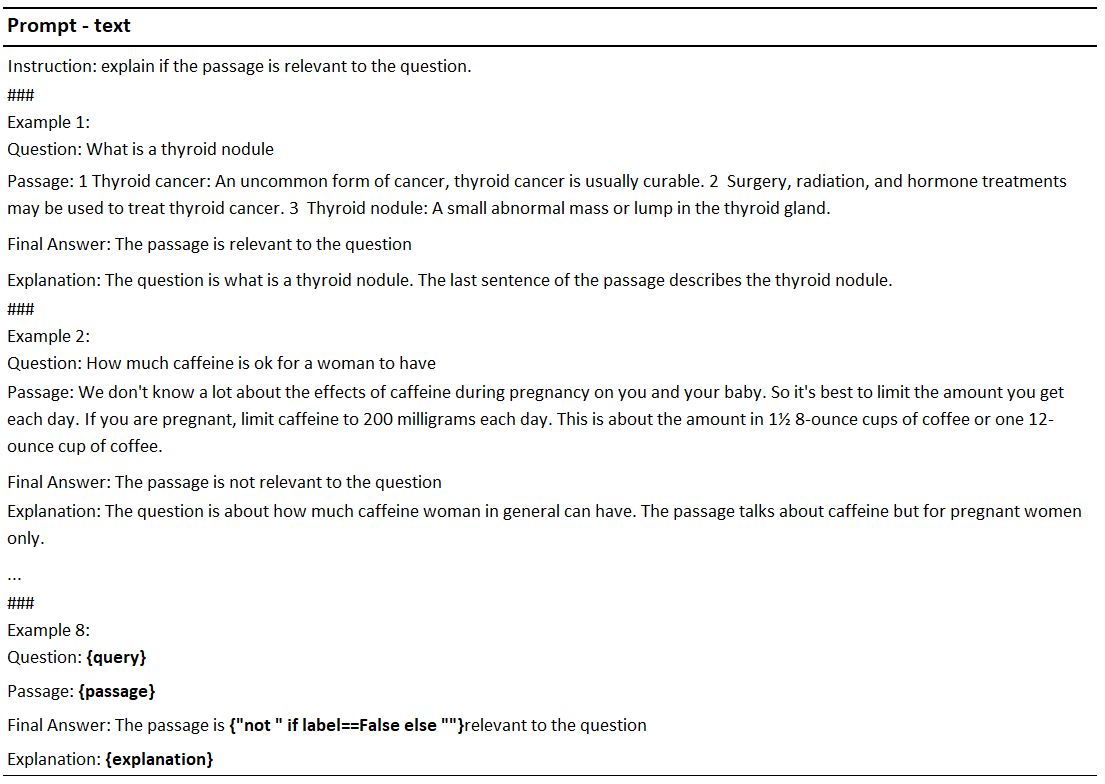
- 使用 GPT-3.5 配合 few-shot 提示,为 MS MARCO 数据集中 30,000 个查询-段落对生成合成解释。
- 将训练数据结构化为:{标签}. 解释: {生成的解释},以引导模型优先预测标签。
- 在数据增强过程中使用贪婪解码,并设置 256 个 token 的长度限制以生成解释。
- 推理时仅使用标签 token 的概率,以保持计算效率。
- 通过消融实验比较标签优先与解释优先的生成顺序,并在多个 BEIR 基准数据集上进行评估。
实验结果
研究问题
- RQ1在微调过程中引入自然语言解释是否能提升神经排序性能,尤其是在低数据场景下?
- RQ2生成顺序——先标签后解释,还是先解释后标签——是否对模型有效性具有关键影响?
- RQ3GPT-3.5 等大语言模型能否在大规模上有效生成高质量、与任务相关的检索数据解释?
- RQ4当与大规模已有标注数据结合时,解释增强训练是否仍具优势?
- RQ5模型是否能按需生成解释而不增加推理成本?
主要发现
- 仅使用 30,000 个样本(15,000 个正例,15,000 个负例)并结合合成解释进行微调的 ExaRanker,在 nDCG@10 上达到 0.680,与未使用解释但在三倍数据量上微调的模型性能相当。
- 先生成标签再生成解释的模型比相反顺序高出 9.6 个 nDCG@10 点,与思维链推理模式相反。
- 在进一步微调 400,000 个正样本数据集后,添加解释仅带来 0.2 个 nDCG@10 的提升,表明在数据充足时收益递减。
- 推理过程中无额外计算开销,因为仅使用标签 token 的概率。
- 该方法支持在不改变排序流水线的前提下,按需生成相关性预测的解释。
- 该方法与 InPars 和 Promptagator 等现有方法具有互补性,提示未来可集成使用。
阅读本论文
在 Nubint 阅读器中打开原文,边读边就任意段落提问。
在 Nubint 中阅读本论文本解读由 AI 根据论文原文生成,引用前请核对原文。