
[论文解读] Experimental Study: Enhancing Voice Spoofing Detection Models with wav2vec 2.0
本论文提出通过使用微调后的wav2vec 2.0模型作为特征提取器,从预训练模型中选择并微调特定的Transformer层,以增强语音欺骗检测。该方法在ASVspoof 2019 LA数据集上实现了最先进性能,使用XLS-R(1B)与RawNet2时,最小t-DCF为0.0032,EER为0.12%。
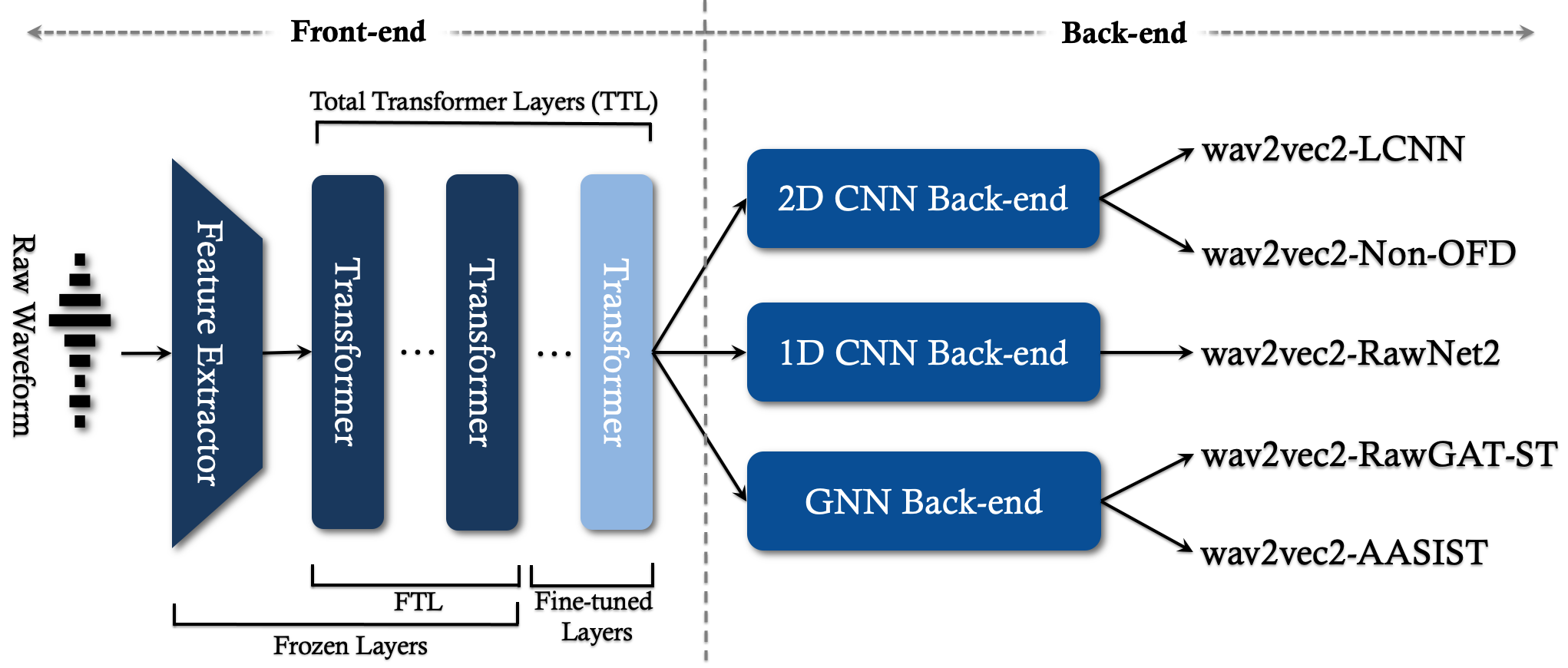
Conventional spoofing detection systems have heavily relied on the use of handcrafted features derived from speech data. However, a notable shift has recently emerged towards the direct utilization of raw speech waveforms, as demonstrated by methods like SincNet filters. This shift underscores the demand for more sophisticated audio sample features. Moreover, the success of deep learning models, particularly those utilizing large pretrained wav2vec 2.0 as a featurization front-end, highlights the importance of refined feature encoders. In response, this research assessed the representational capability of wav2vec 2.0 as an audio feature extractor, modifying the size of its pretrained Transformer layers through two key adjustments: (1) selecting a subset of layers starting from the leftmost one and (2) fine-tuning a portion of the selected layers from the rightmost one. We complemented this analysis with five spoofing detection back-end models, with a primary focus on AASIST, enabling us to pinpoint the optimal configuration for the selection and fine-tuning process. In contrast to conventional handcrafted features, our investigation identified several spoofing detection systems that achieve state-of-the-art performance in the ASVspoof 2019 LA dataset. This comprehensive exploration offers valuable insights into feature selection strategies, advancing the field of spoofing detection.
研究动机与目标
- 通过利用大规模预训练的wav2vec 2.0模型作为深度音频特征提取器,替代手工设计的特征,以提升语音欺骗检测性能。
- 通过选择性地选取层并进行微调,缓解通用预训练模型与欺骗检测任务之间的领域差异问题。
- 识别wav2vec 2.0模型的最优配置,特别是所选和微调的Transformer层的数量,以用于欺骗检测系统。
- 在ASVspoof 2019 LA基准上,评估该方法在多种后端模型(尤其是AASIST和RawNet2)上的有效性。
- 通过使用wav2vec 2.0进行迁移学习,建立语音欺骗检测的新最先进性能基线。
提出的方法
- 将预训练的wav2vec 2.0模型(XLS-R(1B)、XLSR-53)用作原始音频波形的前端特征提取器。
- 采用两阶段策略:首先从完整模型中选择最左侧的一组Transformer层;其次,对所选子集中最右侧的部分层进行微调。
- 引入两个关键超参数:#TTL(所选Transformer层的数量)和#FTL(微调层的数量),并通过网格搜索进行优化。
- 在wav2vec 2.0前端之上,使用五种欺骗检测后端模型(LCNN、Non-OFD、RawNet2、RawGAT-ST和AASIST)进行评估。
- 端到端训练后端模型,使用提取的特征,重点以AASIST进行详细的消融研究和配置分析。
- 利用迁移学习原理,将通用的wav2vec 2.0表征适配到欺骗检测的特定领域。
实验结果
研究问题
- RQ1从预训练的wav2vec 2.0模型中提取多少个Transformer层,可实现语音欺骗检测的最佳性能?
- RQ2对所选层的子集进行微调,如何提升领域适应性和检测性能?
- RQ3wav2vec 2.0的哪种变体与哪种后端模型组合能在ASVspoof 2019 LA数据集上实现最佳欺骗检测性能?
- RQ4经过精心选择和微调的wav2vec 2.0前端是否能超越传统手工特征和现有最先进系统?
- RQ5在不同后端架构下,模型规模(如XLS-R(1B)与XLSR-53)对欺骗检测性能有何影响?
主要发现
- 使用XLS-R(1B)与RawNet2作为后端的所提方法,在ASVspoof 2019 LA数据集上实现了最先进性能,最小t-DCF为0.0032,EER为0.12%。
- 对所选wav2vec 2.0模型中Transformer层的最右侧部分进行微调,相比使用冻结模型,显著提升了性能。
- 在ASVspoof 2019 LA数据集上,语音欺骗检测的最优所选层数量(#TTL)位于{12, 15, 18}范围内。
- wav2vec 2.0 + AASIST系统实现了0.22%的EER和0.0063的t-DCF,展示了在多种指标上的强劲性能。
- XLS-R(1B)模型优于较小的变体(如XLSR-53和BASE),凸显了在正确微调下,更大、参数更丰富的模型的优势。
- 该方法显著优于先前的最先进系统,包括wav2vec 2.0 + VIB和wav2vec 2.0 + ASP,证实了所提出的层选择与微调策略的有效性。
阅读本论文
在 Nubint 阅读器中打开原文,边读边就任意段落提问。
在 Nubint 中阅读本论文本解读由 AI 根据论文原文生成,引用前请核对原文。