
[论文解读] Explainable Data-driven Modeling of Adsorption Energy in Heterogeneous Catalysis
本文将浅层机器学习模型与事后 SHAP 分析和符号回归相结合,利用 OC20 数据解释吸附体系中吸附物–催化剂的吸附能预测,强调吸附物性质为主要驱动因素并推导出可解释的关系。
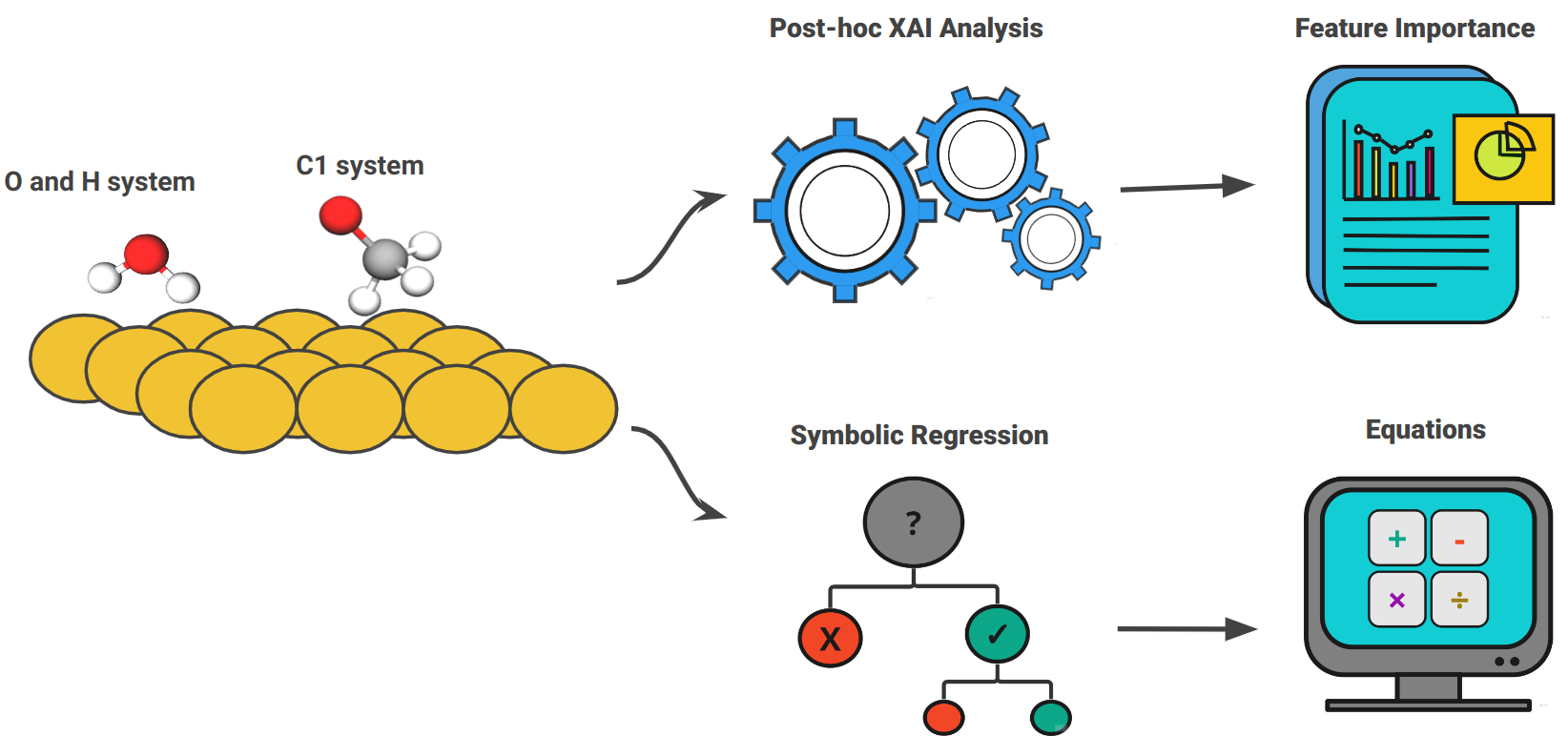
The increasing popularity of machine learning (ML) in catalysis has spurred interest in leveraging these techniques to enhance catalyst design. Our study aims to bridge the gap between physics-based studies and data-driven methodologies by integrating ML techniques with eXplainable AI (XAI). Specifically, we employ two XAI techniques: Post-hoc XAI analysis and Symbolic Regression. These techniques help us unravel the correlation between adsorption energy and the properties of the adsorbate-catalyst system. Leveraging a large dataset such as the Open Catalyst Dataset (OC20), we employ a combination of shallow ML techniques and XAI methodologies. Our investigation involves utilizing multiple shallow machine learning techniques to predict adsorption energy, followed by post-hoc analysis for feature importance, inter-feature correlations, and the influence of various feature values on the prediction of adsorption energy. The post-hoc analysis reveals that adsorbate properties exert a greater influence than catalyst properties in our dataset. The top five features based on higher Shapley values are adsorbate electronegativity, the number of adsorbate atoms, catalyst electronegativity, effective coordination number, and the sum of atomic numbers of the adsorbate molecule. There is a positive correlation between catalyst and adsorbate electronegativity with the prediction of adsorption energy. Additionally, symbolic regression yields results consistent with SHAP analysis. It deduces a mathematical relationship indicating that the square of the catalyst electronegativity is directly proportional to the adsorption energy. These consistent correlations resemble those derived from physics-based equations in previous research. Our work establishes a robust framework that integrates ML techniques with XAI, leveraging large datasets like OC20 to enhance catalyst design through model explainability.
研究动机与目标
- 弥合吸附能建模中数据驱动的机器学习与基于物理的理解之间的差距。
- 确定哪些吸附物和催化剂特征对吸附能影响最大。
- 通过 SHAP 分析和符号回归为机器学习预测提供可解释的解释。
- 展示事后解释与符号回归结果之间的一致性。
- 利用 OC20 促成通过可解释模型进行催化剂设计的洞察。
提出的方法
- 在基于 OC20 的特征上训练浅层机器学习模型(Adaboost、XGBoost、SVR、KRR、LASSO),以预测吸附能。
- 应用 SHAP 事后分析以确定特征重要性和特征之间的相关性。
- 使用 PySR 进行符号回归,推导将输入与吸附能联系起来的可解释方程。
- 将 SHAP 得出的见解与符号回归方程进行比较,以验证物理合理性。
- 使用一个子集(2886 个体系)进行事后分析,以及一个氢吸附物子集(994 个体系)进行符号回归。
实验结果
研究问题
- RQ1在基于 OC20 的数据集中,哪些特征对吸附能预测的影响最强?
- RQ2SHAP 派生的解释是否与符号回归确定的物理驱动关系一致?
- RQ3是否存在一个简单的数学表达式可以捕捉催化剂和吸附物特征对吸附能的依赖?
- RQ4吸附物特征在驱动吸附能预测方面与催化剂特征相比有何差异?
主要发现
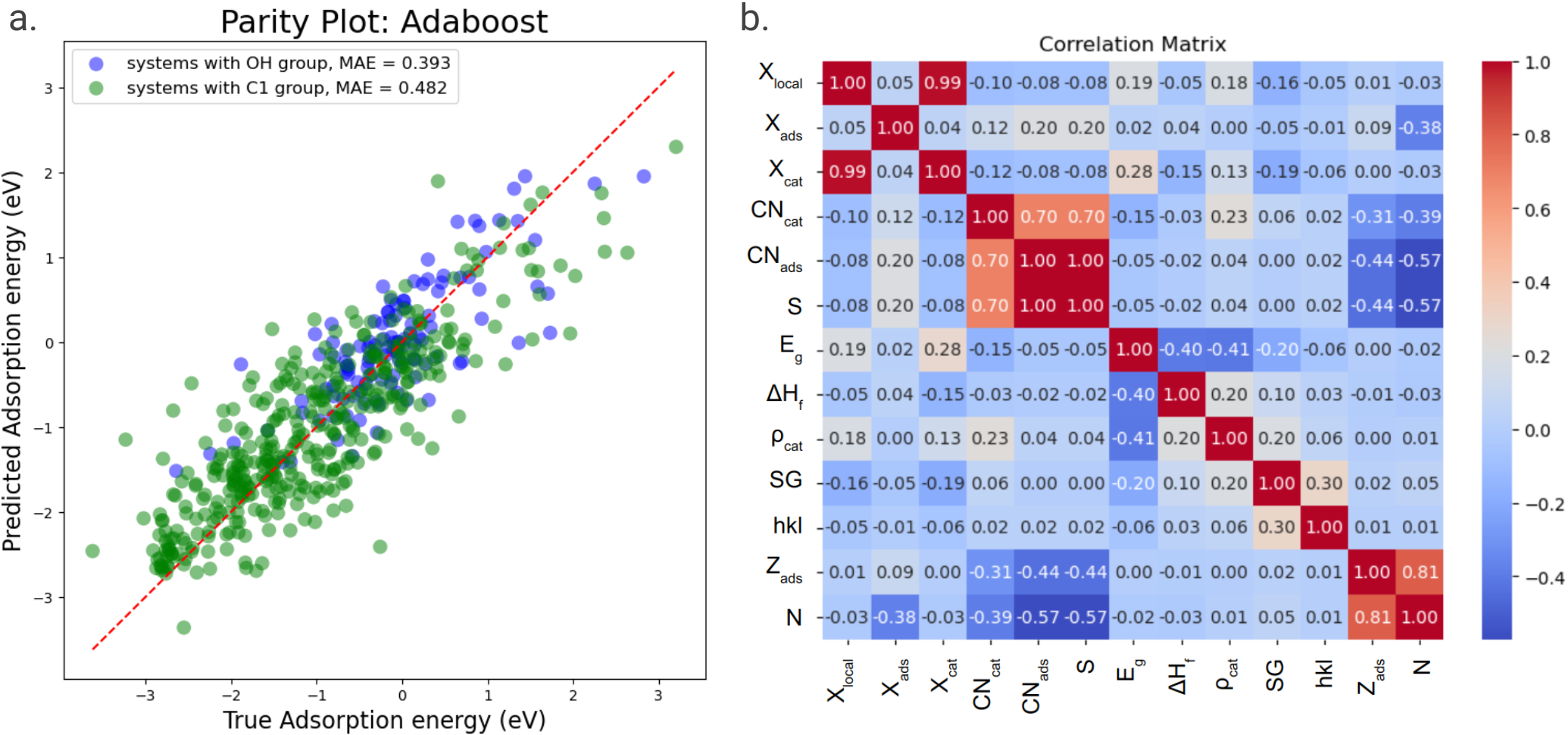
- 按 SHAP 重要性排序的前五个特征:吸附物的电负性、吸附物原子数、催化剂电负性、有效配位数,以及吸附物原子序数之和。
- 吸附物性质对吸附能的影响大于催化剂性质。
- 在该数据集中观察到催化剂电负性与吸附能之间的正相关。
- 符号回归得出的关系与 SHAP 结果一致,尤其是在若干方程中 ΔE_ads ∝ X_cat^2。
- PySR 推导的 MAE 通常低于 Trasatti 参考方程,表明表达式更简洁且可靠。
- 催化剂体相的电负性可以作为吸附研究的表面电负性的代理变量。
阅读本论文
在 Nubint 阅读器中打开原文,边读边就任意段落提问。
在 Nubint 中阅读本论文本解读由 AI 根据论文原文生成,引用前请核对原文。