
[论文解读] Explicit Correspondence Matching for Generalizable Neural Radiance Fields
MatchNeRF 引入通过 Transformer 提取特征的组级余弦相似性实现显式跨视图对应匹配,为可泛化的 NeRF 提供几何先验,在仅需两视图的情况下达到最先进的结果。
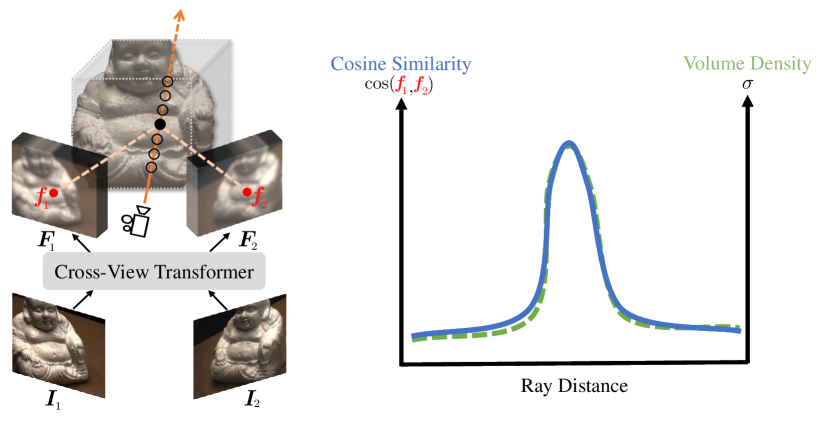
We present a new generalizable NeRF method that is able to directly generalize to new unseen scenarios and perform novel view synthesis with as few as two source views. The key to our approach lies in the explicitly modeled correspondence matching information, so as to provide the geometry prior to the prediction of NeRF color and density for volume rendering. The explicit correspondence matching is quantified with the cosine similarity between image features sampled at the 2D projections of a 3D point on different views, which is able to provide reliable cues about the surface geometry. Unlike previous methods where image features are extracted independently for each view, we consider modeling the cross-view interactions via Transformer cross-attention, which greatly improves the feature matching quality. Our method achieves state-of-the-art results on different evaluation settings, with the experiments showing a strong correlation between our learned cosine feature similarity and volume density, demonstrating the effectiveness and superiority of our proposed method. The code and model are on our project page: https://donydchen.github.io/matchnerf
研究动机与目标
- 开发一个可泛化的 NeRF,能够用很少的输入视图(最少两视图)合成未见场景的新视图。
- 利用显式跨视图对应信息为 NeRF 密度预测提供几何先验。
- 通过使用基于对应关系的先验来提升泛化能力,避免对 3D 代价体的依赖。
- 在标准基准测试(DTU、Real Forward-Facing、Blender)下在 3 视图和 2 视图设置中展示最先进的性能。
提出的方法
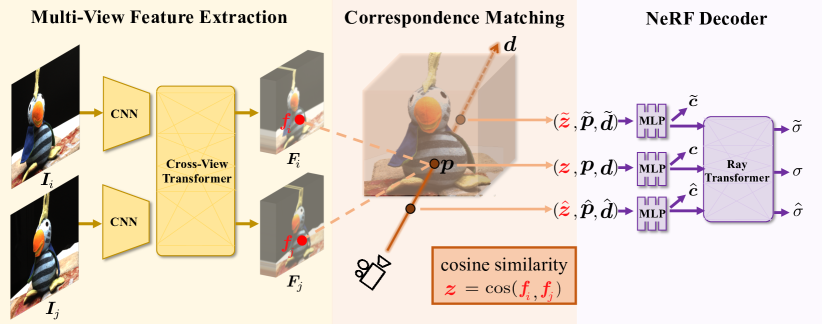
- 使用 Transformer 提取多视图图像特征,模型通过成对视图处理来建模跨视图交互。
- 将 3D 点投影到每个视图以采样 Transformer 特征,并计算成对的组级余弦相似性作为几何先验 z。
- 在所有视图对之间聚合余弦相似性,得到一个对视图无关的 z,用以对 NeRF 解码器进行条件化。
- 用 NeRF 解码器预测颜色和值密度,同时在光线上应用射线 Transformer 以实现跨点交互。
- 端到端训练,使用光度损失,不依赖地面的真实几何信息。
实验结果
研究问题
- RQ1显式跨视图特征对应是否可以提供可靠的几何先验,用于没有 3D 代价体的可泛化 NeRF?
- RQ2跨视图特征的分组余弦相似性是否比简单的相似性或隐式相似学习更能提升密度预测和渲染质量?
- RQ3在标准基准上,不同输入视图数量(2 与 3)时,该方法的表现如何?
- RQ4该方法对参考视图的选择是否鲁棒,能否推广到未见场景?
主要发现
- MatchNeRF在 3 视图和 2 视图设置下在 DTU、Real Forward-Facing、Blender 上达到最先进的结果。
- 成对 Transformer 特征之间的显式组级余弦相似性与体积密度显著相关,帮助几何预测。
- 同时使用 1/8 与 1/4 分辨率特征以及射线 Transformer 可获得最佳性能,编码器中的跨注意力带来显著改进。
- 该方法对视图无关,相较于基于代价体的方法(如 MVSNeRF)对参考视图的敏感度较低。
- 即使对比基线在输入视图数量上高于该方法(如 GPNR 设置中的 5–10 视图),MatchNeRF 仍优于基线。
阅读本论文
在 Nubint 阅读器中打开原文,边读边就任意段落提问。
在 Nubint 中阅读本论文本解读由 AI 根据论文原文生成,引用前请核对原文。