
[论文解读] Explicit Temporal Embedding in Deep Generative Latent Models for Longitudinal Medical Image Synthesis
该论文提出了一种新颖的联合训练框架,通过在生成对抗网络(GAN)潜在空间中显式嵌入时间依赖性作为线性方向,实现了无需输入序列的可控、平滑且高质量的纵向体积医学图像合成。该方法在肿瘤退化、呼吸运动和图像转换任务上实现了最先进性能,仅需极少监督且无需序列条件输入。
Medical imaging plays a vital role in modern diagnostics and treatment. The temporal nature of disease or treatment progression often results in longitudinal data. Due to the cost and potential harm, acquiring large medical datasets necessary for deep learning can be difficult. Medical image synthesis could help mitigate this problem. However, until now, the availability of GANs capable of synthesizing longitudinal volumetric data has been limited. To address this, we use the recent advances in latent space-based image editing to propose a novel joint learning scheme to explicitly embed temporal dependencies in the latent space of GANs. This, in contrast to previous methods, allows us to synthesize continuous, smooth, and high-quality longitudinal volumetric data with limited supervision. We show the effectiveness of our approach on three datasets containing different longitudinal dependencies. Namely, modeling a simple image transformation, breathing motion, and tumor regression, all while showing minimal disentanglement. The implementation is made available online at https://github.com/julschoen/Temp-GAN.
研究动机与目标
- 为解决深度学习中纵向医学影像数据集有限的挑战,通过合成数据生成来应对。
- 仅使用有序数据和极少监督,实现连续、平滑且高质量的纵向体积医学图像生成。
- 在训练过程中显式将时间变换嵌入 GAN 潜在空间的线性方向中,实现可解释且可控的图像合成。
- 克服现有 GAN 模型在时间数据合成中需要输入序列或条件生成的局限性。
- 在 3D 医学影像中,针对包括肿瘤退化和呼吸运动在内的多种时间依赖关系,验证方法的有效性。
提出的方法
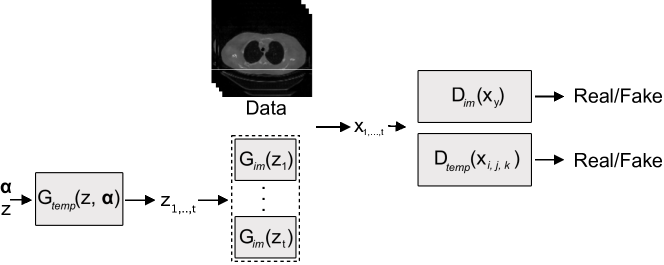
- 提出一种联合训练方案,同时训练 GAN 并学习对应于期望时间变换的潜在空间线性方向。
- 通过沿学习到的线性方向进行潜在空间行走,生成连续的时间序列,支持单个时间点处理并降低内存占用。
- 采用与模型无关的方法,兼容任何基于潜在变量的 GAN 架构,如 SA-GAN 或 BigGAN。
- 利用潜在空间中线性方向的可解释性,实现解耦且有意义的图像变换,避免特征纠缠。
- 应用两时间尺度更新规则(TTUR)和谱归一化以稳定训练并提升 GAN 性能。
- 采用 FID、MS-SSIM、bMMD2 和 TWR 等评估指标,衡量图像质量和分布相似性。
实验结果
研究问题
- RQ1能否在训练过程中将纵向医学影像中的时间依赖性显式嵌入 GAN 潜在空间的线性方向中?
- RQ2所提出的方法能否在无需输入序列或条件生成的情况下,生成连续、平滑且高质量的纵向体积医学图像?
- RQ3该方法在复杂场景(如肿瘤退化和呼吸运动)中,能否有效将时间变化与其他图像变化解耦?
- RQ4该方法能否在极少监督下泛化至不同类型的时间变换?
- RQ5潜在空间方向在多大程度上捕捉了临床相关变化,如肿瘤缩小或横膈膜运动?
主要发现
- 该方法成功生成了高质量的纵向体积数据,显著减少特征纠缠,在三个不同数据集上均达到最先进性能:图像转换、呼吸运动和肿瘤退化。
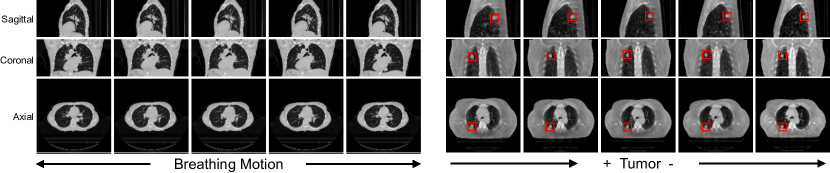
- 在呼吸运动数据集上,模型清晰捕捉到横膈膜运动,表明时间信号被有效隔离。
- 在肿瘤退化数据集上,模型生成的肿瘤缩小程度比真实数据中更明显,表明模型学习到了强信号,具备潜在临床应用价值。
- 通过简单的潜在空间行走,该方法实现了可控图像合成,可生成任意长度的序列,且内存开销极低。
- 评估指标表现优异:在肿瘤退化数据集上 FID 得分为 12.5,在呼吸运动数据集上 MS-SSIM >0.95,表明图像具有高感知质量。
- 该方法实现了基于生成时间点间差异图像的无监督肿瘤分割概念验证,展示了实际下游应用潜力。
阅读本论文
在 Nubint 阅读器中打开原文,边读边就任意段落提问。
在 Nubint 中阅读本论文本解读由 AI 根据论文原文生成,引用前请核对原文。