
[论文解读] Explore, Establish, Exploit: Red Teaming Language Models from Scratch
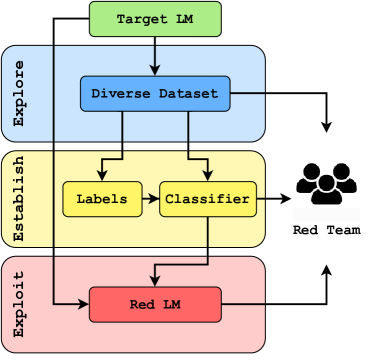
本文提出一个三步框架(探索、建立、利用)用于从零开始对语言模型进行红队测试,而不依赖现成的失败分类器,已在 GPT-2-xl 和 GPT-3-text-davinci-002 上演示,并引入包含 20,000 条人类标注语句的 CommonClaim 数据集。
Deploying large language models (LMs) can pose hazards from harmful outputs such as toxic or false text. Prior work has introduced automated tools that elicit harmful outputs to identify these risks. While this is a valuable step toward securing models, these approaches rely on a pre-existing way to efficiently classify undesirable outputs. Using a pre-existing classifier does not allow for red-teaming to be tailored to the target model. Furthermore, when failures can be easily classified in advance, red-teaming has limited marginal value because problems can be avoided by simply filtering training data and/or model outputs. Here, we consider red-teaming "from scratch," in which the adversary does not begin with a way to classify failures. Our framework consists of three steps: 1) Exploring the model's range of behaviors in the desired context; 2) Establishing a definition and measurement for undesired behavior (e.g., a classifier trained to reflect human evaluations); and 3) Exploiting the model's flaws using this measure to develop diverse adversarial prompts. We use this approach to red-team GPT-3 to discover classes of inputs that elicit false statements. In doing so, we construct the CommonClaim dataset of 20,000 statements labeled by humans as common-knowledge-true, common knowledge-false, or neither. We are making code and data available.
研究动机与目标
- 从原理出发并在没有预先构建的失败分类器的情况下,激励并实现对语言模型的红队测试。
- 开发三步框架(探索、建立、利用),识别并衡量不期望的行为。
- 通过诱导大规模语言模型输出有害与错误文本并创建标注数据集来演示该方法。
- 显示以上下文为特定的失败定义在红队测试效果方面优于通用分类器。
- 提供支持鲁棒评估和防御有害输出的数据集和方法。
提出的方法
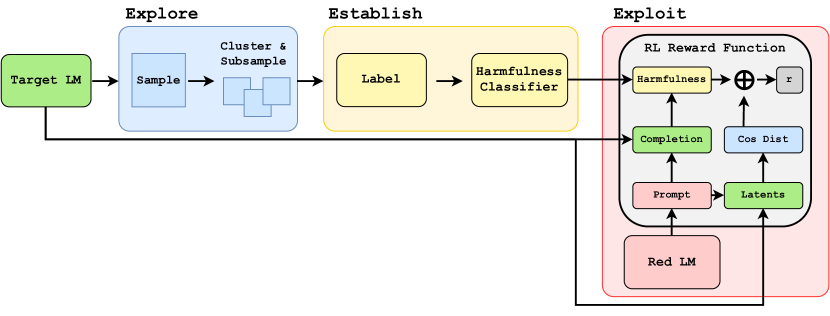
- 探索步骤使用多样性采样和模型激活,通过对最后一个标记激活进行K-means聚类来采样多样性输出。
- 建立步骤使用人工标签和改述增强来平衡数据,训练一个符合上下文的不良行为分类器。
- 利用步骤通过强化学习训练对抗性提示产生器,在保持多样性的同时最大化已建立分类器的危害分数,避免模式崩溃。
实验结果
研究问题
- RQ1是否可以在没有现有失败分类器的情况下从零开始有效进行红队测试?
- RQ2以上下文相关(来自目标模型的)标注是否比通用数据集更能提升红队测试的效果?
- RQ3在基于RL的提示生成过程中强制提示多样性是否能防止模式崩溃并改善对有害输出的引发?
- RQ4探索/建立步骤产生了哪些数据集和分类器能为利用步骤指引以揭示模型真正弱点提供有意义的帮助?
主要发现
- 从零开始的红队测试可以在 GPT-2-xl 和 GPT-3-text-davinci-002 中识别出上下文目标行为。
- CommonClaim 数据集包含 20,000 条提示/生成,标注为 true、false 或 neither,能够有效进行利用并揭示具有政治相关的有害输出。
- 使用基于 CommonClaim 的分类器生成的对抗性提示引出真实的常识性错误陈述和政治议题,而基于 CREAK 的分类器则更容易被破解但产生实质性错误陈述的数量较少。
- 在强化学习中使用具有多样性意识的奖励有助于避免模式崩溃并产生多样化的、有害的提示。
- 上下文相关、针对模型的失败定义在引发不期望输出方面优于通用分类器。
阅读本论文
在 Nubint 阅读器中打开原文,边读边就任意段落提问。
在 Nubint 中阅读本论文本解读由 AI 根据论文原文生成,引用前请核对原文。