
[论文解读] Exploring Collaboration Mechanisms for LLM Agents: A Social Psychology View
论文通过模拟具有不同特征和思维模式的代理人,研究多代理LLM社会的协作机制,评估在MMLU、MATH和Chess Move Validity数据集上的各种策略,以揭示类似人类的社交行为和最优协作模式。
As Natural Language Processing (NLP) systems are increasingly employed in intricate social environments, a pressing query emerges: Can these NLP systems mirror human-esque collaborative intelligence, in a multi-agent society consisting of multiple large language models (LLMs)? This paper probes the collaboration mechanisms among contemporary NLP systems by melding practical experiments with theoretical insights. We fabricate four unique `societies' comprised of LLM agents, where each agent is characterized by a specific `trait' (easy-going or overconfident) and engages in collaboration with a distinct `thinking pattern' (debate or reflection). Through evaluating these multi-agent societies on three benchmark datasets, we discern that certain collaborative strategies not only outshine previous top-tier approaches, but also optimize efficiency (using fewer API tokens). Moreover, our results further illustrate that LLM agents manifest human-like social behaviors, such as conformity and consensus reaching, mirroring foundational social psychology theories. In conclusion, we integrate insights from social psychology to contextualize the collaboration of LLM agents, inspiring further investigations into the collaboration mechanism for LLMs. We commit to sharing our code and datasets\footnote{\url{https://github.com/zjunlp/MachineSoM}.}, hoping to catalyze further research in this promising avenue.
研究动机与目标
- 探索不同代理人特征(随和型 vs. 自信过度)和思维模式(辩论 vs. 反思)如何影响多代理协作。
- 在三个基准上评估一系列协作策略,以识别有效模式与令牌使用更高效的方式。
- 研究LLM代理互动是否展现出类似人类社会的社交动力学,如从众或多数决。
- 提供设计更高效且具社交意识的多代理AI系统的见解。
提出的方法
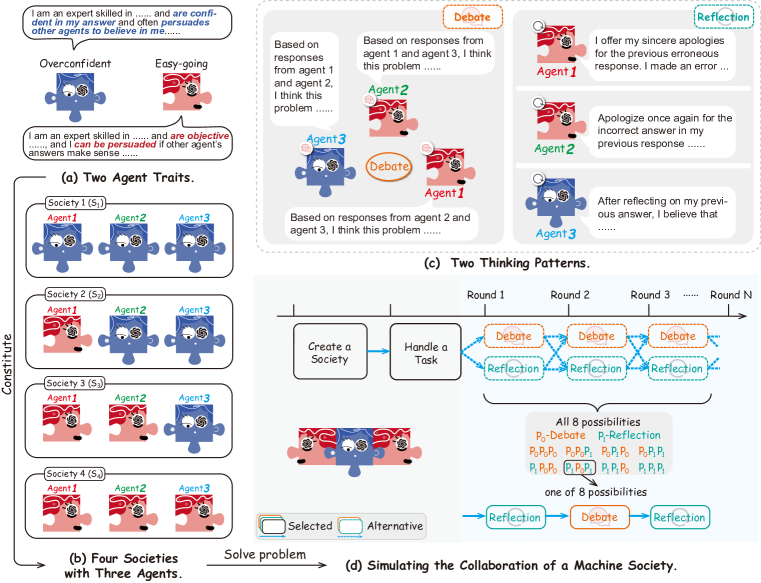
- 构建四个三人LLM代理社会,固定每个代理的特征配置(随和型或自信过度)。
- 定义两种思维模式:辩论(p0)和反思(p1);评估八种可能的三轮策略排列。
- 以GPT-3.5-turbo作为LLM引擎,在MMLU、MATH和Chess Move Validity数据集上运行实验。
- 衡量准确率(Acc)、令牌成本(Cost)以及一个表示某策略在五次试验中是否击败连续辩论基线的WIN-TIE(W-T)指标。
- 分析结果以识别策略顺序、特征组合和轮次结构对性能的影响。
- 通过在GitHub分享代码和数据来提供可复现性。
实验结果
研究问题
- RQ1RQ1: 不同协作策略与社会中的社会体对问题解决有效性有何影响?
- RQ2RQ2: 机器的社会协作与人类社会的动态在多大程度上相似?
- RQ3RQ3: 代理数量与轮次对协作性能和稳定性有何影响?
- RQ4RQ4: 不同思维模式序列(辩论与反思)如何影响幻觉风险与准确性?
主要发现
- 协作策略的顺序对性能有显著影响,通常以辩论(p0)开头的策略在各数据集上表现优于其他策略。
- 纯反思序列会增加不稳定性和幻觉风险,而辩论有助于稳定协作结果并抵消自信过度。
- 代理特征组成(随和型 vs. 自信过度)对性能的影响较小,较大影响来自思维模式的排序。
- 增加代理数量通常降低平均性能并提高方差,但可降低不稳定性并体现群体动力学效应。
- MMLU在不同社会体和策略中的准确率差异显著,p0p0p1在S1–S4上常表现良好;成本和W-T指标随策略和数据集而异。
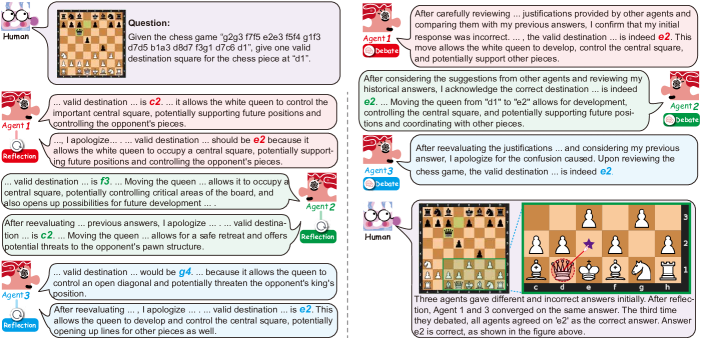
- 定性案例揭示类似人类的社交动力学,如从众(groupthink)以及代理对话中集体智能(SoM)的涌现。
阅读本论文
在 Nubint 阅读器中打开原文,边读边就任意段落提问。
在 Nubint 中阅读本论文本解读由 AI 根据论文原文生成,引用前请核对原文。