
[论文解读] Exploring Large-Scale Entanglement in Quantum Simulation
该论文在51离子量子模拟器中实现了对纠缠哈密顿量的实验学习,揭示了一维XXZ海森堡链基态和激发态中纠缠的局域结构。关键结果是令人信服的证据,表明纠缠主要集中在子系统边界附近,证实了大规模量子系统中纠缠哈密顿量的局域性。
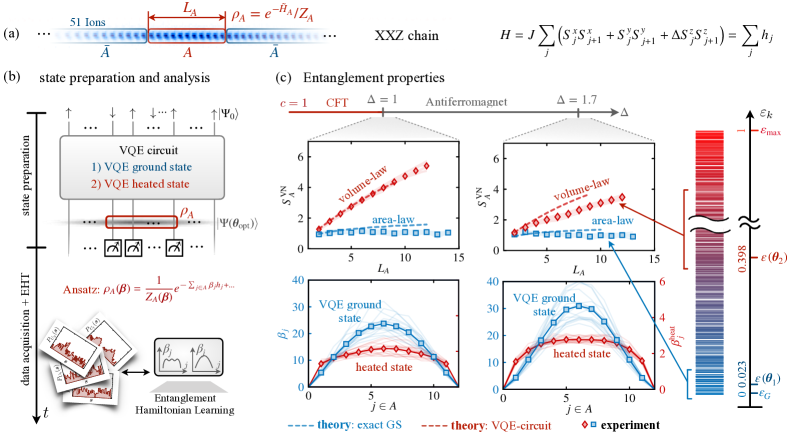
Entanglement is a distinguishing feature of quantum many-body systems, and uncovering the entanglement structure for large particle numbers in quantum simulation experiments is a fundamental challenge in quantum information science. Here we perform experimental investigations of entanglement based on the entanglement Hamiltonian, as an effective description of the reduced density operator for large subsystems. We prepare ground and excited states of a 1D XXZ Heisenberg chain on a 51-ion programmable quantum simulator and perform sample-efficient `learning' of the entanglement Hamiltonian for subsystems of up to 20 lattice sites. Our experiments provide compelling evidence for a local structure of the entanglement Hamiltonian. This observation marks the first instance of confirming the fundamental predictions of quantum field theory by Bisognano and Wichmann, adapted to lattice models that represent correlated quantum matter. The reduced state takes the form of a Gibbs ensemble, with a spatially-varying temperature profile as a signature of entanglement. Our results also show the transition from area to volume-law scaling of Von Neumann entanglement entropies from ground to excited states. As we venture towards achieving quantum advantage, we anticipate that our findings and methods have wide-ranging applicability to revealing and understanding entanglement in many-body problems with local interactions including higher spatial dimensions.
研究动机与目标
- 利用量子模拟研究大规模量子多体系统中的纠缠结构。
- 在1D XXZ海森堡链中,对最多20个自旋的子系统实验学习纠缠哈密顿量。
- 检验纠缠哈密顿量表现出局域结构(尤其是子系统边界附近)的假设。
- 确认纠缠哈密顿量参数作为局域逆温度的物理解释。
- 提供主导纠缠贡献在纠缠切附近空间局域化的证据。
提出的方法
- 该研究使用可编程的51离子量子模拟器制备一维XXZ海森堡链的基态和激发态。
- 通过样本高效的量子态层析与优化技术,在最多20个自旋的子系统上学习纠缠哈密顿量。
- 利用泡利弦期望值重建子系统的约化密度矩阵,重点关注贯穿整个自旋链的弦。
- 理论建模假设为吉布斯态形式,ρ_A ∝ exp(−Ĥ_EH),其中Ĥ_EH为具有位置依赖参数β_j的纠缠哈密顿量。
- 通过计算布拉斯科夫-施密特向量与基态之间的能量密度差异,分析纠缠本征态的空间结构。
- 数值与实验分析均表明,在大系统极限下,非对角相干项趋于消失,从而支持使用非相干混合近似。
实验结果
研究问题
- RQ1在量子自旋链中,大规模子系统的纠缠哈密顿量是否表现出局域结构?
- RQ2主导纠缠贡献是否局域在子系统的边界附近?
- RQ3纠缠哈密顿量参数β_j能否被解释为局域逆温度?
- RQ4纠缠谱与施密特向量如何反映纠缠结构中的空间非均匀性?
- RQ5多体波函数中的非对角相干项在大系统中在多大程度上影响约化密度矩阵?
主要发现
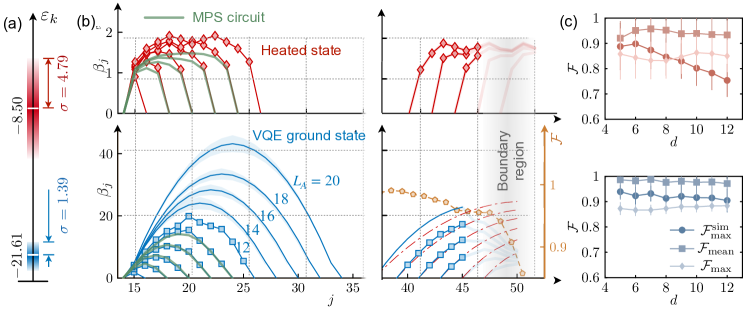
- 在一维XXZ链中,最多20个自旋的子系统,其纠缠哈密顿量表现出局域结构,参数β_j在中间最大,靠近纠缠切处最小。
- 在系统尺寸L ∼ 10^3时,子系统的约化密度矩阵与吉布斯态ρ_A ∝ exp(−Ĥ_EH)不可区分,表明多体波函数中的非对角相干项趋于消失。
- 纠缠谱的主导施密特向量对应于靠近纠缠切的局域激发,这由低能纠缠本征态中能量密度差异的峰值所证实。
- 纠缠谱的空间非均匀性支持将β_j解释为局域(纠缠)温度的逆。
- 数值验证表明,在大系统极限下,长泡利弦的期望值趋于消失,从而验证了局域纠缠哈密顿量模型的适用性。
- 研究结果将李-哈尔丹的拓扑序图像推广至一般量子多体系统,表明边界局域化纠缠是普遍特征。
阅读本论文
在 Nubint 阅读器中打开原文,边读边就任意段落提问。
在 Nubint 中阅读本论文本解读由 AI 根据论文原文生成,引用前请核对原文。