
[论文解读] Exploring LLM Prompting Strategies for Joint Essay Scoring and Feedback Generation
该论文研究了用于 prompting 策略的 LLM,旨在共同评分作文并生成反馈,结果表明联合评分和反馈可以提升 AES,同时反馈质量保持较高,尽管评分对反馈的影响有限。
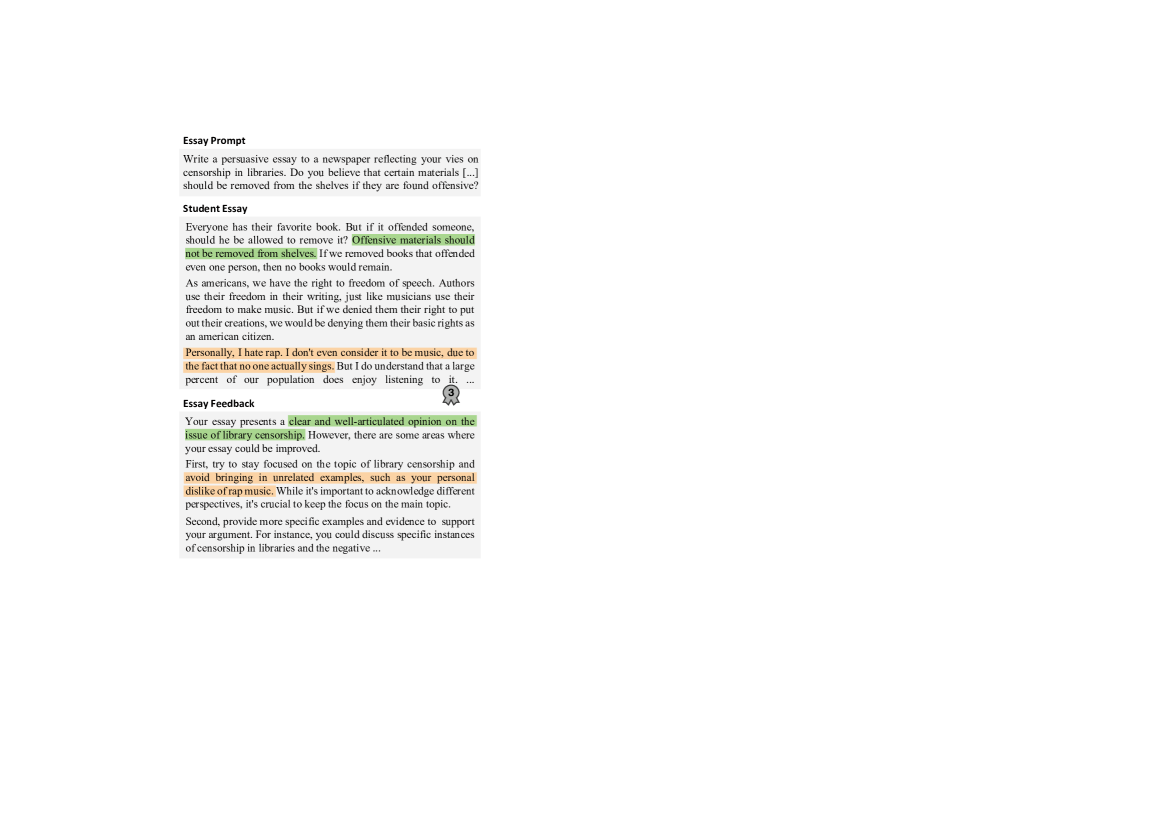
Individual feedback can help students improve their essay writing skills. However, the manual effort required to provide such feedback limits individualization in practice. Automatically-generated essay feedback may serve as an alternative to guide students at their own pace, convenience, and desired frequency. Large language models (LLMs) have demonstrated strong performance in generating coherent and contextually relevant text. Yet, their ability to provide helpful essay feedback is unclear. This work explores several prompting strategies for LLM-based zero-shot and few-shot generation of essay feedback. Inspired by Chain-of-Thought prompting, we study how and to what extent automated essay scoring (AES) can benefit the quality of generated feedback. We evaluate both the AES performance that LLMs can achieve with prompting only and the helpfulness of the generated essay feedback. Our results suggest that tackling AES and feedback generation jointly improves AES performance. However, while our manual evaluation emphasizes the quality of the generated essay feedback, the impact of essay scoring on the generated feedback remains low ultimately.
研究动机与目标
- 在作文写作中自动化、个性化的反馈,以补充或取代教师手动反馈。
- 探索使用 LLMs 进行联合作文评分与反馈生成的 zero-shot 和 few-shot prompting 策略。
- 评估不同提示设计如何影响自动化作文评分(AES)性能和反馈的有用性。
- 研究评分是否会影响反馈质量,反之亦然,并确定最有效的提示配置。
提出的方法
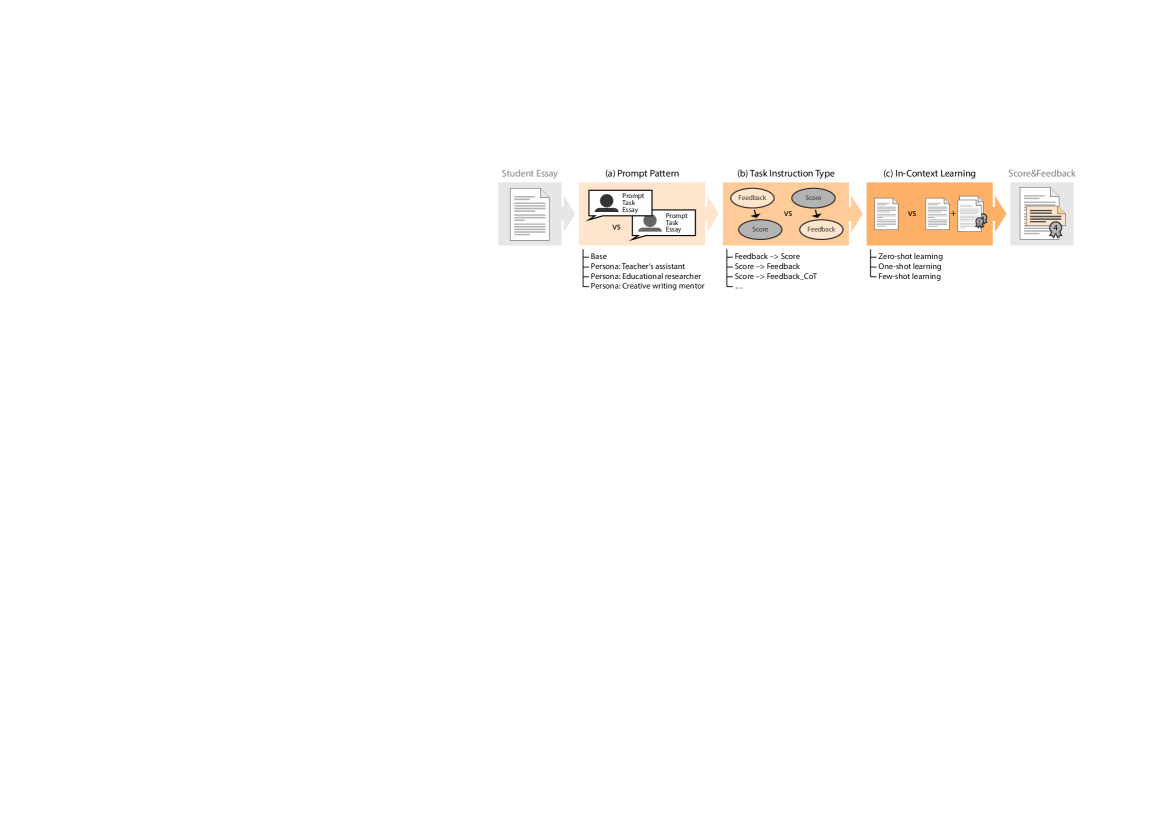
- 系统性地变换三个提示方面:提示模式(base 与 persona-based),任务指令类型(评分、反馈,或按顺序同时执行),以及 in-context learning(zero-shot、one-shot、few-shot)。
- 尽可能使用 Mistral-7B-Instruct-v0.2 作为主要 LLM,采用贪婪解码来生成 JSON 格式的分数和反馈。
- 在 zero-shot 和 one-shot/few-shot 设置下,将提示模式和任务指令与 AES-Prompt Tao et al. (2022) 和 R2BERT 等基线进行比较。
- 通过 ASAP 数据集(8 套作文)上的二次加权 kappa(QWK)评估评分,使用交叉验证切分。
- 通过来自 LLM 的自动有用性分数和人工注释评估反馈生成,比较 persona 提示模式。
- 研究同时解决评分和反馈对性能及被认为有用性的影响。
实验结果
研究问题
- RQ1在 zero-shot 和 few-shot prompting 下,LLMs 能否可靠地对作文进行评分,并生成有帮助的整体性与特征性反馈?
- RQ2将作文评分与反馈生成联合解决是否相较于仅进行评分能提升 AES 性能?
- RQ3不同的提示模式、任务指令和 in-context learning 方案如何影响生成的反馈质量与有用性?
主要发现
- 在若干提示配置下,联合处理作文评分与反馈生成能提升 AES 性能(在某些以评分为主的变体中观察到最高的平均 QWK)。
- 使用 persona 角色的提示模式(如 Educational Researcher、Teacher’s Assistant)通常比 base 模式获得更好的评分性能。
- 以反馈为先的提示变体(如 Feedback → Scoring,或 Feedback_dCoT → Scoring)往往比先进行评分的变体带来更高的评分性能。
- 在反馈生成方面,persona-based 提示(尤其是 Educational Researcher 和 Creative Writing Mentor)产生更高的自动有用性分数,人工评估显示反馈通常被认为有帮助。
- 人工评估表明反馈有助于提升学生写作,但评分对反馈有用性的影响有限。
阅读本论文
在 Nubint 阅读器中打开原文,边读边就任意段落提问。
在 Nubint 中阅读本论文本解读由 AI 根据论文原文生成,引用前请核对原文。