
[论文解读] Exploring OCR Capabilities of GPT-4V(ision) : A Quantitative and In-depth Evaluation
对 GPT-4V(vision) 在场景文本、手写、数学表达式、表格和 VIE 方面的 OCR 能力进行定量、跨任务的评估,突出其对拉丁文内容的优势以及在多语言和复杂场景中的局限性。
This paper presents a comprehensive evaluation of the Optical Character Recognition (OCR) capabilities of the recently released GPT-4V(ision), a Large Multimodal Model (LMM). We assess the model's performance across a range of OCR tasks, including scene text recognition, handwritten text recognition, handwritten mathematical expression recognition, table structure recognition, and information extraction from visually-rich document. The evaluation reveals that GPT-4V performs well in recognizing and understanding Latin contents, but struggles with multilingual scenarios and complex tasks. Specifically, it showed limitations when dealing with non-Latin languages and complex tasks such as handwriting mathematical expression recognition, table structure recognition, and end-to-end semantic entity recognition and pair extraction from document image. Based on these observations, we affirm the necessity and continued research value of specialized OCR models. In general, despite its versatility in handling diverse OCR tasks, GPT-4V does not outperform existing state-of-the-art OCR models. How to fully utilize pre-trained general-purpose LMMs such as GPT-4V for OCR downstream tasks remains an open problem. The study offers a critical reference for future research in OCR with LMMs. Evaluation pipeline and results are available at https://github.com/SCUT-DLVCLab/GPT-4V_OCR.
研究动机与目标
- 评估 GPT-4V(vision) 在多样化任务(STR、HTR、HMER、TSR、VIE)上的 OCR 性能。
- 识别拉丁文与非拉丁文内容以及在复杂场景中的优势与局限。
- 为专门 OCR 模型的持续价值提供指引,并探讨在 OCR 研究中潜在利用大语言模型(LMMs)的可能性。
提出的方法
- 通过专用评估管道、基于网页的界面以及为每个 OCR 任务精心设计的提示来评估 GPT-4V。
- 使用标准 OCR 基准:STR(CUTE80、SCUT-CTW1500、Total-Text、WordArt、ReCTS、MLT19),HTR(IAM、CASIA-HWDB),HMER(CROHME2014、HME100K),TSR(SciTSR、WTW),VIE(FUNSD、XFUND-zh)
- 在可用情况下,使用 WAICS、精确率/召回率/F1、WER/CER、AR/CR 和 1-NED 评估逐字与端到端识别。
- 通过对图像进行缩放以改变输入分辨率并观测识别性能来研究影响。
- 突出定性示例以说明优势(拉丁文内容)和弱点(多语言、复杂布局)。
- 将 GPT-4V 的结果与最先进的专用 OCR 模型进行比较,并讨论对下游 OCR 任务的影响。
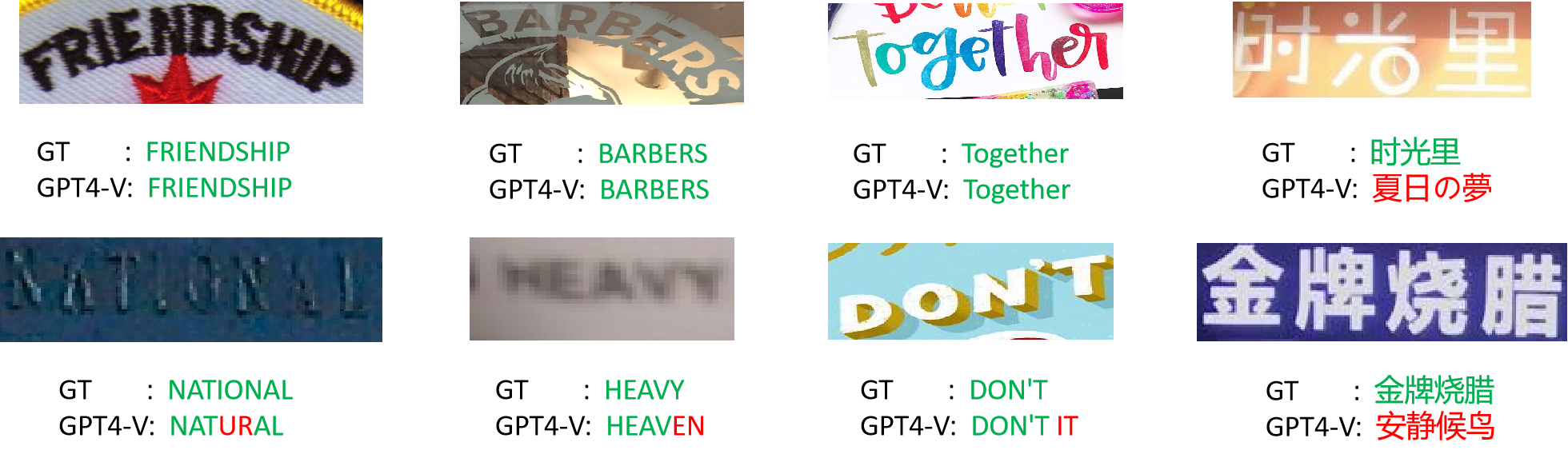
实验结果
研究问题
- RQ1GPT-4V 在英语与非英语语言的场景文本识别中表现如何?
- RQ2GPT-4V 在手写文本识别(包括中文文本)方面的能力与局限性是什么?
- RQ3GPT-4V 对手写数学表达式识别、表格结构识别以及从可视化丰富的文档中提取信息的表现如何?
- RQ4在不同任务中,通用型大模型在多大程度上可以替代或补充专门的 OCR 模型?
- RQ5哪些策略可以提升 GPT-4V 的 OCR 性能(语义理解、微调、数据构建)?
主要发现
- GPT-4V 对拉丁/英语内容识别能力较强,但在 ReCTS 中对中文场景文本的准确率为零。
- 英语和一些非拉丁语言(法语、德语、意大利语)在表现上优于非拉丁字母,表明多语言 OCR 存在局限。
- 输入分辨率的提高对识别性能有正向影响,较高分辨率在英文子集(MLT19)上获得更高的 Precision/Recall/F1。
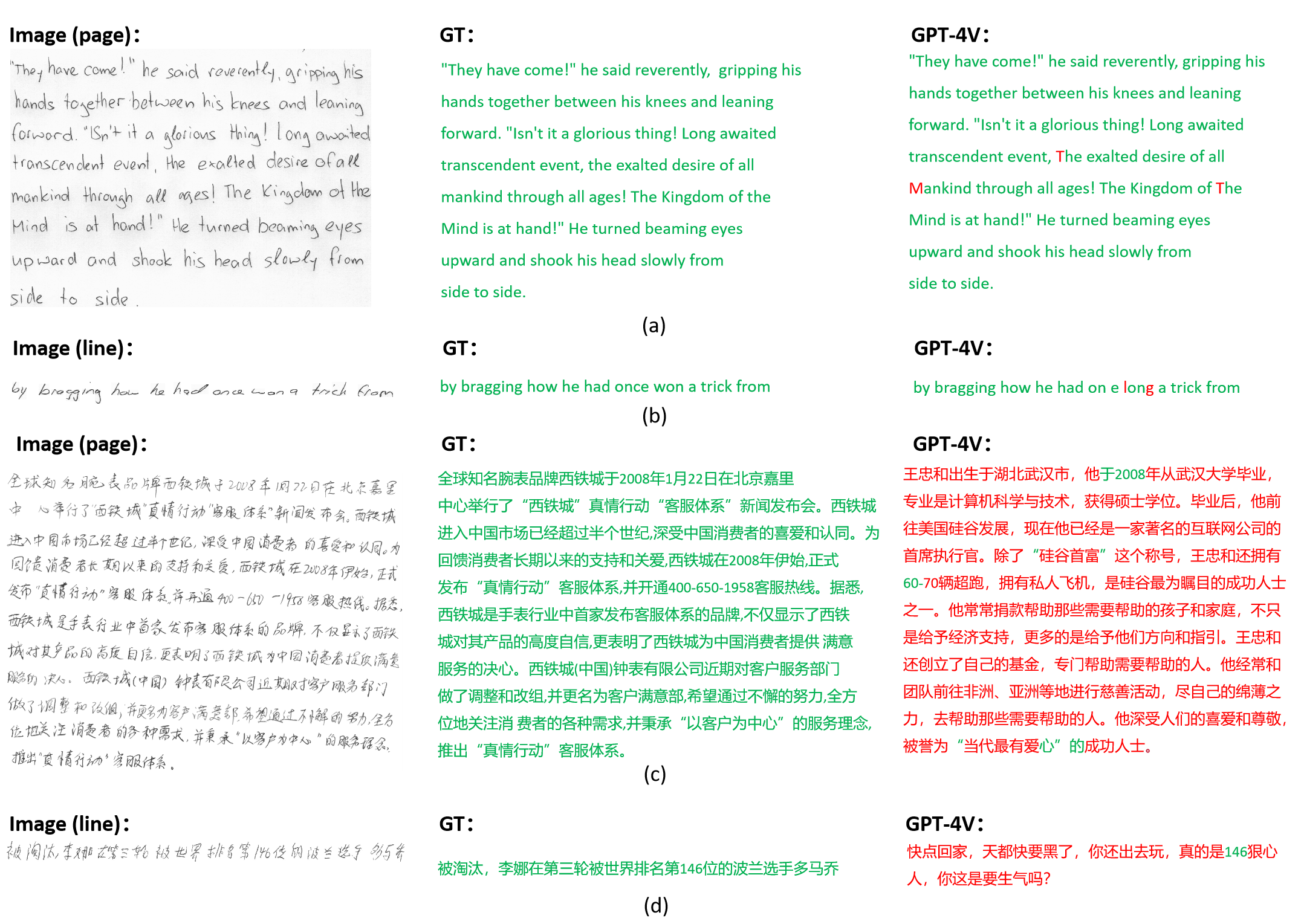
- GPT-4V 在手写文本,尤其是中文手写和复杂书写体方面表现欠佳,并且中文文本输出中存在幻错(hallucinations)。
- 在 HMER、TSR 和 VIE 任务中,GPT-4V 的表现落后于有监督的 SOTA,且在长表格中存在明显的内容省略与复杂布局的困难。
- SER 与成对提取结果显示实体级 F1 中等(SER),成对提取性能偏低,且较高的 1-NED 指示对齐挑战;XFUND-zh 显示出由于较少的中文字符识别而特别弱的结果。
阅读本论文
在 Nubint 阅读器中打开原文,边读边就任意段落提问。
在 Nubint 中阅读本论文本解读由 AI 根据论文原文生成,引用前请核对原文。