
[论文解读] Exploring Precision and Recall to assess the quality and diversity of LLMs
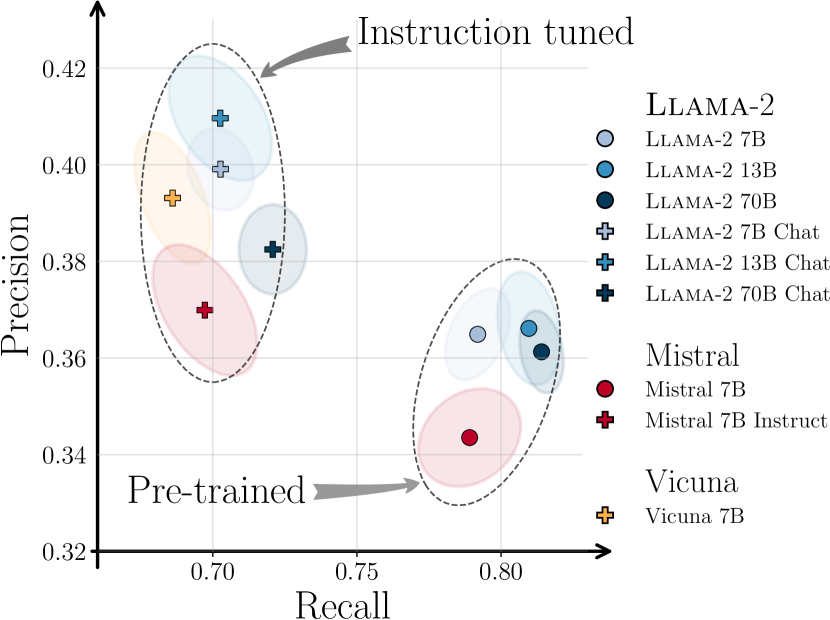
该论文将原本用于图像生成的精确率(Precision)和召回率(Recall)指标适配至大语言模型(LLMs)的文本生成评估中,如 Llama-2 和 Mistral。通过将模型输出分布与参考分布进行比较,无需依赖对齐的人工参考,该方法揭示了一个关键权衡:使用人类反馈进行微调可提升生成质量(精确率更高),但会降低输出多样性(召回率更低)。
We introduce a novel evaluation framework for Large Language Models (LLMs) such as extsc{Llama-2} and extsc{Mistral}, focusing on importing Precision and Recall metrics from image generation to text generation. This approach allows for a nuanced assessment of the quality and diversity of generated text without the need for aligned corpora. By conducting a comprehensive evaluation of state-of-the-art language models, the study reveals new insights into their performance on open-ended generation tasks, which are not adequately captured by traditional benchmarks. The findings highlight a trade-off between the quality and diversity of generated samples, particularly when models are fine-tuned on instruction dataset or with human feedback. This work extends the toolkit for distribution-based NLP evaluation, offering insights into the practical capabilities and challenges that current LLMs face in generating diverse and high-quality text. We release our code and data.
研究动机与目标
- 解决传统基于参考的评估方法在开放性大语言模型生成任务中的局限性。
- 开发一种基于分布的评估框架,无需依赖人工标注的参考语料库。
- 为大语言模型在文本生成中的质量(精确率)与多样性(召回率)提供细致的评估。
- 探究人类反馈微调对大语言模型输出中质量与多样性平衡的影响。
- 通过引入精确率与召回率,拓展基于分布的指标(如 MAUVE),以提供更具可解释性与可操作性的洞察。
提出的方法
- 将大语言模型的输出建模为分布 Q,将参考数据集(如 WebText)建模为分布 P。
- 将精确率定义为 Q 中与 P 接近的样本比例,用于衡量生成文本的相关性或质量。
- 将召回率定义为 P 中被 Q 覆盖的样本比例,用于衡量模型输出的多样性。
- 使用嵌入相似度(如 sentence-BERT)定义两种指标中样本之间的“接近程度”。
- 在开放式传记生成任务上,对零样本和指令微调的大语言模型(如 Llama-2、Mistral)应用该指标。
- 通过误差椭圆报告结果,以显示统计不确定性,支持模型间的比较。
实验结果
研究问题
- RQ1如何在大语言模型的文本生成中,有意义地将精确率与召回率从图像生成任务中适配过来?
- RQ2最先进的大语言模型(如 Llama-2 和 Mistral)在开放式生成任务中,在高质量与多样性输出方面达到了何种程度?
- RQ3人类反馈微调对生成质量与多样性之间权衡的影响是什么?
- RQ4精确率与召回率与现有基于分布的指标(如 MAUVE)相比,在捕捉模型行为方面表现如何?
- RQ5精确率与召回率能否检测到大语言模型输出中的特定失败模式,如重复或低质量幻觉?
主要发现
- 使用人类反馈对大语言模型进行微调可显著提升精确率,表明生成输出的质量和相关性更高。
- 然而,这种提升是以召回率下降为代价,表明输出多样性的显著降低。
- Mistral Instruct v0.2 在传记生成任务中表现出极低的召回率(接近零),尽管参考集具有高度多样性,但模型反复生成相同的传记内容。
- Llama-2-7b 虽具有高召回率,但精确率较低,表明其输出虽然多样,但常常存在事实性或上下文错误。
- 精确率与召回率之间的权衡关系被实证量化并可视化,揭示了不同模型之间的清晰性能边界。
- 所提出的框架成功识别出特定于模型的失败模式——如重复(召回率低)或低质量生成(精确率低)——这些模式在标准基准中未被捕捉。

阅读本论文
在 Nubint 阅读器中打开原文,边读边就任意段落提问。
在 Nubint 中阅读本论文本解读由 AI 根据论文原文生成,引用前请核对原文。