
[论文解读] Exploring the Feasibility of ChatGPT for Event Extraction
本文评估在 ACE05 上使用零样本的 ChatGPT 进行事件抽取,并将其与专用模型(Text2Event、EEQA)进行比较,发现竞争力有限且提示敏感性显著,尤其在长尾和复杂案例中。
Event extraction is a fundamental task in natural language processing that involves identifying and extracting information about events mentioned in text. However, it is a challenging task due to the lack of annotated data, which is expensive and time-consuming to obtain. The emergence of large language models (LLMs) such as ChatGPT provides an opportunity to solve language tasks with simple prompts without the need for task-specific datasets and fine-tuning. While ChatGPT has demonstrated impressive results in tasks like machine translation, text summarization, and question answering, it presents challenges when used for complex tasks like event extraction. Unlike other tasks, event extraction requires the model to be provided with a complex set of instructions defining all event types and their schemas. To explore the feasibility of ChatGPT for event extraction and the challenges it poses, we conducted a series of experiments. Our results show that ChatGPT has, on average, only 51.04% of the performance of a task-specific model such as EEQA in long-tail and complex scenarios. Our usability testing experiments indicate that ChatGPT is not robust enough, and continuous refinement of the prompt does not lead to stable performance improvements, which can result in a poor user experience. Besides, ChatGPT is highly sensitive to different prompt styles.
研究动机与目标
- 由于标注数据稀缺,阐明事件抽取是一个具有挑战性的NLP任务。
- 评估 ChatGPT 在不进行微调的情况下是否能够执行零样本的事件检测。
- 在长尾和多事件文本场景下,将 ChatGPT 与专用模型进行比较。
- 研究提示设计如何影响 ChatGPT 的事件抽取性能。
- 评估 ChatGPT 在实际事件抽取工作流中的可用性和鲁棒性。
提出的方法
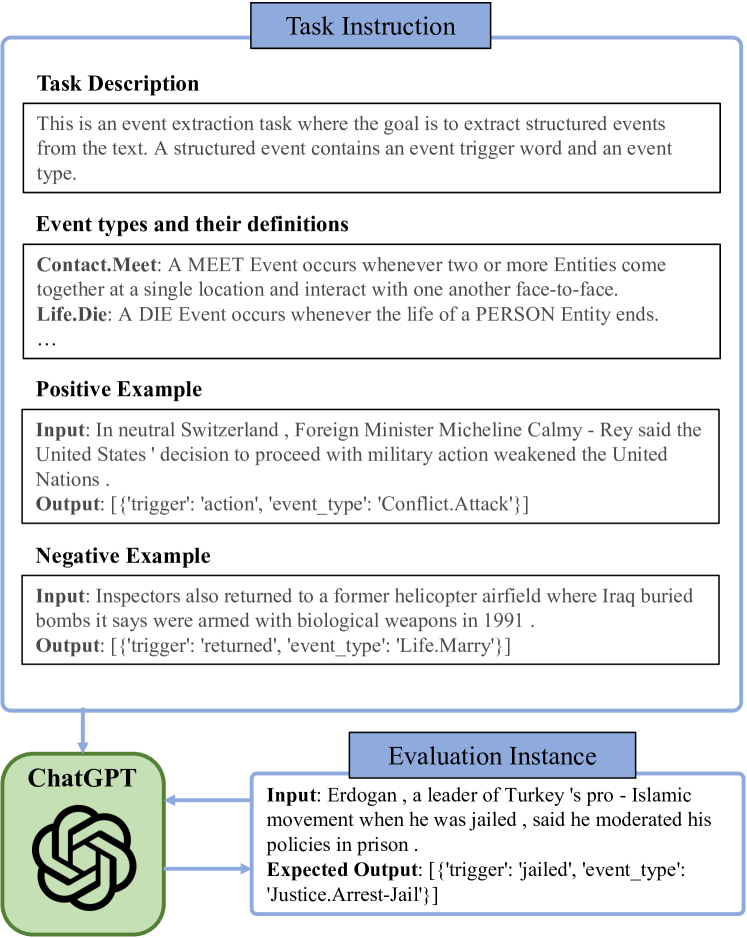
- 将事件抽取框架化为一个多轮问答任务,使用自然语言指令并输出 JSON 序列化。
- 使用 ACE 2005 作为数据集,采用与前期工作相同的划分和预处理。
- 在从 ACE05 测试集中随机抽取的 20 个样本上,将 ChatGPT 与 Text2Event(T5-base 和 T5-large)以及 EEQA(BERT-base)进行对比评估。
- 通过移除提示元素(事件定义、正/负示例)进行消融研究,以评估对 F1 的影响。
- 通过按事件频次和文本中事件数量对测试集进行分区,开展长尾和复杂情景分析。
- 开展一项包含四名标注者的可用性研究,以观察跨尝试的提示敏感性和鲁棒性。
实验结果
研究问题
- RQ1在零-shot 设置下,ChatGPT 能否识别事件触发词并对事件类型进行分类?
- RQ2在 ACE05 上,ChatGPT 的性能与专用模型(Text2Event 和 EEQA)相比如何,尤其是在长尾和复杂情景中?
- RQ3提示元素(定义、示例演示、正/负示例)如何影响 ChatGPT 的事件抽取性能?
- RQ4在不同的提示风格和用户尝试下,ChatGPT 是否对实际场景的事件抽取具有鲁棒性和可用性?
主要发现
- ChatGPT 在事件检测上获得 F1 = 64.00,低于 Text2Event(T5-base 75.76,T5-large 77.42)和 EEQA(81.82)。
- 平均而言,ChatGPT 在长尾和复杂情景中仅达到 EEQA 性能的 51.04%。
- 在长尾分析中,ChatGPT 对低频事件达到 EEQA 的 49.2%,对高频事件达到 56.7%。
- 在复杂情景中,ChatGPT 相较于 EEQA 和 Text2Event 在简单样本和复杂样本上均表现不佳。
- 提示消融显示,去除正示例使 F1 降低 6.17 点,去除事件类型定义使 F1 降低 11.95 点,且结果随提示风格变化;其中一次移除意外地提升了性能。
- 可用性测试表明 ChatGPT 在多次尝试中不具鲁棒性,对提示风格高度敏感,标注者获得的结果差异大(例如,最高 F1 66.67,最低 26.92)。

阅读本论文
在 Nubint 阅读器中打开原文,边读边就任意段落提问。
在 Nubint 中阅读本论文本解读由 AI 根据论文原文生成,引用前请核对原文。