
[论文解读] Exposing flaws of generative model evaluation metrics and their unfair treatment of diffusion models
本文表明常用评估指标(尤其是基于Inception的FID)与人类判断的相关性很差,并不公平地惩罚扩散模型,提出基于DINOv2的表示用于更好评估,并突出记忆化问题。
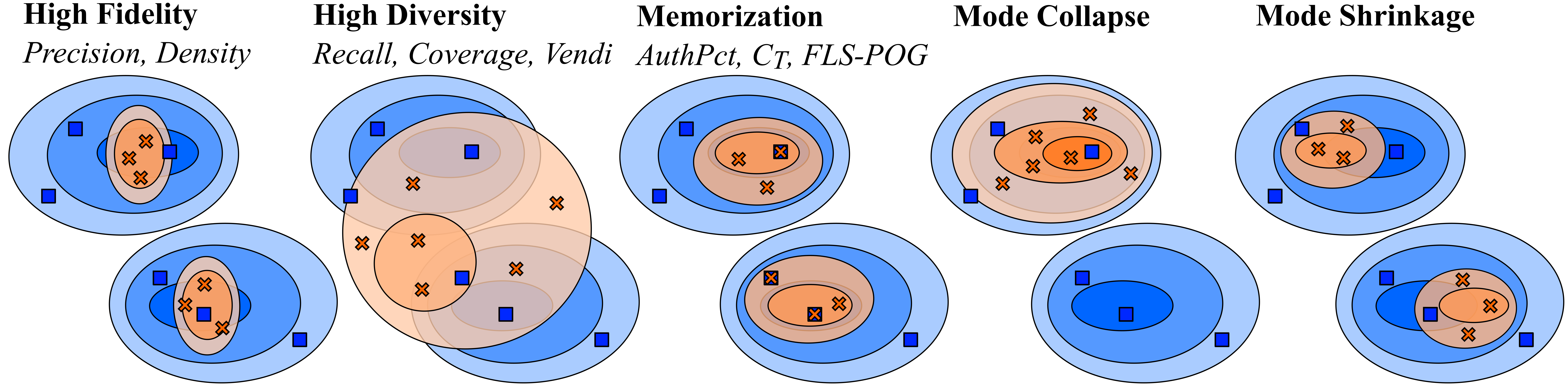
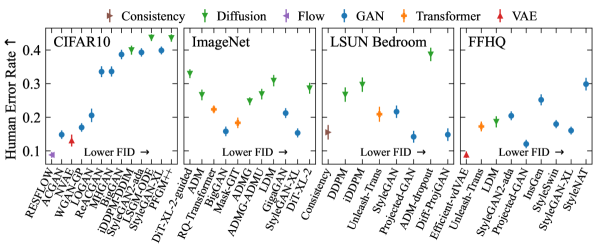
We systematically study a wide variety of generative models spanning semantically-diverse image datasets to understand and improve the feature extractors and metrics used to evaluate them. Using best practices in psychophysics, we measure human perception of image realism for generated samples by conducting the largest experiment evaluating generative models to date, and find that no existing metric strongly correlates with human evaluations. Comparing to 17 modern metrics for evaluating the overall performance, fidelity, diversity, rarity, and memorization of generative models, we find that the state-of-the-art perceptual realism of diffusion models as judged by humans is not reflected in commonly reported metrics such as FID. This discrepancy is not explained by diversity in generated samples, though one cause is over-reliance on Inception-V3. We address these flaws through a study of alternative self-supervised feature extractors, find that the semantic information encoded by individual networks strongly depends on their training procedure, and show that DINOv2-ViT-L/14 allows for much richer evaluation of generative models. Next, we investigate data memorization, and find that generative models do memorize training examples on simple, smaller datasets like CIFAR10, but not necessarily on more complex datasets like ImageNet. However, our experiments show that current metrics do not properly detect memorization: none in the literature is able to separate memorization from other phenomena such as underfitting or mode shrinkage. To facilitate further development of generative models and their evaluation we release all generated image datasets, human evaluation data, and a modular library to compute 17 common metrics for 9 different encoders at https://github.com/layer6ai-labs/dgm-eval.
研究动机与目标
- 评估当前生成模型评估指标在多样数据集上与人类对真实感知的一致性程度
- 评估编码器选择(Inception vs SSL-based)对指标可靠性的影响
- 将多样性、稀有性和记忆化作为独立的评估轴进行研究
- 提供数据集、人类评估数据,以及一个模块化工具包,能够对9个编码器的17个指标进行计算,以促进更好的评估实践
提出的方法
- 在CIFAR10、ImageNet1k、FFHQ和LSUN-Bedroom上进行大规模的人类评估,测量真实感
- 为每个模型生成100k张图片,形成评估数据集
- 使用9种不同的编码器评估17个指标,包括Inception-V3、ConvNeXt,以及七种SSL模型(SimCLRv2、DINOv2、SwAV、MAE、data2vec、CLIP OpenCLIP、DreamSim)
- 将指标分数与人类评估的真实感进行比较,以评估相关性和可靠性
- 分析多样性(Vendi分数)、稀有性和记忆化(像素级和重建性),以解释指标行为差异
- 发布生成的数据集、人类数据,以及一个包含17个指标的模块化dgm-eval库
实验结果
研究问题
- RQ1当前的生成模型评估指标是否在多样数据集上与人类对真实感的判断相关?
- RQ2不同的编码器(Inception vs SSL-based)如何影响如FID、FD等指标的可靠性?
- RQ3相较于GAN,扩散模型是否被基于Inception的指标不公平地惩罚,SSL-based指标能否解决这一问题?
- RQ4记忆化、多样性和稀有性在多大程度上能解释人类判断与指标之间的差异?
主要发现
- 在各数据集上,尚无现有指标与人类评估者之间存在强相关性
- 扩散模型在人工评估的真实感方面优于GAN,但被基于Inception的指标如FID所拉低排名
- 将Inception-V3替换为DINOv2-ViT-L/14能够提高指标与人类判断的一致性,并提供更丰富的评估
- 在CIFAR10上存在记忆化现象,但在ImageNet/FFHQ/LSUN上并不明显;当前的记忆化指标未能可靠检测到它
- 基于DINOv2的FD分数与人类判断的相关性更强,且在对类别进行单独评估并结合Vendi时更好地捕捉多样性,显示改进的评估能力
阅读本论文
在 Nubint 阅读器中打开原文,边读边就任意段落提问。
在 Nubint 中阅读本论文本解读由 AI 根据论文原文生成,引用前请核对原文。