
[论文解读] Extracting Low-/High- Frequency Knowledge from Graph Neural Networks and Injecting it into MLPs: An Effective GNN-to-MLP Distillation Framework
本文提出 FF-G2M,一种新颖的 GNN 到 MLP 知识蒸馏框架,通过在频域中进行分解,从预训练的 GNN 中提取并注入低频和高频知识到学生 MLP 中。通过解决‘信息淹没’问题——即在蒸馏过程中高频知识被掩盖——FF-G2M 在六组数据集上的平均性能相比原始 MLP 提升 12.6%,且优于教师 GNN 模型平均 2.6%。
Recent years have witnessed the great success of Graph Neural Networks (GNNs) in handling graph-related tasks. However, MLPs remain the primary workhorse for practical industrial applications due to their desirable inference efficiency and scalability. To reduce their gaps, one can directly distill knowledge from a well-designed teacher GNN to a student MLP, which is termed as GNN-to-MLP distillation. However, the process of distillation usually entails a loss of information, and ``which knowledge patterns of GNNs are more likely to be left and distilled into MLPs?" becomes an important question. In this paper, we first factorize the knowledge learned by GNNs into low- and high-frequency components in the spectral domain and then derive their correspondence in the spatial domain. Furthermore, we identified a potential information drowning problem for existing GNN-to-MLP distillation, i.e., the high-frequency knowledge of the pre-trained GNNs may be overwhelmed by the low-frequency knowledge during distillation; we have described in detail what it represents, how it arises, what impact it has, and how to deal with it. In this paper, we propose an efficient Full-Frequency GNN-to-MLP (FF-G2M) distillation framework, which extracts both low-frequency and high-frequency knowledge from GNNs and injects it into MLPs. Extensive experiments show that FF-G2M improves over the vanilla MLPs by 12.6% and outperforms its corresponding teacher GNNs by 2.6% averaged over six graph datasets and three common GNN architectures.
研究动机与目标
- 为解决工业应用中 GNN 的高精度与 MLP 的推理效率之间的差距。
- 探究现有 GNN 到 MLP 知识蒸馏方法表现不佳的原因,尤其是高频知识的丢失。
- 开发一种知识蒸馏框架,保留来自 GNN 的低频与高频知识模式,以提升学生 MLP 的性能。
- 正式识别并解决‘信息淹没’问题,即在蒸馏过程中高频知识被低频知识所掩盖。
提出的方法
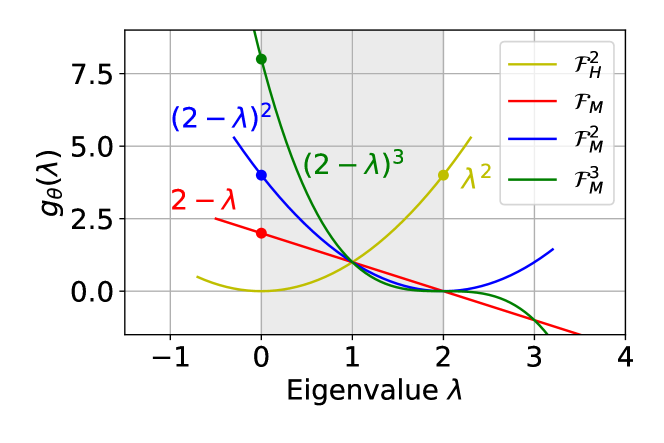
- 利用图信号处理在频域中对 GNN 学习到的知识进行分解,分离出低频与高频分量。
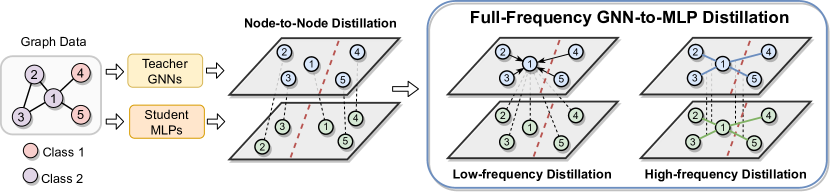
- 推导低频与高频分量在空间域中的对应关系,以实现向 MLP 的蒸馏。
- 设计两种不同的蒸馏损失:低频蒸馏(LFD)用于保留邻域平滑性,高频蒸馏(HFD)用于保持节点对之间的距离差异。
- 将 LFD 与 HFD 融合为统一的全频带 GNN 到 MLP(FF-G2M)框架,联合优化两类知识。
- 使用平均余弦相似度与 KL 散度作为评估指标,量化低频与高频知识的保留程度。
- 使用包含 LFD 与 HFD 损失的知识蒸馏训练学生 MLP,实现在无消息传递延迟情况下的全频带知识迁移。
实验结果
研究问题
- RQ1在 GNN 到 MLP 的知识蒸馏过程中,哪类知识(低频 vs. 高频)最容易丢失?
- RQ2‘信息淹没’问题——即高频知识被低频知识掩盖——是如何产生并影响蒸馏性能的?
- RQ3是否可以通过联合蒸馏低频与高频分量,使学生 MLP 的性能优于现有方法?
- RQ4在 GNN 到 MLP 的知识蒸馏中,低频与高频知识对整体模型性能的相对贡献如何?
- RQ5是否存在一种方法,可在不重新引入数据依赖性或延迟的情况下,同时保留两类知识?
主要发现
- 所提出的 FF-G2M 框架在六组图数据集上的平均性能相比原始 MLP 提升 12.6%,且优于其对应的教师 GNN 模型平均 2.6%。
- 在标准蒸馏过程中,高频知识常因信息淹没而丢失,即低频模式主导了蒸馏过程。
- 仅使用低频蒸馏(LFD)在全部六组数据集上均优于 GLNN,证明其在捕捉图拓扑诱导的平滑性方面具有显著有效性。
- 仅使用高频蒸馏(HFD)相比原始 MLP 可提升性能,但相较于 LFD,其作用为次要辅助角色。
- 在 FF-G2M 中联合使用 LFD 与 HFD 可实现互补增益,全模型显著优于单一组件及基线方法。
- 可视化与度量分析表明,FF-G2M 成功保留了邻域接近性(低频)与相对节点位置差异(高频),而 GLNN 或原始 MLP 则未能实现。
阅读本论文
在 Nubint 阅读器中打开原文,边读边就任意段落提问。
在 Nubint 中阅读本论文本解读由 AI 根据论文原文生成,引用前请核对原文。