
[论文解读] Fast Exact Leverage Score Sampling from Khatri-Rao Products with Applications to Tensor Decomposition
该论文提出了一种新颖的数据结构,可对大规模矩阵的Khatri-Rao积实现快速、精确的杠杆系数采样,从而在张量分解中实现高效的随机化图示。通过实现与矩阵规模对数相关的采样时间以及与秩相关的平方时间,该方法降低了CANDECOMP/PARAFAC(CP)分解中最小二乘求解的复杂度,在十亿规模稀疏张量上实现了比现有最先进方法更高的精度和高达2.5倍的加速。
We present a data structure to randomly sample rows from the Khatri-Rao product of several matrices according to the exact distribution of its leverage scores. Our proposed sampler draws each row in time logarithmic in the height of the Khatri-Rao product and quadratic in its column count, with persistent space overhead at most the size of the input matrices. As a result, it tractably draws samples even when the matrices forming the Khatri-Rao product have tens of millions of rows each. When used to sketch the linear least squares problems arising in CANDECOMP / PARAFAC tensor decomposition, our method achieves lower asymptotic complexity per solve than recent state-of-the-art methods. Experiments on billion-scale sparse tensors validate our claims, with our algorithm achieving higher accuracy than competing methods as the decomposition rank grows.
研究动机与目标
- 为大型矩阵的Khatri-Rao积实现高效、精确的杠杆系数采样,这些积是张量分解和最小二乘问题的核心。
- 降低CANDECOMP/PARAFAC(CP)张量分解中随机化图示的计算复杂度,特别是针对高维、稀疏张量。
- 设计一种支持快速采样和增量更新的数据结构,即使输入矩阵有数千万行也适用。
- 在保持高精度的前提下,实现比近期最先进方法更低的每次最小二乘求解的渐近复杂度。
- 在真实世界中十亿规模稀疏张量上展示实际优越性,其中传统方法变得不可行。
提出的方法
- 该方法构建一种数据结构,预先计算Khatri-Rao积上的杠杆系数分布,而无需显式生成完整的积。
- 每次采样J个样本的时间复杂度为O(NR³ + J∑ₖ R² log(max(Iₖ, R))),使用O(R³)的临时存储空间,实现与矩阵高度对数相关的依赖。
- 该数据结构支持高效的增量更新:单个元素更改的时间复杂度为O(R log(Iⱼ/R)),完整矩阵更新的时间复杂度为O(IⱼR²)。
- 该方法利用Kronecker积的性质以及通过QR分解计算杠杆系数的特性,避免显式构造Khatri-Rao积。
- 对于稀疏输入,构造时间和存储空间分别为O(R ∑ₙz(Uⱼ))和O(∑ₙz(Uⱼ)),保持了高效性。
- 采样器支持从输入矩阵的任意子集进行采样,这对CP分解中的交替最小二乘法至关重要。
实验结果
研究问题
- RQ1我们能否在不显式生成完整积的情况下,对具有万亿行的Khatri-Rao积实现精确的杠杆系数采样?
- RQ2我们能否设计一种数据结构,实现与行数对数相关、与秩平方相关的采样时间,同时保持较低的持久存储开销?
- RQ3与近似采样方法相比,通过该方法实现的精确杠杆系数采样是否能带来更低的渐近复杂度和更高的CP张量分解精度?
- RQ4该采样器在十亿规模稀疏张量上的性能如何扩展,尤其是在高分解秩的情况下?
- RQ5在实际应用中,精确采样的更高成本在何种条件下能被更快的最小二乘求解所抵消?
主要发现
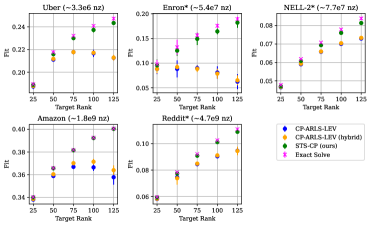
- 在Amazon和Reddit等大型稀疏张量上,STS-CP相比CP-ARLS-LEV实现了高达2.5倍的加速,同时达到非随机化ALS方法95%的拟合度。
- 在Enron张量上,STS-CP在分解秩高于50时实现了95%的精度,而CP-ARLS-LEV即使使用54倍更多的样本也完全失败。
- 在Enron上,STS-CP每求解一次仅需约65,000个样本即可在秩>50时达到95%的精度,展现出卓越的采样效率。
- 该算法每次求解的渐近复杂度低于最先进方法,复杂度为O(NR³ log I + IR²)/(εδ)。
- 对于非零元素超过十亿的张量,STS-CP在所有测试秩下均实现了1.4倍至2.0倍的加速,尤其在高秩分解中受益显著。
- STS-CP的性能优势在大型稀疏张量上最为明显,此时精确采样的成本被更快的最小二乘求解所抵消。
阅读本论文
在 Nubint 阅读器中打开原文,边读边就任意段落提问。
在 Nubint 中阅读本论文本解读由 AI 根据论文原文生成,引用前请核对原文。