
[论文解读] FastComposer: Tuning-Free Multi-Subject Image Generation with Localized Attention
FastComposer 使无调优、面向主体、多主体的图像生成在局部化跨注意力和延迟条件下实现,获得巨大的加速和对新主体零额外存储。
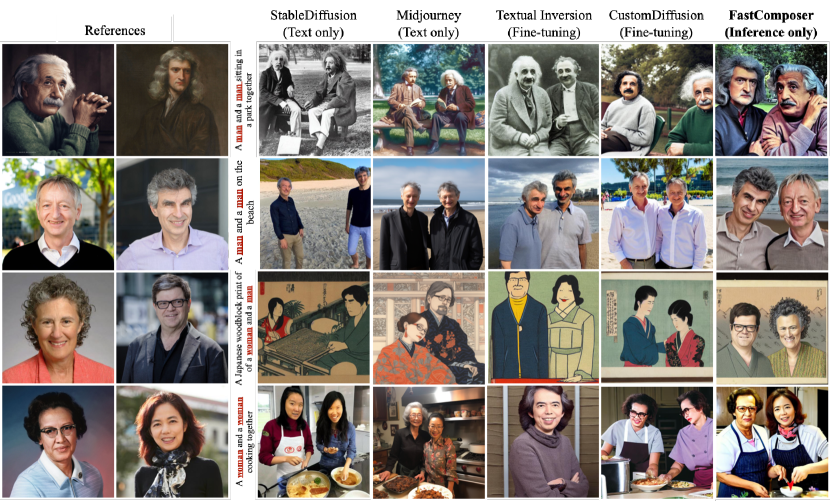
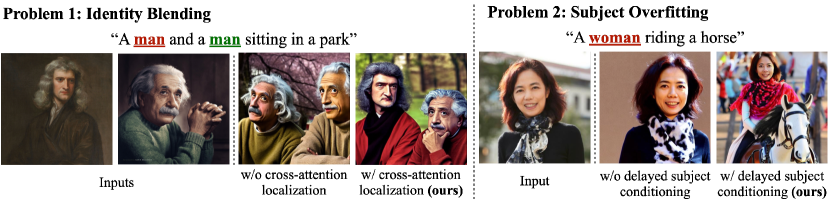
Diffusion models excel at text-to-image generation, especially in subject-driven generation for personalized images. However, existing methods are inefficient due to the subject-specific fine-tuning, which is computationally intensive and hampers efficient deployment. Moreover, existing methods struggle with multi-subject generation as they often blend features among subjects. We present FastComposer which enables efficient, personalized, multi-subject text-to-image generation without fine-tuning. FastComposer uses subject embeddings extracted by an image encoder to augment the generic text conditioning in diffusion models, enabling personalized image generation based on subject images and textual instructions with only forward passes. To address the identity blending problem in the multi-subject generation, FastComposer proposes cross-attention localization supervision during training, enforcing the attention of reference subjects localized to the correct regions in the target images. Naively conditioning on subject embeddings results in subject overfitting. FastComposer proposes delayed subject conditioning in the denoising step to maintain both identity and editability in subject-driven image generation. FastComposer generates images of multiple unseen individuals with different styles, actions, and contexts. It achieves 300$ imes$-2500$ imes$ speedup compared to fine-tuning-based methods and requires zero extra storage for new subjects. FastComposer paves the way for efficient, personalized, and high-quality multi-subject image creation. Code, model, and dataset are available at https://github.com/mit-han-lab/fastcomposer.
研究动机与目标
- 用从参考图像派生的主体嵌入替代每主体微调以实现个性化生成。
- 在训练期间通过跨注意力本地化来减轻多主体生成中的身份混淆。
- 在推理时通过延迟主体条件来在保持主体身份的同时实现文本驱动的编辑。
- 实现对未见的多个主体的仅推理生成,保持高保真且高效。
提出的方法
- 使用图像编码器和MLP 将视觉特征与文本嵌入融合,将来自参考图像的主体嵌入添加到文本提示中。
- 通过主体增强的条件训练和局部化损失使跨注意力图与参考分割掩码对齐,以防止身份混淆。
- 通过在训练阶段监督跨注意力图以呈现主体分割掩码对跨注意力进行本地化。
- 在去噪阶段引入延迟的主体条件,先应用文本条件来建立布局,随后在过程后期进行主体条件的细化。
- 从 FFHQ 构建一个带全景分割掩码和名词短语对齐的主体增强图文数据集;在掩蔽主体背景的情况下训练基于 Stable Diffusion 的模型以提高泛化。
实验结果
研究问题
- RQ1无调优就能使用主体嵌入实现个性化生成吗?
- RQ2跨注意力本地化是否降低多主体生成中的身份混淆?
- RQ3延迟主体条件是否在推理阶段保持身份的同时保持可编辑性?
- RQ4与基于微调的方法相比,推理级多主体生成的效率提升有多少?
主要发现
- 与基于微调的方法相比,FastComposer 实现了 300× 到 1200× 的加速和 2.8× 的内存降低。
- 新主体不需要额外存储。
- FastComposer 的单主体生成在身份保持和提示一致性方面达到更高水平,且与基线相比具有竞争力的提示一致性。
- 多主体生成在身份保持方面优于基于微调的基线,且提示一致性与它们相当。
- 跨注意力本地化提高了主体之间的身份分离度(消融显示若无本地化,身份保持降低)。
- 延迟主体条件在身份保持与可编辑性之间取得平衡,当条件比率大约在 0.6 到 0.8 之间时获得最佳结果。
阅读本论文
在 Nubint 阅读器中打开原文,边读边就任意段落提问。
在 Nubint 中阅读本论文本解读由 AI 根据论文原文生成,引用前请核对原文。