
[论文解读] Fault-tolerant quantum algorithm for symmetry-adapted perturbation theory
本文提出了一种容错量子算法,用于使用海森堡极限估计方法计算一阶对称性自适应微扰理论(SAPT)的相互作用能分量——静电、交换及静电-交换分量。通过利用高阶张量分解与块编码,该算法实现了最优的不确定性标度,并对基准分子及血红素–青蒿素复合物提供了详细的资源估算,识别出大规模量子化学应用中的关键成本驱动因素。
The efficient computation of observables beyond the total energy is a key challenge and opportunity for fault-tolerant quantum computing approaches in quantum chemistry. Here we consider the symmetry-adapted perturbation theory (SAPT) components of the interaction energy as a prototypical example of such an observable. We provide a guide for calculating this observable on a fault-tolerant quantum computer while optimizing the required computational resources. Specifically, we present a quantum algorithm that estimates interaction energies at the first-order SAPT level with a Heisenberg-limited scaling. To this end, we exploit a high-order tensor factorization and block encoding technique that efficiently represents each SAPT observable. To quantify the computational cost of our methodology, we provide resource estimates in terms of the required number of logical qubits and Toffoli gates to execute our algorithm for a range of benchmark molecules, also taking into account the cost of the eigenstate preparation and the cost of block encoding the SAPT observables. Finally, we perform the resource estimation for a heme and artemisinin complex as a representative large-scale system encountered in drug design, highlighting our algorithm's performance in this new benchmark study and discussing possible bottlenecks that may be improved in future work.
研究动机与目标
- 开发一种容错量子算法,用于计算超越总能量的物理可解释SAPT相互作用能分量。
- 在容错量子计算机上实现SAPT可观测量期望值估计的海森堡极限不确定性标度。
- 为一系列分子(包括与药物设计相关的大型体系)提供以逻辑量子比特和Toffoli门数量表示的详细资源估算。
- 识别算法中的计算瓶颈,特别是本征态制备与块编码部分,以供未来优化。
提出的方法
- 该算法使用QSP-EVE方法实现SAPT算符期望值估计的海森堡极限不确定性标度。
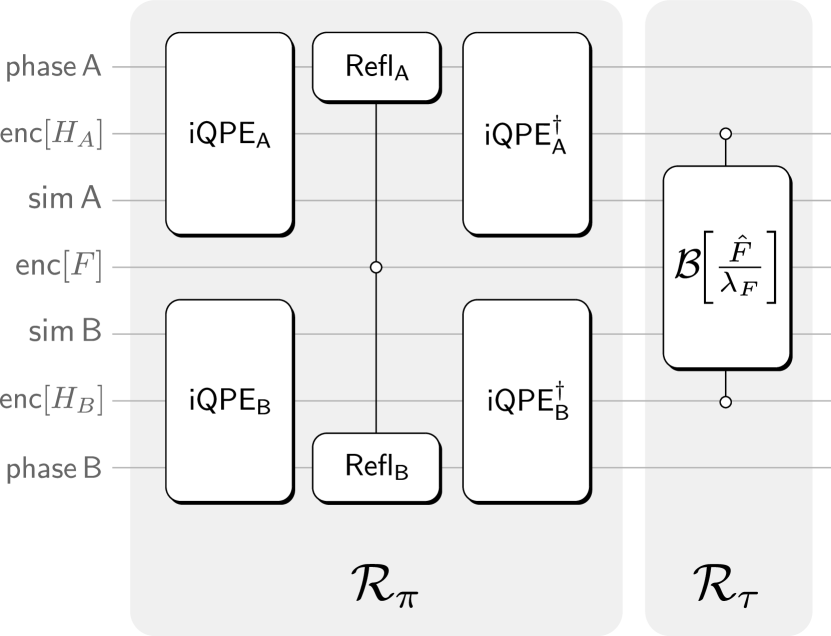
- 采用块编码高效表示SAPT哈密顿量,从而实现可观测量评估的低深度实现。
- 应用高阶张量分解将SAPT算符分解为稀疏、低秩分量,降低资源开销。
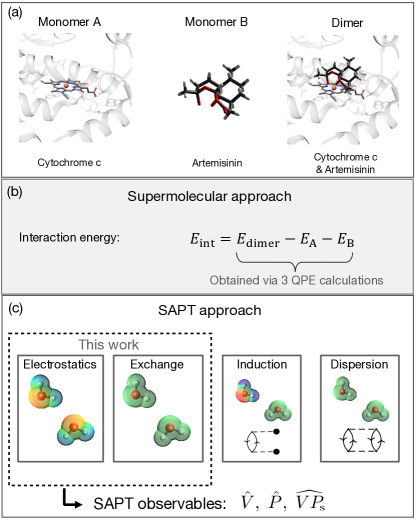
- 该方法专用于计算形如⟨ΨAΨB|F̂|ΨAΨB⟩的期望值,其中F̂为一阶SAPT算符。
- 资源估算基于表面码容错量子计算模型,包括逻辑量子比特数量与Toffoli门数量。
- 该框架应用于基准分子及血红素–青蒿素复合物,分析了在cc-pVDZ及更大基组下的基组依赖性。
实验结果
研究问题
- RQ1容错量子算法能否实现对SAPT相互作用能分量估计的海森堡极限不确定性标度?
- RQ2在不同分子体系中,计算一阶SAPT可观测量的主要资源成本(逻辑量子比特与Toffoli门)为何?
- RQ3SAPT算符的本征态制备与块编码如何影响整体计算成本?
- RQ4在大规模分子体系(如类药物复合物)中,该算法的主要瓶颈是什么?
- RQ5基组大小与体系复杂性如何影响容错硬件上SAPT所需量子资源的规模?
主要发现
- 该算法在期望值估计的不确定性上实现了海森堡极限标度,使精度随运行时间最优地提升。
- 对于采用cc-pVDZ[46]基组的血红素–青蒿素复合物,交换项的计算需要约3.39×10¹¹个Toffoli门与1.43×10⁴个逻辑量子比特。
- 主要资源开销来自SAPT算符的块编码,尤其在较大基组下,Toffoli门数量与基函数数的平方成比例增长。
- 本征态制备对总成本贡献显著,尤其在较大分子中,是当前实现中的主要瓶颈。
- 资源估算表明,基组大小影响强烈:对于cc-pVDZ[90],交换项的Toffoli门数量达到3.44×10⁴,逻辑量子比特数量超过5×10⁵。
- 本研究识别出,优化块编码与本征态制备可显著提升整体算法效率。
阅读本论文
在 Nubint 阅读器中打开原文,边读边就任意段落提问。
在 Nubint 中阅读本论文本解读由 AI 根据论文原文生成,引用前请核对原文。